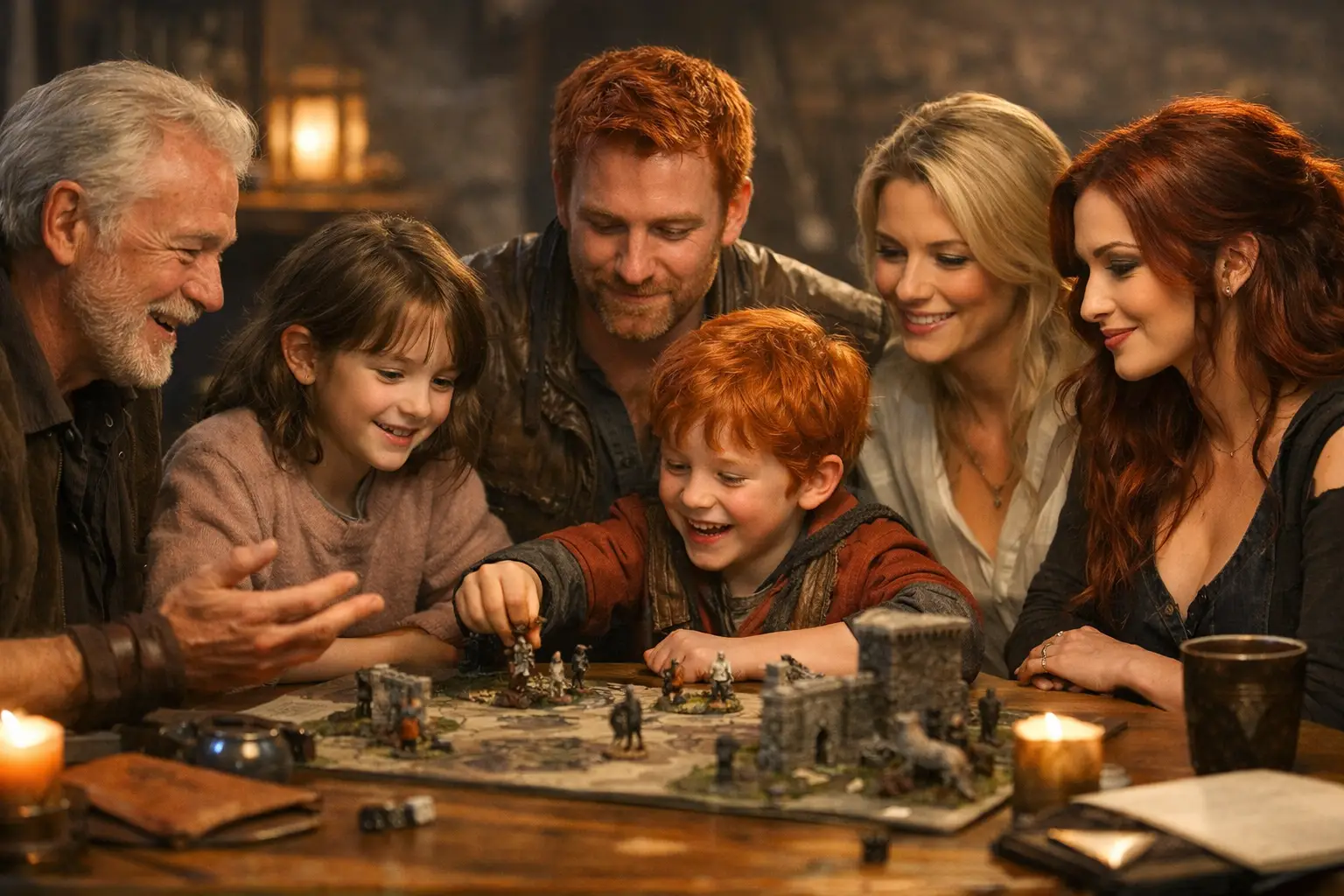
Atmosphere, immersion and the strange art of remembering places that never existed
The room contains five people, a laptop, some dice and too many half-finished drinks.
Yet nobody is really there.
One player is standing beneath a broken gate while rain runs down the stones. Another is watching the windows of a house across the street. Someone can hear dogs barking beyond the wall. The Game Master lowers his voice.
Then the music changes.
A bell begins to ring.
One of the players says, without thinking:
“I run.”
Nobody asks what his character does.
For a moment, the distinction hardly matters.
This is one of the peculiar powers of tabletop roleplaying. Books can transport us. Films can overwhelm us. Audio drama can build entire rooms out of voices, silence and sound. Human beings have been using stories to carry one another somewhere else for a very long time.
Tabletop roleplaying does not replace any of those arts.
It adds one extraordinary thing.
Once the story has taken us somewhere, it asks:
What do you do?
That question changes everything.
Stories have always been portals
The idea of crossing from our world into another appears everywhere in popular culture.
Stargate gives us a literal threshold between worlds. Sliders throws its characters through one reality after another. Ultima turns the player into the Avatar and sends them into Britannia. Star Trek’s holodeck imagines a room where narrative becomes an environment people can enter. Joel Rosenberg’s Guardians of the Flame takes the fantasy almost literally: roleplayers find themselves inside the world they had been playing.
The fantasy underneath all of them is ancient.
What if the story stopped being something in front of us and became somewhere around us?
Virtual reality tries to answer that question technologically.
Storytelling has been answering it psychologically for thousands of years.
Long before headsets, animated maps or surround sound, storytellers understood how to make absent places feel present. Across cultures, oral traditions used voice, rhythm, repetition, gesture, song, familiar images and the reactions of the audience to create worlds that existed nowhere except in the minds of the people gathered together.
A storyteller did not need to render every tree.
A few strong details could be enough.
The cold before dawn.
Smoke hanging above the houses.
A rider appearing alone on the road.
A name everyone around the fire already knew.
The listeners did the rest.
> Before we built virtual worlds with machines, we built them in one another.
Tabletop roleplaying belongs to that very old family of arts.
But it gives the people listening permission to answer back.
Atmosphere builds the doorway
Immersion begins before choice.
First, the imagined world has to acquire enough presence that the players can orient themselves inside it.
That is the job of atmosphere.
Atmosphere is often mistaken for elaborate description. A Game Master describes every tapestry, every candle and every bloody cobblestone until the players have forgotten why they entered the room.
That is not necessarily immersion.
Sometimes it is just inventory.
Atmosphere comes from specificity and coherence.
A manor does not become unsettling because we are told it is sinister.
Perhaps the entrance smells of damp wool.
Several portraits have been turned towards the wall.
There is mud on the stairs.
Then someone notices a child’s footprint on the ceiling.
The players’ minds will happily build the rest.
> The Game Master does not need to render the whole world. The players’ minds will do most of the work.
This is one of the oldest tricks in storytelling.
Give imagination enough material to work with, then get out of its way.
Music can give a world emotional memory
Modern tabletop roleplaying can add another layer.
Music.
Sound.
Images.
Maps.
Handouts.
Lighting.
Animated scenes.
Used well, none of these replace storytelling. They give the shared imagination additional anchors.
A piece of music associated with a city can eventually do more than provide atmosphere.
After twenty sessions, the first few notes may tell the players:
We are home.
Another theme may mean danger.
A character.
A faction.
A church.
A ship.
A particular stretch of wilderness where something terrible happened six months ago.
Now the music carries memory.
Tools such as Syrinscape are useful not because tabletop roleplaying somehow requires professional sound design, but because they demonstrate what sound can contribute when it serves the fiction: rain, engines, tavern noise, distant artillery, a forest at night, the machinery of a starship, a door slammed at precisely the wrong moment.
Description tells us that thunder rolls.
Sound can make the moment arrive.
But restraint matters.
If every sword swing has its own effect and every room sounds like someone has emptied an entire film library onto the table, the players stop entering the world and start admiring the soundboard.
Immersion is not measured in decibels.
A quiet voice at the right moment can do more than fifty effects.
> Music and sound work best when they stop feeling like decoration and begin feeling like part of the place.
Maps give imagination somewhere to stand
The same is true of maps.
A good map does something more useful than display tactical distances.
It gives the group’s imagination a common piece of ground.
That doorway is there.
The river is behind the mill.
The car is parked on the other side of the road.
That alley is the one where we nearly lost Marcus.
A map begins as information.
Through play, it can become memory.
Animated maps can strengthen that impression. Rain crosses a street. Smoke moves above a battlefield. Water runs through a sewer. Lights flicker inside an abandoned station.
But movement is not automatically immersion.
A poor animated map remains a poor map. It simply wiggles now.
> The best animated map makes the world move without making the players stop to watch the map moving.
And a strong static map can be every bit as powerful.
The point is not technology for its own sake.
The point is presence.
Research gives imagination something solid to stand on
Atmosphere becomes much harder to sustain when the world beneath it is hollow.
Players may not know the precise reason something feels wrong, but human beings are remarkably good at noticing when a setting behaves like a theme park.
The medieval town has a blacksmith because medieval towns are apparently issued one at the gate.
The church is vaguely religious.
The nobles are vaguely noble.
Everyone eats stew.
Research changes that.
Not because the Game Master needs to lecture the table about medieval taxation.
Research gives behaviour, places and institutions internal logic.
What do people believe?
What work shapes the rhythm of the day?
Who has authority?
What does wealth look like?
How quickly does information travel?
What do people fear?
What kinds of stories do they tell about themselves?
What does the local religion actually mean to the people practising it?
Which details belong to this place rather than to a generic version of the past?
Research gives imagination something solid to stand on.
Then atmosphere can grow from the world instead of being painted over it.
That is one of the foundations of Mythveil.
We do not research because trivia is impressive.
We research because a world becomes easier to enter when its parts seem to belong together.
Immersion begins when the player gains a position inside the world
A novel can make us feel present.
A film can make us forget the room around us.
An audio drama can place a voice so convincingly in the dark that we instinctively turn towards it.
Tabletop roleplaying can do all of that through imagination.
Then it adds agency.
> A novel can make you feel present in a world. A tabletop roleplaying game can ask you what you do once you are there.
That question changes emotional participation into causal participation.
You no longer merely worry about whether the door will be opened.
You decide whether to open it.
You can refuse.
You can knock.
You can set fire to the house.
You can ask the suspicious neighbour what is behind it.
You can walk away entirely.
Then the world answers.
That answer is the crucial part.
If nothing changes regardless of what you choose, the illusion weakens.
The world becomes scenery.
But when an NPC remembers what you said, a faction responds to what you did, a damaged bridge remains damaged and a frightened witness behaves differently because you once protected her, the imagined world begins to confirm your presence inside it.
> Atmosphere helps us see the world. Agency gives us a position inside it. Consequence proves that the position mattered.
This is where immersion becomes something more than mood.
The group makes the imagined world socially real
And tabletop roleplaying has another advantage that neither a book nor a solitary game can quite reproduce in the same way.
The imagined event is shared.
Five people may be sitting in different countries around a virtual table, yet all of them are currently treating the same impossible situation as consequential.
One player says:
“Run.”
Another says:
“I am not leaving her.”
The Game Master changes the response of the creature.
Someone else suddenly realises what that means.
A joke dies halfway through the sentence.
The whole table becomes quiet.
Nobody has confused fiction with reality.
But everyone is investing attention in the same fictional event at the same time.
And, more importantly, their reactions alter what happens next.
> Everyone at the table experiences the same imagined event while helping determine what that event becomes.
That creates a loop.
The world creates atmosphere.
Atmosphere creates imagination.
Imagination produces emotion.
Emotion influences decisions.
Decisions change the world.
The changed world creates new atmosphere.
Round and round it goes.
Sometimes a scene becomes powerful because the Game Master prepared it brilliantly.
Sometimes it becomes powerful because a player says one unexpected sentence and four other people immediately understand why it matters.
That cannot be manufactured completely.
It can only be made possible.
A beer-and-pretzels table is not doing anything wrong
None of this means every game should pursue maximum immersion.
Sometimes people want pizza, jokes, goblins and a heroic disregard for architectural safety.
Excellent.
The relaxed beer-and-pretzels game is not an inferior form of roleplaying.
It simply makes a different promise.
Immersion is not a moral achievement.
It is one possible artistic goal.
When a table does want deeper presence, however, every element should be pulling roughly in the same direction.
Tone.
Rules.
Research.
Maps.
Music.
NPC behaviour.
Player expectations.
Consequences.
If the campaign promises desperate horror but no action carries meaningful risk, atmosphere will struggle.
If the campaign promises political intrigue but reputation and relationships never matter, the politics will eventually feel decorative.
If a supposed living city forgets every public catastrophe by next Tuesday, no amount of rain animation will save it.
The world has to participate in its own illusion.
Relationships turn locations into places
Eventually, however, the deepest immersion rarely comes from scenery.
It comes from people.
At first, the tavern is a tavern.
Then the players know the owner.
Later they know his daughter.
They remember the night somebody broke the upstairs window.
They know which table belongs to the old soldiers.
They once hid somebody in the cellar.
Now the tavern is no longer a location.
It is their place.
This is why living NPCs and relationships matter so much.
> Places become worlds when relationships grow inside them.
A city becomes emotionally real when someone is waiting there.
A house becomes home because particular people live inside it.
A neighbourhood becomes dangerous because the players recognise who controls it.
A battlefield becomes haunting because they remember who died there.
Relationships give geography emotional weight.
That is also why a minor NPC can unexpectedly become more important than the villain whose portrait was on the campaign notes.
The table decides what it begins to care about.
A living campaign notices.
Continuity turns immersion into history
A powerful scene can create immersion for ten minutes.
Continuity allows that immersion to survive for years.
Yesterday matters today.
That sounds simple, but it changes the entire relationship between player and setting.
If a character publicly humiliates a mayor and the mayor greets them warmly next week as though nothing happened, the world reveals itself as a set.
If the character returns six months later and the mayor looks across the room and says only:
“You.”
the world has confirmed something.
You were here before.
> Continuity turns immersion from a moment into a history.
This is where Mythveil’s living-world philosophy becomes important.
NPCs remember.
Relationships move.
Institutions react.
Influence changes.
Places develop.
Rumours spread.
What players do becomes part of the world’s past and therefore part of its future.
Not every choice must produce an earthquake.
Often the smallest echoes are the most convincing.
A door opens more easily.
Someone refuses to shake a hand.
A shopkeeper remembers a debt.
A child has grown older.
A name has acquired a reputation.
The world does not need to shout:
YOUR CHOICES MATTER.
It merely needs to behave as though they happened.
Bardic News lets the world answer back
There is another problem, though.
A consequence that exists only in the Game Master’s notes is barely a consequence from the player’s point of view.
The world has to communicate.
That is where Bardic News becomes so important in Mythveil.
> The players act in the world. Bardic News lets them discover what the world thinks they did.
In a modern game, that might be a news broadcast, police report, social-media post, podcast, corporate statement or political speech.
In Warhammer, perhaps a pamphlet, sermon, rumour, town crier or drunken song.
In fantasy, a bard may carry the tale further.
In science fiction, it may be propaganda, a military briefing or a network feed.
And the account need not be accurate.
In fact, it becomes more interesting when it is not.
The players save a district.
A newspaper credits the authorities.
A politician claims responsibility.
A survivor describes them as heroes.
Another witness insists they caused the disaster.
A hostile faction turns the whole thing into propaganda.
The players sit there thinking:
That is not what happened.
Precisely.
The world is no longer functioning as a database.
It is functioning as a society.
People interpret events.
Institutions protect themselves.
Rumours simplify.
Enemies lie.
Friends exaggerate.
Songs improve the ending.
> Bardic News is where consequence becomes something the players can see, hear and feel.
And now presentation and world memory meet.
The newspaper can actually appear as a handout.
The radio report can be played aloud.
The propaganda poster can hang on the Foundry scene.
A battle may return as a song.
The world gives the experience back to the players in a new form.
That is extraordinarily powerful.
The world remembers — and then reminds you
A letter arrives three months after the characters spared an enemy.
The seal is familiar.
The handwriting is not.
One player goes quiet because they remember the promise.
Not the plot summary.
The promise.
This is the point where continuity becomes memory.
> A consequence becomes memory when the world gives it back to the players.
The return does not need to be dramatic.
A familiar melody.
A rebuilt house.
A gravestone.
A rumour.
An old enemy with grey in his hair.
A child who is no longer a child.
A bartender who still remembers what happened to his window.
The world says:
That happened. Time passed. Something remained.
And because the players were involved in causing it, the memory carries a strange kind of ownership.
Why tabletop memories feel different
This is where tabletop storytelling leaves marks that can feel different from those left by other forms of narrative.
Not necessarily stronger.
Not necessarily better.
Different.
We remember films.
We remember books.
We remember songs, voices and scenes that changed us.
But tabletop roleplaying adds several layers at once.
We imagined the place.
We reacted emotionally.
We made decisions inside it.
Other people witnessed those decisions.
They reacted.
The fictional world responded.
And years later, some of those same people may still remember the event with us.
Listen to the language players use.
Rarely:
“The characters were trapped in the tower.”
Much more often:
> “Remember when we were trapped in that tower?”
That we is doing remarkable work.
No tower existed.
Nobody was physically trapped.
Everyone knows this.
Yet several real people possess a shared memory of being there together.
> A film gives us scenes to remember. A tabletop campaign can give a group moments they remember having lived through together.
The fictional event becomes a real social memory.
The Game Master does not decide what becomes legendary
This also changes the Game Master’s task.
You cannot reliably schedule memory.
You can build an impressive villain and discover that nobody remembers his name.
You can prepare an enormous battle and find that the players talk for years about the little bakery where they hid beforehand.
The table decides what acquires emotional weight.
The Game Master’s job is not to force significance.
It is to notice it.
> The Game Master’s job is not to decide what the players will remember. It is to notice what has begun to matter and let the world remember it too.
That may mean bringing back an improvised NPC.
Remembering an old joke.
Allowing a relationship to deepen.
Letting an altered location remain altered.
Showing the players how their reputation has travelled.
Turning yesterday’s improvisation into tomorrow’s history.
This is where preparation becomes stewardship.
Not protecting a script.
Protecting the world’s ability to answer.
From bardic firelight to the virtual tabletop
Modern roleplaying can look astonishingly different from the old image of people around a kitchen table.
We have virtual tabletops.
Animated maps.
Digital handouts.
Character portraits.
Soundscapes.
Music.
Lighting effects.
AI-assisted visualisation.
Online groups playing across continents.
Yet underneath it all, the technology is remarkably old.
Someone speaks.
Someone listens.
An impossible place appears.
People agree, for a while, to treat what happens there as meaningful.
Then someone asks:
What do you do?
That question is our Stargate.
Our slider.
Our doorway into Britannia.
Our holodeck.
The technology can make the doorway richer. Music can give it emotion. Sound can give it texture. Maps can give it space. Research can give it depth. Rules can give it resistance. Other players can make it socially present.
But the crossing still happens in the mind.
And once the players have crossed, a living world can do something extraordinary.
It can answer them.
It can remember them.
It can tell stories about them.
And eventually, the people around the table can remember that world together.
Perhaps that is the oldest virtual-reality technology humanity ever developed: a story told well enough that everyone around the fire could see the same impossible place.
Tabletop roleplaying adds one remarkable twist.
We are allowed to enter it.
We are allowed to act there.
And sometimes, years later, we return carrying memories of somewhere that never existed.
We know the world was fictional.
The memory is not.
MYTHVEIL
We create worlds people want to live in.
Stories that remember. Worlds that change.
Read: https://mythveilchronicles.com/ Play: https://startplaying.games/gm/dunchan Watch: https://www.youtube.com/@MythveilChronicles Support: https://www.patreon.com/MythveilChronicles Collaborate: https://www.linkedin.com/in/francisco-jos%C3%A9-z-b05aab371/