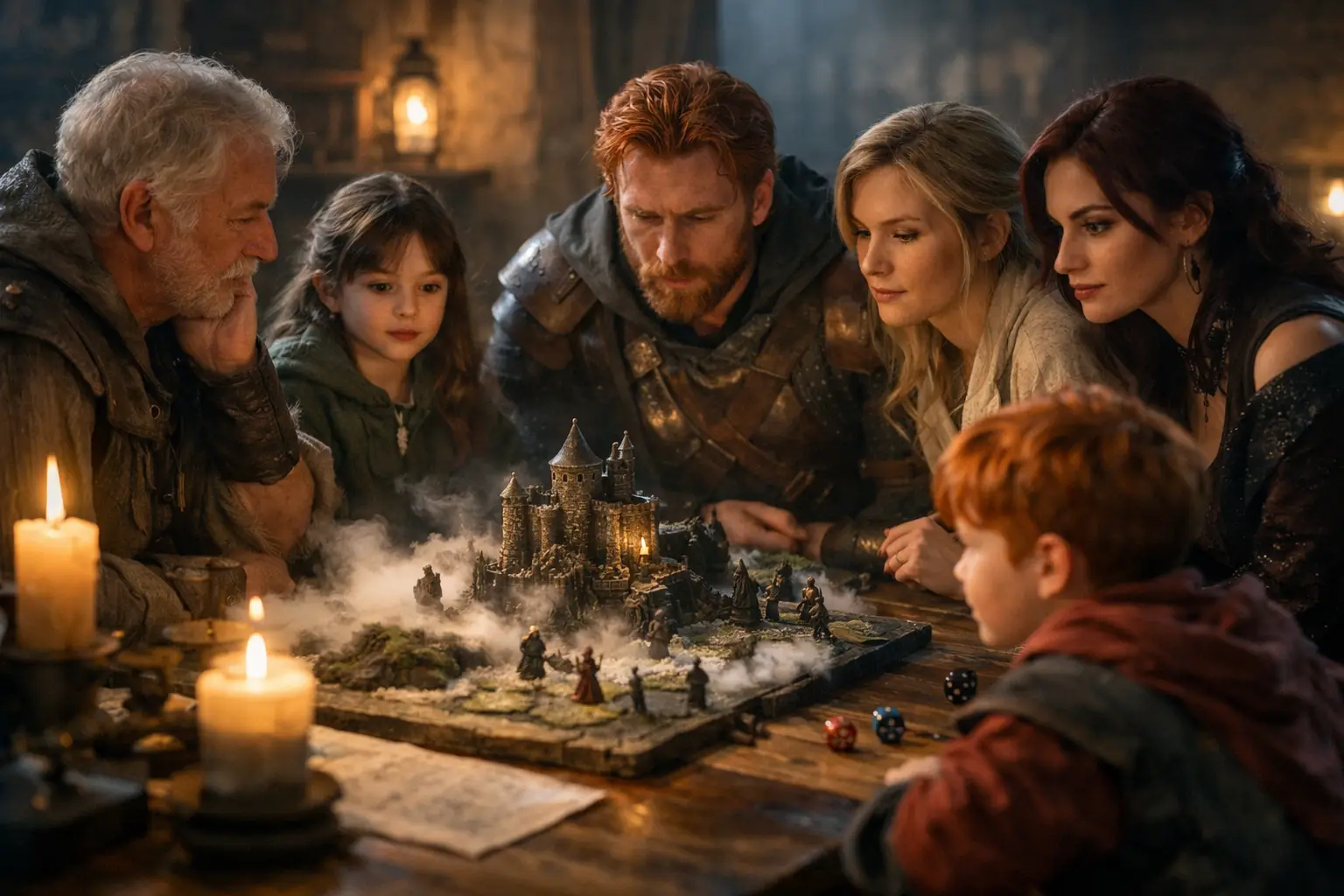
The caravan was supposed to be the straightforward part.
The characters were travelling as guards when the attack came. People scattered, steel was drawn, and by the time the violence ended one fact was impossible to ignore: a Bladeholder had been taken.
Not killed.
Taken.
That alone raised questions. How do you abduct someone carrying that kind of power? Who knew they would be there? Was the attack designed around the kidnapping, or did somebody simply recognise an opportunity?
The characters followed.
Instead of finding a neat answer, they found something else: the remains of an old Radiant Keep, an Oathgate, a chapel, signs that the structure continued underground — and enemies willing to attack them there.
Now there were apparently two mysteries.
Or perhaps one.
Or perhaps two mysteries that had nothing to do with each other yet.
That last word matters.
Because in a living-world campaign, a mystery is not a sequence of revelations waiting for the Game Master to release them at the correct dramatic moment.
It is a problem inside a world that is already moving.
The problem with mystery pacing
Traditional mystery advice often focuses on pacing.
Introduce the disturbance. Give the players several leads. Apply pressure. Allow a partial answer. Create false certainty. Correct that interpretation with another clue. Escalate. Reveal the deeper truth. End with a meaningful decision.
Much of that advice is useful.
The problem appears when those elements become a schedule.
If the important revelation is supposed to happen in session three, what happens when the players discover it in session one?
Do we hide the evidence?
Move the document?
Make the witness inexplicably unavailable?
Add another locked door because the players are not yet supposed to know?
At that point we are no longer protecting the mystery.
We are protecting the plot.
The same problem appears from the other direction. If the players pursue something we did not expect, do we quietly bend every clue until it leads them back towards the prepared finale?
That may create smooth pacing.
It also means there was really only one story.
At Mythveil, we approach the problem differently.
Prepare the causes. Model the forces. Do not prescribe the outcome.
Build the world before you pace the story
A living world begins with a state.
It has history, institutions, relationships, conflicts, resources, beliefs, misunderstandings and unresolved problems. Some of those problems may become major stories. Others may remain unnoticed for months. Some will collide. Some will disappear. Some will become far more important because the players decide to touch them.
The mystery does not sit inside this world waiting for the party.
It develops.
The kidnapped Bladeholder does not remain conveniently kidnapped while the characters spend three sessions exploring the Radiant Keep.
The people responsible have goals.
The Bladeholder has relationships.
His absence matters somewhere.
Other factions may notice.
Plans continue.
Power shifts.
Meanwhile, the Radiant Keep is not frozen either.
The place has a past that produced its present condition. Somebody may already know about it. Somebody may be searching for it. The attackers encountered there came from somewhere and presumably have reasons for being there.
So before the players ever understand either problem, both can already be changing.
The first relationship is therefore not player versus mystery.
It is:
World ↔ Problem
Then the players notice something.
And the structure becomes:
World ↔ Problem ↔ Players
Each can now change the others.
That is where the story begins to grow.
Clues are not plot coupons
One of the strongest ideas in conventional mystery design is that an important fact should be discoverable through more than one route.
We keep that principle.
We simply interpret it differently.
We do not place three copies of a clue because the players must reach the next scene.
Instead, we ask what traces a real event would leave behind.
If people have disappeared from a coastal village every thirty years for a century, that history might survive in parish records, family memories, missing graves, property transfers, local songs, newspaper fragments, memorial stones, superstitions or gaps nobody has previously thought to compare.
These are not backup clues.
They are different consequences of the same past.
And they do not necessarily say the same thing.
An official record may say someone died at sea.
A family tradition may insist they were taken.
A drinking song may turn the event into comedy.
A church document may deliberately omit a name.
A gravestone may simply be missing.
The world provides evidence.
The players create the theory.
That distinction matters.
False certainty belongs to the players
A mystery becomes much more interesting when the Game Master stops deciding what the players are supposed to believe.
Suppose the characters discover destroyed portraits, a missing official and evidence of an old ritual.
They may decide that a local elder murdered the official to protect the ritual.
Perhaps they are right.
Perhaps they are partly right.
Perhaps they are completely wrong.
We do not need a planned “false certainty phase”.
Their theory is theirs.
Then they act on it.
And this is where a living world does something a static mystery cannot.
A wrong interpretation can still change reality.
Imagine the characters believe the kidnapped Bladeholder and the Radiant Keep are connected.
Initially, they are not.
But the players begin asking questions based on that assumption. They tell an ally about the Keep. Someone overhears them. A faction connected to the kidnapping learns that an Oathgate has been discovered.
Now that faction becomes interested.
Perhaps they realise that possessing a Bladeholder gives them an opportunity they did not previously know existed.
Two independent problems have just become connected.
Not because the Game Master revealed that they were secretly the same plot.
Because the players’ interpretation changed the information available to the world.
A false interpretation can create true consequences.
That is a living mystery.
The world interprets the players too
The exchange works in both directions.
Players interpret the world.
The world also interprets the players.
A faction sees the characters investigating the Radiant Keep and concludes that they intend to control the Oathgate.
Wrong.
It does not matter.
If that faction believes it, it may mobilise resources, approach rivals, spread rumours or attempt to remove the characters.
Another faction sees those reactions and reaches a different conclusion.
Soon the players are dealing with consequences of intentions they never had.
That gives us a much richer cycle:
World State → Player Perception → Player Interpretation → Player Action → World Interpretation → Faction Response → Influence Change → New World State
Then the cycle begins again.
The story is not travelling through prepared beats.
It is being created by interacting interpretations and consequences.
The fourth dimension: history
This becomes even more powerful when we stop treating the past as exposition.
The Radiant Keep has a history.
Something built it.
Something sustained it.
Something happened there.
Something caused it to become the ruin the characters have now discovered.
So investigation of the present produces questions about the past.
Why is the Oathgate there?
What was the chapel for?
Which people used the site?
Why was it abandoned?
Who inherited knowledge of it?
What was forgotten?
What was deliberately hidden?
This is where research enters the campaign.
Not because every mystery needs enormous amounts of lore.
Because the campaign has created a question.
We research the questions the campaign creates.
And we research only as deeply as the world needs.
The result can alter our understanding of the present.
Perhaps research reveals that a powerful modern family built its legitimacy around a false account of what happened at the Keep centuries ago.
The past has not changed.
But the world has discovered a different past.
That can change everything.
Who owns the evidence?
Who believes it?
Who benefits from publication?
Who loses legitimacy?
Who wants the discovery buried?
Historical truth becomes political power.
The past does not have to change for the future to change. Sometimes it is enough for the world to discover a different past.
This is why the fourth dimension matters.
Past events produced the present.
The present interprets the past.
People act on those interpretations.
Those actions change the future.
That future eventually becomes history.
Research backwards. Simulate forwards.
This is one of the simplest ways to describe the process.
A discovery in the present creates a historical question.
We research backwards until we understand enough of the causal path.
Then we return to the current world.
Now the factions may be different from what we thought.
Their motivations may be deeper.
Old rivalries may suddenly make sense.
Forgotten institutions may become relevant.
Influence may change because historical legitimacy has changed.
Then we simulate forwards.
Not by deciding what the next chapter must be.
By asking what the actors can reasonably do now.
The future is not canon.
It is a projection from the current state.
And projections change.
Where the Faction Game and Influence Game enter
None of this replaces the existing living-world machinery.
It gives that machinery something meaningful to work upon.
Research helps us understand the people and structures connected to the problem.
The Faction Game establishes who wants what, what they know, what they believe, what they fear and what they can actually do.
The Influence Game tracks how their relationships, access and power shift.
Guardian pressures can emerge when one force becomes too dominant and other parts of the world respond.
Nemesis dynamics can develop when an opponent, institution or successor gains the position to become a lasting counterforce.
The World Tick asks what these actors actually do next given the current state.
Bardic Resonance carries what happened back into society.
And none of those systems need to know what the final story is.
They only need to know what the world is now.
Pressure without pacing
Soro’s original mystery model is also right that discoveries should not happen in a vacuum.
There can be pressure.
But we do not insert pressure because the adventure has become too quiet.
Pressure comes from causes.
A coastal crypt floods because tides exist.
A witness leaves because they are frightened.
Records disappear because somebody has realised what the investigators are searching for.
A political faction moves because the Bladeholder’s absence has created an opportunity.
An enemy acts because the players have exposed themselves.
Sometimes nothing happens.
That is allowed too.
A living world is not a machine for constant escalation.
There may be an hour of slow research followed by three discoveries in ten minutes. There may be an entire session spent debating what one symbol means. The characters may abandon the mystery for six sessions and return to find the situation transformed.
There is still rhythm at the table.
The rhythm is experienced. It is not prescribed.
A reveal should change meaning, not complete a checklist
Another useful idea from traditional mystery design survives intact: a powerful discovery often changes the meaning of things the players already knew.
A burned portrait was once evidence of guilt.
New knowledge reveals that it was an attempt to erase someone from a ritual lineage.
The object has not changed.
Its meaning has.
That is stronger than simply adding another clue.
A strong mystery reveal changes the meaning of what the players already know.
But again, we do not schedule when that must happen.
If the players uncover the decisive document immediately, they do.
Then the campaign changes immediately.
We do not hide the truth because the next three sessions have already been written.
There is no scheduled climax
Eventually the players may reach a position where they understand enough and possess enough access, allies or power to fundamentally alter the problem.
That may feel like a climax.
But it is not a scene we reserved in advance.
It is an achieved world state.
Perhaps the Bladeholder is rescued.
Perhaps the Oathgate is opened.
Perhaps the players expose an ancient lie.
Perhaps they destroy one faction and accidentally empower another.
Perhaps they solve the original mystery and create a larger political crisis.
Perhaps they decide the problem is not worth solving.
All are valid.
Resolution is a world state the players helped create, not a scene the Game Master scheduled.
And once that state exists, the world continues.
Bardic Resonance: when events become history
What the players did does not remain a clean factual record.
People interpret it.
A Radiant order may call the discovery sacred.
A noble house may call it proof of inheritance.
A military faction may call it a strategic threat.
Villagers may say the characters woke something that should have remained buried.
Years later, a song may describe them as heroes who reclaimed a lost stronghold.
The players may remember mostly being confused and nearly dying.
Both now matter.
Because the story told about an event can influence the world almost as much as the event itself.
Bardic Resonance turns consequence into memory, propaganda, myth and reputation.
That memory affects future factions.
Future power struggles reinterpret it again.
And eventually the campaign has produced its own history.
So what happened to mystery pacing?
It became unnecessary.
The useful parts survived.
Multiple leads became multiple historical traces.
False certainty became player interpretation.
Pressure became consequence.
Escalation became world development.
The reveal became changed understanding.
The climax became an achieved state.
The aftermath became the next version of the world.
What disappeared was the assumption that the Game Master knows the story before the players live it.
At Mythveil, that is the part we do not need.
Do not arrange discoveries to create a story. Build a world in which discoveries have causes, meanings and consequences — then let the players decide what they make of them.
The mystery is not the story.
The story is what happens when players interpret a living world, act upon that interpretation, and are changed by the world’s response.
The world creates evidence.
The players create meaning.
Their actions create history.
Stories that remember. Worlds that change.
Read more about Mythveil Chronicles and the Rexborn Framework: https://mythveilchronicles.com/
Play with Dunchan Hunter Games: https://startplaying.games/gm/dunchan
Join the Mythveil seminar, Campaigns That Remember Your Players: https://startplaying.games/adventure/cmqzlufe80063jj04bafujpq0
Support the project and deeper design work: https://www.patreon.com/MythveilChronicles
Collaborate on narrative design, living worlds or consulting: https://www.linkedin.com/in/francisco-jos%C3%A9-z-b05aab371/