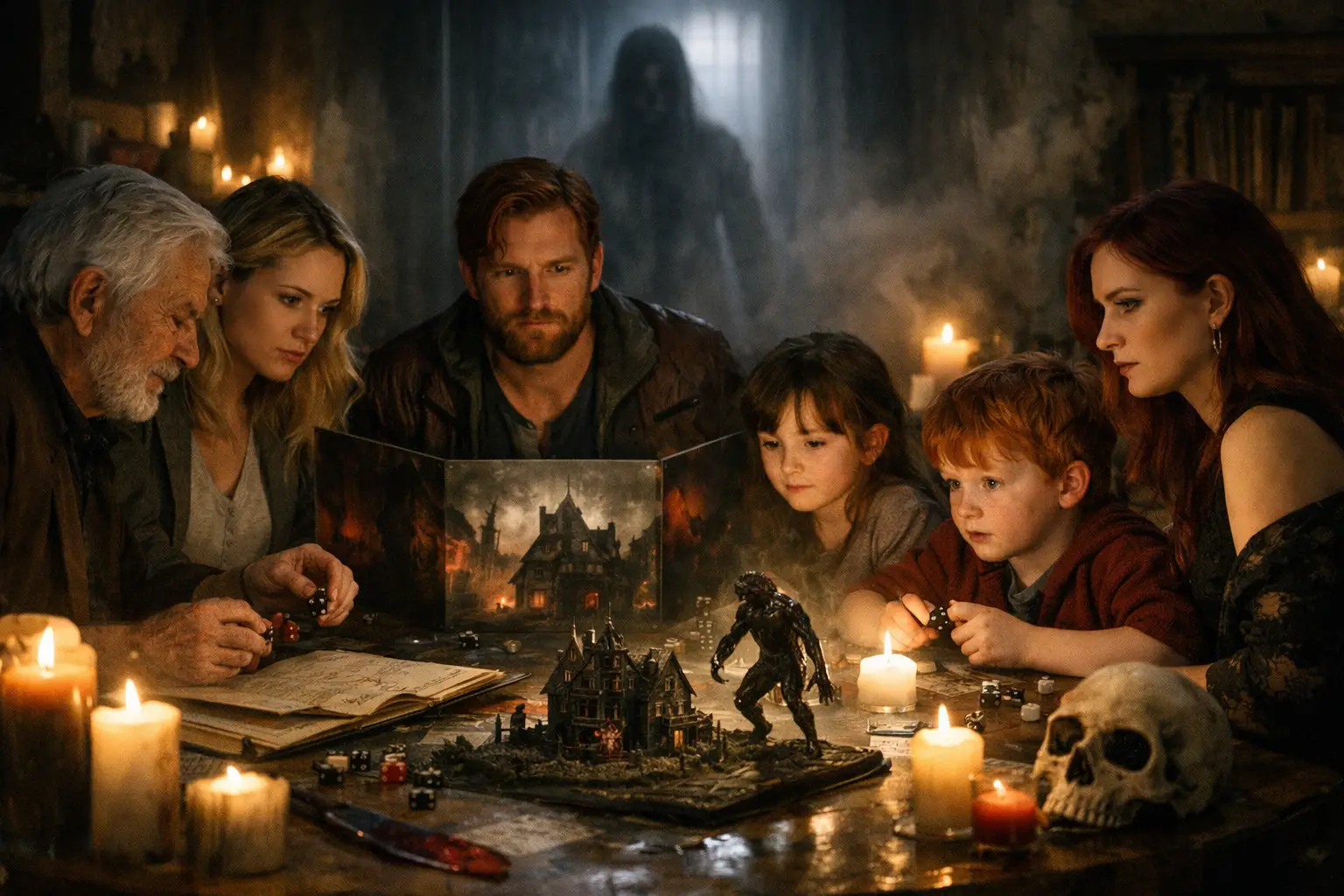
10 Best Horror Tabletop RPGs for Lasting Fear
How research, living influence and a world that answers back make fear believable
MYTHVEIL CHRONICLES · HORROR · LIVING WORLDS
The telephone rings at 2.13am.
Nobody at the table wants to answer it, because the investigator who owns the house has been dead for three sessions.
The fear does not come from the sound alone. The players know the house. They remember the funeral. They know who inherited the keys, which stair creaks near the landing, and why the study has remained locked ever since. The world has already convinced them that its owner is gone.
That is why one impossible ringing telephone matters.
The best horror tabletop RPGs do not begin by asking what monster will appear. They begin by establishing a reality the players are willing to inhabit. That reality may be historical, contemporary, folkloric, gothic, industrial or entirely fictional. It does not need to be possible in our world. It needs to feel as though it existed before the characters entered it and will continue moving after they leave.
At Mythveil Chronicles, that process begins in reality: history, society, culture, religion, geography, technology, work, memory and the institutions through which people exercise power. Deep research reveals how those forces fit together. Influence sets them in motion before the first supernatural event ever occurs.
Then one truth changes.
The dead investigator’s telephone rings. A police file contains a signature dated before its author was born. A familiar path ends in the wrong place. A starship lists one more crew member than boarded it. The impossible does not replace the established world. It enters a world already alive enough to resist, exploit, deny, worship or remember it.
That is where lasting fear begins.
What makes a horror world feel real?
Immersion is often mistaken for constant atmosphere. Dim lighting, unsettling music, distressed handouts and a practiced whisper can all help. None of them can rescue a world that behaves arbitrarily.
Players stop fearing a threat when they can see the machinery of the scene too clearly. A monster that appears anywhere because the Game Master wants a shock does not feel unknowable; it feels convenient. An institution that becomes incompetent only when the plot requires it does not feel corrupt; it feels written. An NPC who abandons every established motive to force the group towards the next clue does not create uncertainty; they reveal the rails.
Fear needs uncertainty. It does not survive incoherence.
A believable horror reality begins with ordinary causality. People want things. Institutions protect their authority. Families preserve secrets. Communities develop habits. Businesses seek profit. Religions explain suffering. Fractions compete for resources, information and legitimacy. They act before the characters arrive, and they continue acting while the characters are somewhere else.
This is why research and influence belong at the beginning rather than being added after the monster is designed.
Research tells us what shaped the world. Influence tells us how that world behaves.
The supernatural then enters an existing field of pressures. A haunting affects inheritance, property prices, family loyalties and local belief. A cult uses an economic crisis it did not create. A vampire relies on real transport routes, political networks and human institutions. An alien organism enters a workplace whose owners have already calculated the acceptable cost of losing the crew.
The players do not act upon a waiting world. They enter a world already acting upon itself.
Every choice changes what other people, institutions and hidden forces are able, willing or afraid to do next. Growing power creates resistance. Weakness attracts successors. Rumours and official explanations begin changing behaviour before the event is even over. Those reactions alter influence again, and the cycle continues.
The ten games below are not ranked by body count, brutality or the number of monsters in their bestiaries. They are here because each offers an unusually strong foundation for creating a reality the players can accept – and therefore a fear they may continue carrying after the session ends.
- Call of Cthulhu – history before the Mythos
Call of Cthulhu remains one of the clearest examples of horror growing from a researched reality. Its investigators do not begin inside an abstract nightmare. They begin in a specific time, surrounded by the assumptions, technologies, prejudices, institutions and limits of that period.
An investigation in the 1890s should not feel like the 1920s with different clothing. A campaign in the 1930s should not interpret science, travel, colonial power, psychiatry, religion or public scandal in the same way as a modern one. The deeper the historical reality, the more disturbing it becomes when evidence refuses to fit the accepted chronology.
An excavation first needs to feel like a real excavation. Who funded it? Which museum expects the finds? Who performs the labour? Which government claims the site? What academic rivalry will shape the published interpretation? Only then does the impossible artefact matter.
The Mythos becomes powerful when it does not replace history but exposes its incompleteness. A family archive contradicts an official record. A religious text preserves a memory that archaeology should have disproved. Several cultures describe the same event through different concepts of time. The terror grows step by step because the players understand what each contradiction is damaging.
Mythveil deepens this through transdisciplinary research rather than a single historical lens. Political history may explain who controlled an expedition. Anthropology may show how outsiders misunderstood a local practice. Religious studies may reveal why two communities recognised the same phenomenon differently. Material culture, ecology and folklore may each preserve part of a truth no official archive could hold alone.
For groups who enjoy research, slow revelation and the sense that knowledge itself changes the investigators’ place in history, Call of Cthulhu remains exceptional. Its weakness appears when every scenario begins with a fresh cult and ends with another isolated apocalypse. Recurring institutions, families, places and beliefs turn isolated mysteries into a world that remembers.
- Delta Green – the modern state meets an impossible fact
Delta Green begins with recognisable institutions: police departments, federal agencies, hospitals, laboratories, military commands, private contractors and the bureaucratic machinery that decides who is responsible for what.
That realism is not background decoration. It is the instrument of the horror.
An agent knows how a normal crime scene should be processed. A doctor knows what a body should permit. An analyst knows how a report is attributed, classified and amended. When one element refuses to obey those systems, the contradiction carries professional as well as emotional weight.
Deep research makes the conspiracy more convincing because the Unnatural does not hover above a generic government. It collides with actual jurisdictions, legal limits, career incentives, institutional rivalries and different standards of proof. One agency wants containment. Another wants exploitation. A local detective wants the missing person found. A private company wants liability buried. A frightened superior wants the case closed before anyone asks why it was opened.
Influence is especially potent here. Different organisations do not merely hold different clues; they possess different powers to define reality. The agents may know the truth while an official report, a medical finding and a televised statement establish three incompatible public versions.
Guardian appears as counterpressure around any concentration of knowledge. A programme that becomes too capable attracts oversight, sabotage, rival cells and internal purges. Nemesis gathers before a vacuum is fully empty: if one operation destroys a cult, someone is already trying to inherit its contacts, data or access. Bardic Resonance takes the form of redacted files, podcasts, conspiracy forums, training documents and lies that become operational truth.
Delta Green is ideal for groups who want moral pressure, institutional horror and characters whose private lives erode under the cost of secrecy. It demands care. Bleakness must not become futility, and fragmented information must not become arbitrary manipulation. The agents may be doomed to lose something. They still need meaningful control over what kind of damage survives them.
- Vaesen – folklore as a living relationship
Vaesen works because its supernatural beings belong to places, customs and histories rather than simply occupying encounter locations.
A mystery may begin with spoiled milk, missing animals or an argument over a boundary. Those details matter because they arise from a community’s relationship with land, work, season, faith and memory. The being is not frightening merely because it is ancient. It is frightening because people once knew how to live beside it and that knowledge has been damaged, commercialised, forgotten or deliberately rejected.
This kind of horror benefits enormously from careful cultural research. Folklore is not a universal catalogue of interchangeable monsters. A story belongs to a language, a landscape, a social order and a particular way of understanding the relation between humans and the more-than-human world. Treating every spirit as a combat statistic flattens the very reality that makes it compelling.
Mythveil begins with the community. Who owns the land? Which families stayed? Which people left? What work shapes the year? Which ritual is publicly dismissed but privately observed? Which religious or industrial change disrupted an older balance?
Guardian can emerge through inherited practices, social taboos or people who preserve a boundary without fully explaining it. Nemesis becomes visible when solving one threat removes a protection against another, or when modern interests occupy the space an old arrangement once governed. Bardic Resonance lives naturally in songs, warnings, household habits and stories that preserve practical knowledge beneath the language of superstition.
Vaesen is one of the best choices for players who want melancholy, moral complexity and horror rooted in place. It is less suited to groups seeking relentless combat or simple moral categories. Its strongest mysteries ask not only how to defeat the being, but what human change made the conflict unavoidable.
- Warhammer Fantasy Roleplay – horror inside a functioning society
The Old World becomes frightening because Chaos does not enter an empty fantasy map. It enters markets, guilds, temples, courts, family businesses, military structures and cities whose people already struggle with debt, disease, class, hunger and authority.
Warhammer Fantasy Roleplay is at its best when the cult has a social history. Who joined first? Who finances it? Which official quietly protects it? What wound, ambition or exclusion made its promises attractive? What legitimate institution failed the people now turning towards corruption?
Deep research into urban life, trade, law, religion, disease, war and early-modern social structures gives the setting more than mud and gallows humour. It creates pressures that can exist before Chaos appears and continue after one manifestation has been destroyed.
Influence makes those pressures playable. A merchant guild may control credit but lack religious legitimacy. A temple may dominate public morality while depending on noble patrons. A watch captain possesses force but fears a magistrate who controls appointments. A cult can be militarily weak and socially embedded.
Guardian is already forming as any one faction grows too dominant. Nemesis is already studying the likely vacancy while the players are still fighting the current enemy. Bardic Resonance turns their actions into tavern stories, court accusations, sermons, wanted notices and distorted reports travelling towards cities the party has not yet reached.
A long campaign becomes powerful when an early local decision eventually changes who controls a gate, funds an army or believes the characters’ name. The horror does not reset between adventures. It becomes social history.
Choose Warhammer Fantasy Roleplay for grim investigation, political consequence and characters who begin close enough to ordinary life for every compromise to matter. The game can become numb if everything is equally corrupt and every decent act is punished. Hope should be costly, not absent.
- Vampire: The Masquerade – our city after dark
A convincing Vampire: The Masquerade chronicle should begin with a real city rather than an abstract collection of clan territories.
Who lives there? Which districts are changing? Where are wealth, poverty and public attention concentrated? Which migrant communities, religious institutions, businesses, nightlife venues, transport routes and criminal networks shape movement after dark? What memories do different communities preserve about the same street?
Only after that reality is understood does the hidden nocturnal order begin to emerge.
A vampire faction does not control “politics” in the abstract. It needs people, routines, access, patronage and leverage inside actual institutions. Its immortality does not free it from history; it makes it dependent upon histories that younger people continually reinterpret.
This is where Mythveil’s research and influence game become especially valuable. City history, architecture, migration, subculture, religion, organised crime, public administration and local legend create the mortal systems through which vampiric power must operate. Clans and courts become deeper when they are not laid over the city like a second map but revealed through the structures already shaping human life.
Guardian appears whenever a domain confuses longevity with permanent control. Rival vampires, mortal institutions, community resistance, demographic change and internal decay all answer concentrated power. Nemesis gathers around a weakening prince before the throne is vacant. Bardic Resonance turns undead history into art, family stories, vanished people, neighbourhood myths and buildings whose meanings differ by generation.
Vampire is ideal for political drama, moral horror and players interested in identity under pressure. It requires a group willing to portray predatory, compromised characters without turning darkness into permission to mistreat one another at the table. Its horror lasts when hunger changes relationships, not merely resource totals.
- Mothership – material reality before cosmic terror
Mothership does not need a vast cosmology to make space terrifying. It needs a credible machine keeping people alive.
Air, heat, pressure, distance, maintenance, medicine, fuel and labour create its reality. The crew understands that every door, filter and alarm has a function. That knowledge turns a malfunction into more than set dressing and makes an intruder frightening before anyone knows what it is.
Research in this context is practical and social. How does the station operate? Who repairs it? Which systems are redundant and which were cheaply omitted? What contract brought the crew here? Who owns the salvage? How long would rescue take? Which worker has been reporting the same fault for six months?
Influence exists even in a small crew. The captain controls access. The company controls information. The engineer understands the systems. The medic controls limited treatment. A remote supervisor can deny a request while never smelling the smoke.
The supernatural or alien threat enters those dependencies rather than replacing them. A lifeform in a generic corridor is a monster. A lifeform inside the coolant system of the only functioning reactor is a decision.
Guardian may emerge through improvised crew solidarity, sabotage or an automated system protecting the wrong priority. Nemesis appears in the employer, salvage team or research division already preparing to inherit the biological sample and the abandoned station. Bardic Resonance survives as a distorted distress call, an insurance finding, a crew rumour or a warning that reaches the next ship after the coordinates have been accepted.
Mothership is superb for intense one-shots and short campaigns. Longer play works when the crew gains a ship, debts, employers and a history of places that remember their arrival. Its lean rules create pressure quickly, but the world still needs enough ordinary life for survival to mean more than keeping a character sheet alive.
- Tales from the Loop – childhood makes the impossible personal
Tales from the Loop creates reality through childhood rather than lethality.
The essential details are not merely cassette players, BMX bicycles and familiar songs. They are school routes, sibling rivalries, parents who are distracted for understandable reasons, local shortcuts, places adults have stopped noticing and friendships whose rules feel more important than official ones.
A strange machine in the forest becomes unsettling only after the forest has become part of the children’s lives. They know where the path bends, where someone once broke an arm and which clearing is avoided after dark. When one familiar route ends somewhere new, the mystery is not just spatial. It has violated memory.
Mythveil’s Country Road Kids approach shows how far this can go. Appalachia and West Virginia are not used as an aesthetic backdrop. Geology, mining, family history, religion, state infrastructure, folklore, social decline, local pride and children’s perception form one connected reality. Coldwater Ridge can then generate its own mysteries because the town already possesses wounds, habits and competing explanations.
Influence moves through school, church, family, local government, laboratories and community rumour. Guardian appears in old rules, protective traditions and people resisting forces they may not fully understand. Nemesis gathers whenever industry, authority or the supernatural leaves a vacancy. Bardic Resonance spreads through playground stories, altered calendars, sermons, local warnings and the way adults agree that something is over while children know it is not.
Choose Tales from the Loop for wonder, unease and emotional horror without routine character death. Its stakes depend on players who care about friendship, trust and the possibility that growing up may mean losing access to truths they once recognised immediately.
- The Between – a shared gothic reality
The Between demonstrates that immersion does not require detailed simulation. It requires everyone at the table to inhabit the same kind of reality.
Its London operates through gothic logic: scandal travels, houses retain emotional residue, public respectability conceals private appetite, and personal histories return obliquely rather than through straightforward exposition. The game’s collaborative approach to mystery allows the group to discover a truth that was not fully predetermined.
That freedom works best when it rests upon a strong shared grammar. Research into Victorian class, journalism, policing, medicine, spiritualism, sexuality, empire and urban development gives players more meaningful material from which to construct revelations. Genre knowledge contributes another layer: gothic literature and later cultural memory influence what the city is expected to mean.
Influence here is often narrative as well as institutional. A newspaper, noble household, theatre, hospital or scandal possesses power because people agree that its version matters. Guardian emerges through reputational defence, social counterpressure and people protecting the boundaries of acceptable knowledge. Bardic Resonance is almost immediate: the city begins turning each case into rumour, theatre, gossip or legend while the hunters are still deciding what occurred.
The Between suits confident, improvisational groups who enjoy collaborative interpretation and dramatic structure. It may frustrate players seeking one prewritten factual solution or detailed procedural simulation. Its reality is stylised, but stylisation is not the opposite of truth. It is an agreement about which truths the world will consistently honour.
- Dread – fear becomes physical
Dread uses a block tower instead of dice, turning each risky action into a visible disturbance in the room.
The design is immediate. Players lean forward. Breathing changes. The hand reaching for the tower begins to share the character’s uncertainty. The mechanic does something rare: it makes fictional danger physically present without requiring anyone to pretend the tension is abstract.
But the tower cannot create meaning by itself.
Before the first pull, the situation needs a credible human reality. Why are these people together? What do they owe one another? Who cannot simply be abandoned? What material conditions prevent an easy escape? Which unresolved conflict will make cooperation difficult once the tower begins to shake?
Mythveil’s contribution would therefore be concentrated rather than sprawling. Research grounds the location and situation. Influence clarifies the relationships already under pressure. The tower then amplifies the cost of acting inside them.
Guardian, Nemesis and long-form faction play matter less in a typical single-session Dread scenario, and pretending otherwise would weaken the comparison. Bardic Resonance may exist only in the final image or the story survivors carry away. That limitation is part of the game’s strength. It is designed for a sharp arc, not an indefinitely expanding world.
Choose Dread for a contained night of escalating, bodily tension. It proves that lasting fear does not always require a long campaign. It does require something worth losing before the tower falls.
- Alien: The Roleplaying Game – the company has already priced the loss
The Alien RPG becomes convincing when space horror is treated as labour horror.
People aboard the ship or colony have jobs, shifts, qualifications, contracts, supervisors, complaints and unequal access to information. The machinery is not simply industrial decoration. It determines whether people can breathe, eat, communicate and return home.
Then the organism arrives.
Research into logistics, corporate hierarchy, medicine, industrial safety, communication delay and the economics of remote work gives the setting its human weight. The crew is not a collection of victims waiting for a creature. It is a workplace whose owners have already decided how much rescue is worth.
Influence is active before the first egg opens. The company controls the mission. Officers control orders. Scientists control interpretation. Workers hold local knowledge. An android may possess information no human is authorised to receive.
Guardian appears as resistance, improvised solidarity, quarantine or a system trying to protect corporate property instead of human life. Nemesis is already present in the recovery team, rival company or research division that will inherit what remains. Bardic Resonance determines whether the catastrophe becomes an accident report, an act of sabotage, a classified success or an event officially erased while survivors continue to tell another story.
Alien is excellent for cinematic survival and campaign play built around work, corporate pressure and recurring consequences. Its stress mechanics produce strong acceleration, but constant panic can become noise. The human conflict should exist before the creature enters the room. Otherwise the xenomorph is spectacular, but the world around it remains hollow.
How Mythveil makes horror continue moving
Across these games, the same underlying principle appears in different forms.
We begin with the world as people could recognise it. Deep research examines the historical, social, cultural, religious, material and ecological forces that shaped it. Influence reveals which people and institutions can act, what they need and how they constrain one another.
That movement is already happening before the players arrive.
The players intervene. Other factions respond. Those factions also act upon one another. The supernatural changes what everyone believes is possible, but it does not suspend ordinary interests. A church may interpret the event. A company may exploit it. A family may hide it. A government may classify it. A rival power may recognise an opportunity.
Guardian, Nemesis and Bardic Resonance are therefore not final stages switched on after the climax.
Guardian is always asking what resistance or adaptation is being created by current power. Nemesis is already gathering around weakness, defeat and possible vacancies. Bardic Resonance begins turning partial events into rumours, records, rituals and accepted truths before anyone fully understands what happened.
Those stories then change influence again.
A rumour shifts trust. A memorial grants legitimacy. An official lie weakens survivors. A song preserves forbidden knowledge. A training document makes one faction’s interpretation operational. The world does not merely remember the event. Its memory becomes one of the forces shaping what can happen next.
This is the Rexborn principle beneath a living horror campaign: causality extends beyond the player characters.
The characters matter because they can alter the movement. They are not the only people with motives, resources or the ability to act. Their choices create further choices for others, just as the choices of others create pressure, danger and opportunity for them.
Fear becomes immersive when the impossible enters a world that was already alive – and discovers that everything inside it is capable of answering back.
Choosing the right horror RPG for your group
Choose Call of Cthulhu when historical investigation and the slow collapse of accepted knowledge are central. Choose Delta Green for modern institutions, secrecy and moral erosion. Choose Vaesen for folklore, place and inherited obligations. Choose Warhammer Fantasy Roleplay for social horror, political consequence and a long campaign that turns local decisions into history.
Choose Vampire: The Masquerade for identity, hunger and city politics. Choose Mothership or Alien when work, technology and physical survival should carry the fear. Choose Tales from the Loop for childhood, memory and quiet unreality. Choose The Between for collaborative gothic mystery. Choose Dread for one concentrated evening when risk should become physically visible.
Then ask the harder question:
What reality must the group accept before this game’s horror can matter?
Discuss boundaries before play. Horror depends upon trust, and trust is not weakened by clear limits. Agree on what should remain outside the game, how anyone can pause or redirect a scene, and what intensity the group actually wants. A table that feels safe enough to take imaginative risks can enter darker places than one relying on shock without consent.
Let the telephone ring
The telephone continues to ring.
The players know the house. They remember who chose the wallpaper and where the dead investigator kept the whisky nobody else was allowed to touch. They remember the funeral. They know who inherited the keys. They know the study has remained locked.
Outside that room, the world is already moving.
A solicitor wants the papers inside. A former colleague has begun asking questions. A family member is telling a different version of the death. Someone has offered too much money for the house. Somewhere, a file has been amended by a person who should not know the investigator’s name.
Nobody is waiting for the players.
That is why the sound matters.
Lasting horror does not begin when reality disappears. It begins when reality remains intact in every respect except one.
Begin with the world as it is. Research what shaped it. Let its people, factions and institutions act. Allow the impossible to enter one truth at a time. Then let every response, vacancy and remembered version change what happens next.
Build the house first.
Let it live.
Then let the telephone ring.
Read. Play. Watch. Support. Or Collaborate.
Read: https://mythveilchronicles.com/
Play: https://startplaying.games/gm/dunchan
Watch: https://www.youtube.com/@MythveilChronicles
Support: https://www.patreon.com/mythveilchronicles_bydunchanhuntergames
Collaborate: https://www.linkedin.com/in/francisco-jos%C3%A9-z-b05aab371/
MYTHVEIL
We create worlds you want to live in.
Stories that remember. Worlds that change.
MYTHVEIL | Stories that remember. Worlds that change.