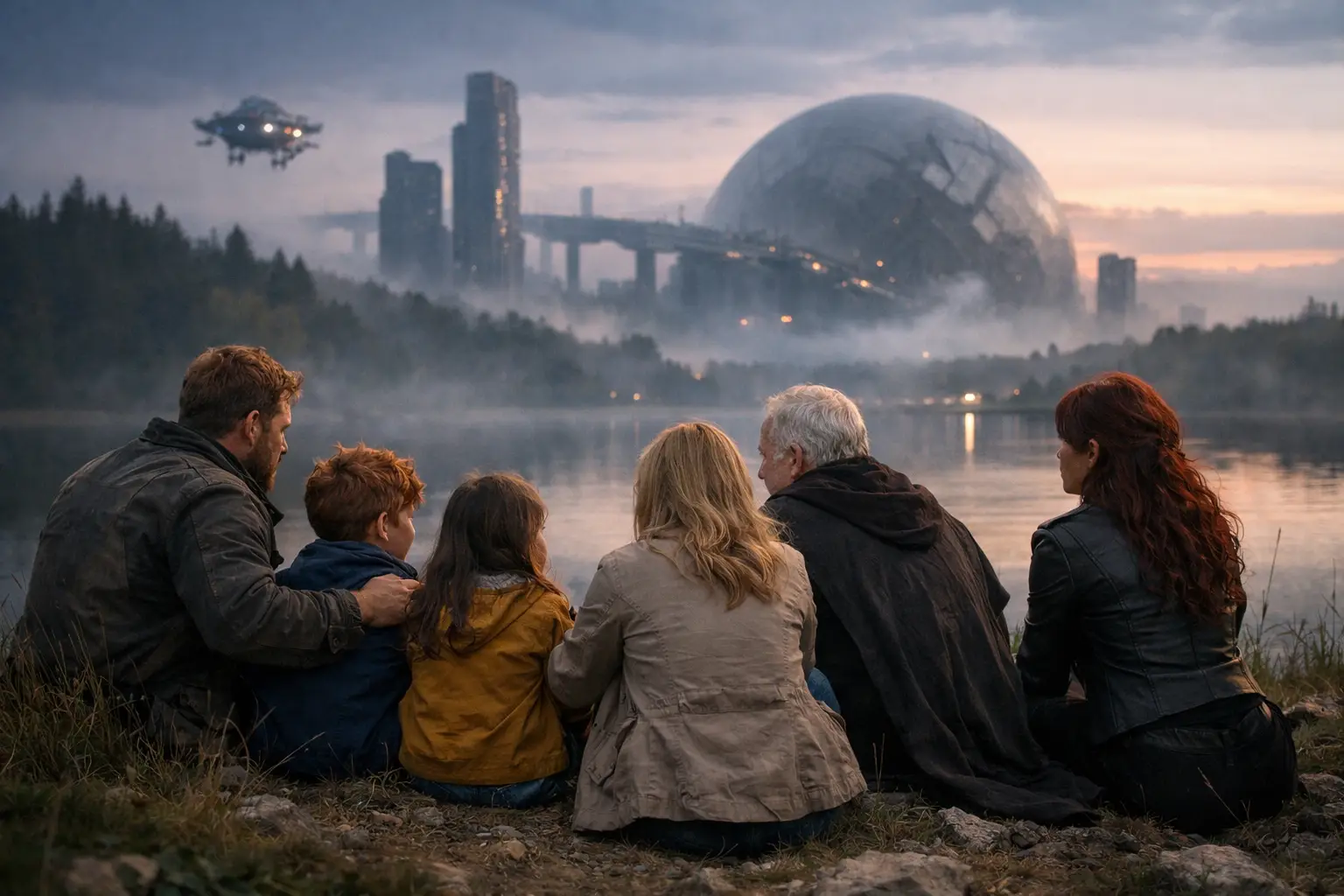
Tales from the Loop GM: Worlds That Remember
How Mythveil research and Rexborn continuity turn Country Road Kids into more than a mystery in West Virginia.
The cassette clicks into place.
Outside, rain turns the streetlights to halos. Somewhere beyond the football field, a machine is humming beneath the earth, and the adults are too tired, frightened, or distracted to hear it.
On Monday morning, a bicycle is still lying beside the county road.
Everyone knows whose it is.
Nobody asks why the sheriff has placed a blanket over the ditch.
By lunchtime, three versions of the story are moving through the school. By Friday, one of them is true.
A great Tales from the Loop GM understands that this is not merely the opening to a mystery. It is the moment a group of young people discovers that their small corner of the world is stranger, larger, and more fragile than they believed.
The machine may be impossible.
The town must be true.
That principle sits at the heart of Country Road Kids, Mythveil Chronicles’ campaign in a fictional West Virginia community called Coldwater Ridge. The strange technology, damaged experiments and impossible events matter. But they only become meaningful because they enter a place that already has a history, a social order, old wounds, competing beliefs and people with reasons to remain silent.
A memorable mystery is not something the Game Master places inside the town.
It is what the town has become.
A Tales from the Loop world begins before the mystery
Tales from the Loop is often described as a game about children confronting science-fiction mysteries in an alternate 1980s. That is accurate, but incomplete.
Its real power lies in the collision between extraordinary events and ordinary lives: a row with a parent, a friendship under strain, a school corridor that suddenly feels hostile, a family depending on a job nobody trusts, and the desperate wish to be taken seriously by adults who have learned not to ask certain questions.
The mystery matters because it presses on those human fault lines.
For Country Road Kids, that means West Virginia cannot be reduced to a visual package of wooded mountains, abandoned mines, trailers and country roads. Those images belong to the region, but without the relationships beneath them they become scenery – or worse, stereotype.
Coldwater Ridge needs to behave as though people lived there before the first session.
Families have histories with the mines, the unions, the churches, the county government and one another. Some parents want their children to leave as soon as they are old enough. Others consider leaving a betrayal. A closed facility may represent corporate wrongdoing to one household, the loss of three generations of work to another, and the only possible source of new employment to a third.
The players do not need a lecture on Appalachian industrial history.
They should understand why one child’s father distrusts the company, another child’s family depends on it, and the sheriff would prefer nobody ask what was found beneath the sealed shaft.
That is what research is for.
Not to make the Game Master sound educated.
To make the players’ decisions legible.
West Virginia is not a filter placed over the story
Mythveil begins with a different question from the one many campaigns ask.
Not: What monster would look good here?
But: What world was already here before the impossible arrived?
For Country Road Kids, the answer required looking at West Virginia and the wider Appalachian region through several lenses at once: geology, industrial history, labor conflict, religion, family structure, folklore, government infrastructure, radio astronomy, local memory, landscape, childhood and the politics of who is believed.
These layers do not provide a list of facts to recite during play. They create pressures that can meet one another.
An abandoned mine is not merely a dungeon entrance. It may have former owners, buried liability, a flooded lower level, a union history, families who lost someone there, and people who still depend on the company responsible for closing it. A new machine discovered beneath it therefore becomes many things at once.
A corporation sees property.
A federal agency sees a containment problem.
A scientist sees an unprecedented discovery.
A former miner sees evidence that the company lied.
A local healer recognizes a place that was never supposed to be opened.
A child sees the only possible way to bring someone home.
Now the mystery belongs to the place.
It could not simply be lifted out of West Virginia and dropped into another small town without changing what it means.
The ordinary world makes the impossible believable
The strongest Tales from the Loop mysteries do not begin with technical exposition. They begin with things children can touch.
A cassette containing a voice recorded tomorrow.
Mud on the floor of a laboratory that has been locked for years.
A school bus driver who refuses to take the usual road.
A family television that receives a picture after its power cord has been pulled from the wall.
A grandmother who does not ask what the children saw. She only asks whether it spoke their names.
The Game Master does not need to explain immediately whether the event is technological, psychological, folkloric or something for which those categories were never useful.
The players need evidence, patterns and the confidence that their actions matter. They do not need the entire architecture behind the event delivered before they have decided whether to follow the humming sound into the trees.
Research gives the impossible weight because the ordinary world around it remains consistent.
The road has a destination.
The laboratory had a budget.
The budget had a sponsor.
The sponsor needed local cooperation.
Someone signed the paperwork.
Someone else kept a copy.
And somebody’s parent was paid to stop asking questions.
The strange event can remain mysterious because the human structures around it are real enough to investigate.
Children experience a different map of the town
Adults preserve history in archives.
Children preserve it by knowing which house to avoid after dark.
That difference is essential to Country Road Kids.
Coldwater Ridge has an official geography: the school, the church, the football field, the county road, the industrial site, the old mine and the government facility whose purpose is described in language nobody locally believes.
The children possess another map.
They know where the creek can be crossed without getting wet. They know which drainage tunnel reaches the other side of the fence. They know the shortcut behind the house where the dogs never bark. They know that the radio loses the same three seconds of every song near the ridge. They know which older student disappeared for two days and returned insisting it had only been an afternoon.
This is more than atmosphere. It gives children a form of agency appropriate to their position in the world.
They cannot command the sheriff’s department, close a federal installation or force a company to release its records. They can move through spaces adults overlook. They can compare stories adults keep separate. They can notice that a school rumor, a family warning and a scientific anomaly describe the same thing in different languages.
Agency in Tales from the Loop is not the power to defeat every adult institution.
It is the power to change what those institutions must now respond to.
Adults need limits, not stupidity
A weak version of the genre makes adults useless so children can become heroes.
A stronger campaign asks what has trapped the adults.
A parent may dismiss a warning because losing another shift would mean losing the house. A teacher may know that a student disappeared near the facility years ago but also know what happened to the last person who spoke publicly. A pastor may sincerely believe that old protective practices are dangerous superstition. A scientist may be concealing evidence because the experiment has already prevented something worse.
The sheriff may protect the children and destroy their evidence in the same night.
These adults are not fools. They are people living inside systems of employment, reputation, faith, duty, fear and dependence.
Deep research makes those limits specific. It stops the Game Master from using poverty, religion, industry or government secrecy as convenient decoration. Each pressure has a history. Each institution gives something as well as taking something. Each adult has reasons that can be understood even when the children cannot accept the choice being made.
This creates moral texture.
The children become important not because every adult has failed to think, but because the adults have learned how expensive certain truths can be.
Build the mystery from collisions, not a single answer
A mystery can be designed as a puzzle with one intended route. The players locate the correct clue, visit the correct place and unlock the prepared conclusion.
That structure can work for a short scenario. It becomes fragile in a continuing campaign.
Country Road Kids is built instead from forces already in motion.
A damaged experiment affects the landscape. The landscape affects local stories. Those stories shape how families interpret new events. A government program attempts to contain the consequences. A company protects its assets. A church reframes older beliefs. A child goes missing. Rumors spread through the school before the official explanation is ready.
The Game Master does not begin by asking, “How will the Kids solve my mystery?”
The better question is:
What will this situation do if the Kids leave it alone?
Once that answer exists, clues no longer function as a narrow trail through a prepared plot. They become windows into the pressures surrounding the children.
The mine records, the broken tape, the frightened animal, the teacher’s evasive answer and the strange lights above the ridge may all concern the same event. But each reveals a different relationship to it.
The children can tell an adult, hide what they found, free something being contained, destroy the equipment, expose the project, protect a family member or decide that the official lie is safer than the truth.
A living world does not demand a particular kind of bravery.
It asks what this group of children is willing to become.
Country Road Kids is about the place beneath the experiment
The government experiments matter in Coldwater Ridge. So do the facilities, the signals, the ruined equipment and the research that crossed boundaries it did not understand.
But the experiments are not the origin of everything strange in Appalachia.
That distinction changes the entire campaign.
The authorities did not arrive in an empty landscape and create the supernatural by themselves. They came because the region already contained anomalies, memories, unusual conditions and traditions for surviving things official language could not explain. Their mistake was assuming that measurement produced ownership.
The research station calls a phenomenon an electromagnetic event.
An older resident calls it a warning light.
A child calls it the thing that followed the school bus.
All three may be describing something true.
The point is not to declare that every legend is secretly science, or every experiment secretly magic. That would flatten both. The point is to allow different systems of knowledge to observe the same wounded place without forcing one of them to erase all the others.
This is where Mythveil’s transdisciplinary approach matters. History, folklore, geology, religion, politics, technology, oral memory and popular culture are not gathered into separate boxes. They challenge and complicate one another.
The result is not a larger encyclopedia.
It is a world capable of producing its own mysteries.
Mythveil researches the world; Rexborn lets it answer
Research can create a convincing first session. Continuity determines whether the campaign remains alive after the children make their first important choice.
This is where the Rexborn Framework enters the background of Country Road Kids.
After a session, the town does not reset.
Someone noticed the children near the fence.
A rescued friend tells a different version of what happened.
The school introduces a new rule without explaining why.
A family becomes more protective. Another becomes more suspicious.
The company moves equipment during the night.
A local tradition gains new followers because something worked.
A government unit changes its procedures because the children exposed a weakness.
A rival force notices the vacuum left by whatever the Kids stopped.
This movement does not require simulating every person in the county. It requires following the changes that matter.
Who gained access?
Who lost trust?
Who heard the rumor?
Who now depends upon whom?
Which place is no longer safe?
Which old warning has acquired a new meaning?
The next mystery should not feel as though it was waiting unopened in a folder.
It should feel as though it grew from what the children did last time.
A world that remembers does not remember neutrally
The children save the town.
The local newspaper reports a transformer fire.
By summer, everyone agrees that the children caused it.
That is how memory works in a living campaign.
Events return through family stories, school rumors, sermons, official reports, graffiti, radio broadcasts, changed behavior and places that no longer look the same. The children know what happened. The world produces versions that protect institutions, assign blame, preserve dignity or make the event easier to live with.
This is Bardic Resonance inside Country Road Kids: not merely the repetition of a past event, but the way its retelling begins to influence what happens next.
A rumor may turn a rescued creature into a local monster.
An official denial may convince a rival agency that something important was hidden.
A phrase spoken by one child may become a playground warning repeated by students who were never there.
A protective act may be remembered as vandalism.
A betrayal may become the story that holds a family together.
The children encounter their own actions again, but those actions no longer belong entirely to them.
The town has interpreted them.
The World Tick can be as small as an empty chair
Living-world design is sometimes mistaken for constant escalation. Every decision becomes a conspiracy. Every background character returns. Every object contains a future plot.
That is not memory. It is clutter.
Rexborn continuity works best when it is selective.
Some consequences should become major pressures. Others should remain intimate.
The most important change after a mystery may not be another machine activating beneath the mountains. It may be an empty chair in the classroom on Monday. A friend who was saved but no longer speaks to the group. A parent who now locks the bedroom window from the outside. A road officially closed for repairs while unmarked trucks pass through it after midnight.
The world moves through institutions and factions, but it also moves through embarrassment, gratitude, silence and fear.
That is especially important in Tales from the Loop, where the emotional truth of childhood must remain stronger than the scale of the science fiction.
The impossible event may threaten the county.
The child still has to go home afterward.
What a Tales from the Loop GM should build
A great Tales from the Loop GM does more than prepare mysteries, portray adults and protect wonder.
They build a place capable of remembering that the children were there.
That begins with research deep enough to make the setting behave like itself. It continues through people and institutions with understandable pressures. It gives children agency without pretending they possess adult authority. It allows mysteries to grow from the collision of local history, technology, belief and human need.
Then it lets the world continue.
Families adapt.
Institutions protect themselves.
Old knowledge finds new uses.
Rumors become memory.
Memory becomes local history.
Years later, one of the children may drive the same country road again.
The ditch is overgrown. The school has closed. The laboratory is listed on county records under a different name. Nobody speaks about the bicycle anymore.
But a strip of faded handlebar tape still hangs from the fence.
The machine beneath the hills may have changed Coldwater Ridge.
The children changed it too.
That is what a world that remembers finally means: not merely a mystery the players can solve, but a place that carries the shape of what they did there long after everyone else has agreed it is over.
Read. Play. Watch. Support. Or Collaborate.
Mythveil Chronicles creates living worlds for players, Game Masters, institutions and creative partners – combining deep research, human storytelling and the Rexborn Framework.
Read: https://mythveilchronicles.com/
Play: https://startplaying.games/gm/dunchan
Support: https://www.patreon.com/mythveilchronicles_bydunchanhuntergames
Support directly: https://ko-fi.com/mythveilchronicles
Collaborate: https://www.linkedin.com/in/francisco-jos%C3%A9-z-b05aab371/
Contact: dunchanhunter@proton.me | Discord: @Dunchan1712
Stories that remember. Worlds that change.