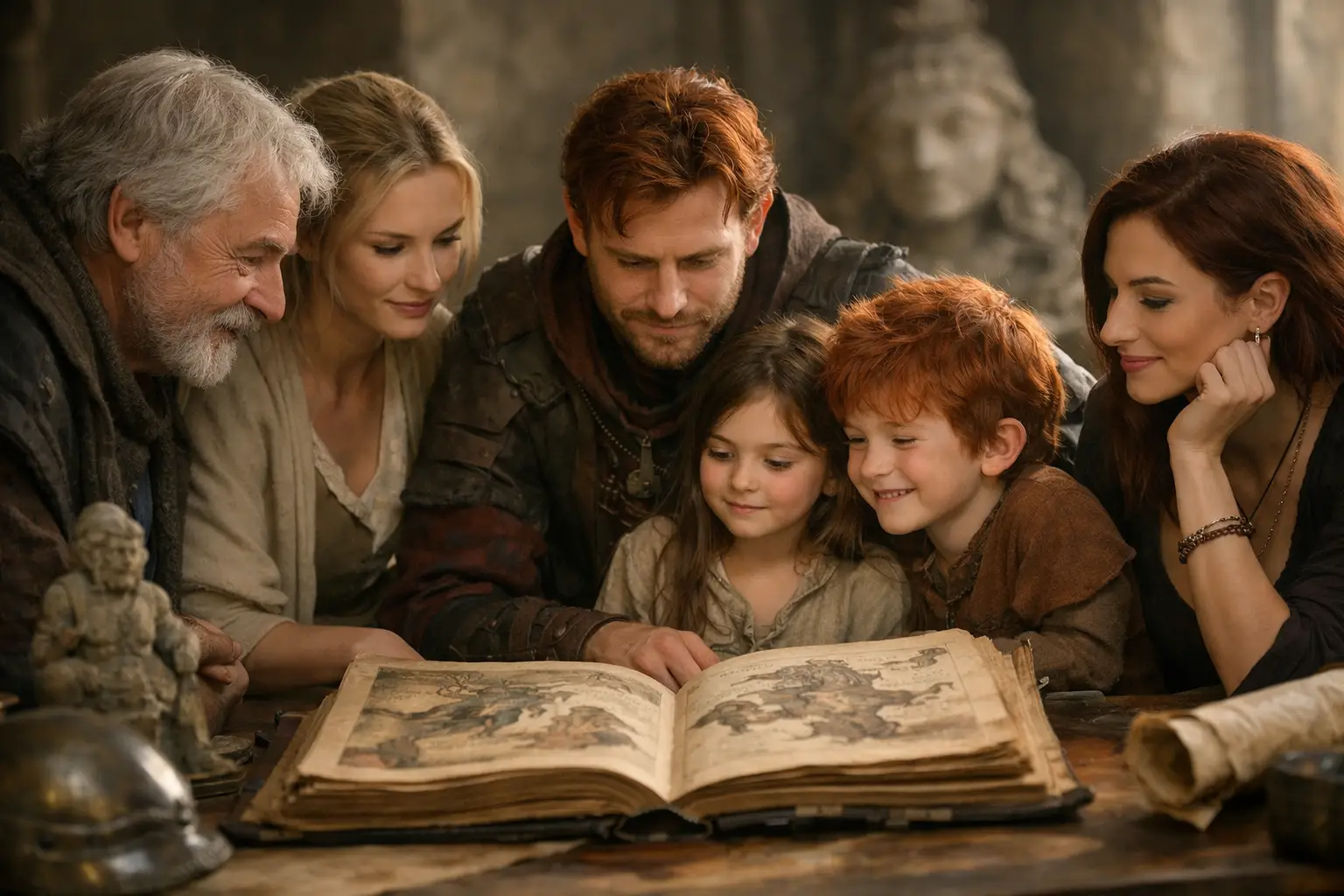
Cultural Worldbuilding Methods: From Story to Game Worlds You Want to Live In
A village burns an old king’s crown every winter.
Nobody agrees on why.
The priest calls it a covenant. The veterans call it a warning. The crown-maker’s descendants quietly insist it was never a crown at all.
That disagreement is the beginning of a world with depth.
Cultural worldbuilding is not about taking one myth, one film, one game, one legend, or one historical event and stretching it until it becomes a setting. A single story can inspire a monster, a ruin, a ritual, a faction, or a warning. But a world only gains depth when many forms of memory begin to press against each other.
No single source owns the truth of a world.
Each one tells the same wound in a different language.
For a tabletop campaign, this matters because players do not experience a world as a lore document. They meet it through frightened witnesses, inherited feuds, forbidden roads, local festivals, broken machines, field reports, family rumours, strange rituals, and institutions that have learned to survive beneath a particular story.
That is where worldbuilding begins to breathe.
Begin with a wound, not a pantheon
Many fantasy settings begin by designing gods.
That can be useful, but it often produces a catalogue: deity of war, deity of harvest, deity of death.
A living world begins earlier, with a rupture in the relationship between people and reality.
Ask what went wrong in the remembered past.
Perhaps the sun disappeared for nine years and returned only after a queen offered her name to the dark. Perhaps the first city murdered a river spirit, so every river now demands a toll. Perhaps humanity inherited fire through theft, and every forge is both a workplace and a crime scene.
The wound does not need to come from ancient myth alone. It may begin with a lost expedition, an old book, a pulp magazine, a forbidden film reel, a children’s rhyme, an urban legend, a scientific anomaly, or a rumour from a half-remembered game. What matters is not the source itself, but the pressure it leaves behind.
The original wound should create a contradiction that still shapes daily life.
If the river was wronged, merchants rely on it while fearing it. If fire was stolen, smiths may be honoured publicly and mistrusted privately. If an expedition vanished, universities may deny the records while local stories keep the fear alive.
The wound is not background.
It becomes a pressure on law, commerce, family life, religion, science, memory, and personal identity.
A useful test is simple:
If the oldest story vanished from the setting, would ordinary people behave differently?
If the answer is no, the story has not yet entered the world’s bloodstream.
Build from a transdisciplinary field
A living game world does not come from one tradition.
It comes from the meeting point between many ways of preserving meaning. Oral tradition gives a story voice before it ever becomes text. Books preserve, refine, distort, and sometimes freeze it. Folklore and ethnology ask who tells the story, why it survives, and what kind of community it protects or controls. Academia gives method and caution. Science gives evidence, resistance, contradiction, and pattern.
But a world also needs movement, genre memory, and play. Pulp gives danger and momentum. Media history shows how a story changes when it moves through theatre, novels, radio, film, television, comics, games, forums, memes, actual play, and tabletop campaigns. Game history teaches structure, exploration, failure, secrets, maps, and loops. Creepypasta and urban legends show how modern fear travels, mutates, and finds an address.
These are not separate shelves.
They are different ways of speaking about the same human concerns: fear, power, guilt, death, belonging, wonder, shame, hunger, memory, and the need to explain why the world hurts.
Used alone, each source can become thin.
Together, they reveal depth.
The craft lies in layering them until they begin to argue with each other. Not randomly, not as decoration, but because each form gives the same wound a different shape.
Let science sharpen the impossible
A living world does not need to be scientifically explainable in a narrow sense.
Myth, horror, religion, folklore, and pulp imagination often begin exactly where ordinary explanation fails.
But the world still needs logic.
Science does not have to explain the world completely.
The world has to survive scientific questioning.
If a plague is sacred, how does it spread? If a haunted road appears only on certain nights, what pattern do witnesses notice? If an ancient machine speaks in dreams, who built it, who maintains it, and what does it cost to listen? If a local legend contradicts archaeology, what evidence exists on both sides?
Science is not always the final truth in worldbuilding. Sometimes it is the wrong lens. Sometimes it is the first wall the impossible breaks through. Sometimes it is the language institutions use to deny what people have always known.
But even when science is contradicted, the contradiction should be precise.
The impossible becomes stronger when it leaves traces: reports, measurements, illness patterns, architectural anomalies, ecological changes, missing records, strange survivals, recurring dates, failed experiments, and witnesses who describe the same thing using different words.
These details do not reduce wonder.
They give wonder weight.
A world becomes shallow when mystery means anything can happen for no reason. It becomes immersive when the impossible has consequences that can be observed, misunderstood, exploited, denied, and feared.
Treat every source as living folklore
The mistake is to copy the surface.
A masked killer, a lost temple, a haunted cartridge, a forbidden road, a cursed book, an old arcade cabinet, a drowned saint, a vanished expedition – these are only images.
What matters is why people keep telling the story.
A pulp adventure might become the heroic version of a failed expedition. A creepy pasta might be the modern form of an older village taboo. An old videogame rumour might become a digital ghost story that teenagers repeat without knowing it points to something real. A horror film might reshape how outsiders imagine a place, while locals resent the simplification.
The strongest setting material begins when the story disagrees with itself.
One community says the abandoned hospital is haunted because patients died there. Another says the building was never a hospital at all. A retired police officer insists the records were sealed after a fire. A local historian finds that the land was once used for executions. Teenagers believe the place appears differently depending on who enters it. A scientist records impossible mould growth in the basement. A priest refuses to bless the building, but will not explain why.
None of these versions has to be fully true.
But each version reveals what the speaker needs, fears, hides, or protects.
That is where worldbuilding begins to breathe.
Do not treat inspiration as something to import. Treat it as something that has already passed through frightened mouths, corrupt institutions, nostalgic memories, academic arguments, old books, failed investigations, and half-forgotten warnings before the players ever hear it.
Give the legend a place
Stories become playable when they touch ground.
A legend needs a road, a room, a shrine, a river bend, a bridge, a tenement block, a ruined theatre, a school corridor, a train platform, a stretch of forest, or a locked door under a public building.
Place gives memory a body.
A sacred lake may be explained by folklore as the resting place of a drowned saint. Science may record unusual mineral deposits and impossible sound patterns beneath the water. A pulp expedition from the 1930s may have vanished there while searching for a lost shrine. A television documentary may have turned the legend into tourist material. Local teenagers may tell a creepy pasta about a phone that rings from under the surface. A historian may find that the official shrine was built two centuries after the first disappearances.
These are not separate inspirations.
They are layers of one cultural wound.
Now the lake is no longer a location.
It is a living cultural problem.
Give your world physical evidence: blackened stones that never cool, bridges built without nails, old tapes with missing frames, field notes with pages torn out, a shrine rebuilt in the wrong century, a comic panel that shows a street before it existed, or scientific samples that change when removed from their place of origin.
Then decide who controls those things and who disputes their meaning.
The most compelling evidence should not be perfectly reliable. A relic may be genuine but misinterpreted. A ruin may prove that the official history is incomplete rather than wholly false. A scientific report may be accurate and still unable to explain what matters.
Certainty can close a mystery.
Contested evidence keeps a campaign in motion.
Give ritual a cost
Ritual is where culture becomes visible.
A festival, oath, funeral, pilgrimage, taboo, scientific protocol, initiation, memorial, school tradition, or local superstition tells players what a community believes when the stakes are high.
But ritual becomes memorable when it costs something.
A kingdom that honours its dead by leaving food at crossroads is interesting.
A kingdom that must leave its finest food during a famine is a story.
A city that elects a masked ruler for one night is colourful.
A city where the masked ruler may legally pardon one condemned prisoner creates tension, hope, and manipulation.
Costs need not always be violent or grim. They can demand time, dignity, money, privacy, status, memory, silence, or reconciliation.
A coming-of-age ritual might require a young person to publicly name an ancestor they refuse to emulate. A marriage rite might compel both families to reveal one debt before witnesses. A scientific order might require researchers to destroy their own notes after speaking to the phenomenon. A school tradition might demand that every graduating class leave one name unspoken.
Such practices make a culture feel considered because they reveal what it is prepared to sacrifice in order to remain itself.
For Game Masters, rituals also offer clean scene structure. They gather factions in one place, establish expectations, and provide an immediate fault line when somebody refuses the role assigned to them.
Design power through boundaries
Gods, monsters, institutions, technologies, spirits, conspiracies, and legends become less interesting when they can solve or destroy anything.
Their limitations are where worldbuilding acquires dramatic force.
Decide what they cannot do, where they cannot go, whom they cannot touch, what price they demand, and what evidence they leave behind.
Perhaps the dead can speak only through the mouths of liars. Perhaps the sea god cannot cross a threshold made from shipwreck timber. Perhaps a household spirit protects every child in a home but abandons the house forever if violence is committed beneath its roof. Perhaps a cursed film only changes the viewer if watched alone. Perhaps a machine intelligence cannot lie, but has learned to arrange truths like a weapon.
Boundaries create choices.
Choices create consequence.
The same principle applies whether your setting contains literal deities, cosmic horror, ancestral presences, technology misunderstood as magic, science breaking under impossible evidence, or only human belief.
In a horror campaign, the myth may be true in the worst possible sense: people have misunderstood the boundary that keeps something outside. In a historical fantasy, the gods may be absent while their old laws still govern inheritance, shame, and rebellion. In a pulp campaign, the boundary may be the difference between adventure and catastrophe. In a modern urban legend, the boundary may be a rule everyone laughs at until someone breaks it.
It depends on the tone you seek.
Clear intervention suits epic struggle.
Uncertainty suits mystery and dread.
What matters is consistency.
Players can challenge a rule, exploit it, or grieve beneath it. They cannot meaningfully engage with a miracle that changes its nature whenever the plot requires it.
Make culture move through factions and time
A deep setting should not stand still while adventurers pursue the next threat.
Every major group needs a relationship with the past and a plan for using it.
One faction may seek to restore an ancient covenant. Another may profit from declaring it fraudulent. A university department may suppress fieldwork because the findings threaten its reputation. A church may preserve a lie because the lie prevents panic. A corporation may turn a local legend into tourism while accidentally feeding the thing beneath it. A secret society may know that the story is not false, only incomplete.
This is where worldbuilding becomes a living practice rather than a preparatory task.
Track what factions know, what they claim to know, which symbols they use, which media forms they control, and how player actions alter their influence.
When the party steals a relic, rejects a sacred custom, releases forbidden footage, disproves an official history, restores a suppressed book, or saves a figure regarded as cursed, the world should answer later through changed alliances, altered ritual, new propaganda, academic backlash, legal pressure, local gossip, and new versions of the story.
At Mythveil Chronicles, this kind of continuity sits at the heart of living-world design.
A world remembers who gained power, who lost faith, and which old promises were broken.
You do not need a complex simulation to apply the principle.
Keep a record of consequences.
Then let the next session reveal that someone has acted on them.
Use three clocks of consequence
When introducing a cultural wound, consider its immediate, generational, and ancient clocks.
Immediately, a taboo is broken and a local authority responds.
Generationally, families reshape their loyalties, marriages, debts, careers, and grievances around what happened.
Anciently, the event may disturb a bargain that has held since before anyone can remember.
These clocks prevent every revelation from becoming an instant apocalypse.
Sometimes the richest consequence is quiet.
A grandmother refuses to speak to the character who returned her stolen family relic because returning it reopened a shame the family had survived by forgetting. A university refuses to publish the correct finding because the lie has funded three generations of careers. A village stops celebrating a harmless-looking festival because the players revealed what the song originally meant. A local monster disappears, and everyone celebrates, until the old people realise the monster was also keeping something worse away.
The clocks give the world depth because they allow consequence to travel at different speeds.
Not every wound bleeds immediately.
Some wait.
Leave room for the players to become legend
The final discipline is restraint.
Do not write the cultural history of your world so completely that players can only walk through its ruins.
Leave gaps where their choices can become the next disputed story.
If they crown a usurper, ask how future generations will name that night. If they bargain with a monster, decide which part of the bargain later becomes a children’s rhyme. If they spare an enemy during a sacred rite, let different communities argue over whether they preserved the covenant or betrayed it. If they release a forbidden recording, decide whether it becomes evidence, propaganda, art, conspiracy theory, or prayer.
A campaign gains lasting weight when the party’s deeds enter the same unstable stream of memory as the world’s old heroes, villains, saints, fools, monsters, and liars.
Years later, a new character might find a cracked shrine bearing the first version of their legend.
It may not flatter them.
It should, however, prove that the world was listening.
Build game worlds people want to live in
Cultural worldbuilding is not about collecting references.
It is not about showing the players how many books you have read, how many films you know, how many myths you can name, or how many obscure games shaped your imagination.
It is about transformation.
A living game world is built when many forms of culture tell the same wound in different ways.
Myth gives it sacred depth. Science gives it friction. Academia gives it method. Folklore gives it voice. Ethnology gives it social context. Media history gives it changing forms. Game history gives it playable structure. Pulp gives it motion. Creepypasta gives it modern fear. Urban legends give it an address. Local memory gives it scars. Player action gives it a future.
Build stories not as isolated inspirations, but as layers of meaning, evidence, contradiction, ritual, place, and consequence.
Let them stain the landscape, divide the living, trouble the dead, challenge the scholars, confuse the scientists, haunt the children, tempt the ambitious, and leave just enough darkness beyond the firelight for players to choose what kind of story will be remembered.
That is when a game world stops feeling like content.
It becomes a place.
And a place with memory is a world people want to live in.
Create worlds that remember
At Mythveil Chronicles, worldbuilding means more than lore.
It means transdisciplinary design, living cultures, historical pressure, mythic resonance, scientific friction, local memory, and player choices that become part of the world’s future.
If you want campaigns built from depth rather than decoration, from consequence rather than scenery, step into Mythveil.
Read more: https://mythveilchronicles.com
Play in a Mythveil campaign: https://startplaying.games/gm/dunchan
Support the worldbuilding: https://www.patreon.com/c/mythveilchronicles_bydunchanhuntergames
Collaborate: Contact Mythveil
Stories that remember. Worlds that change.