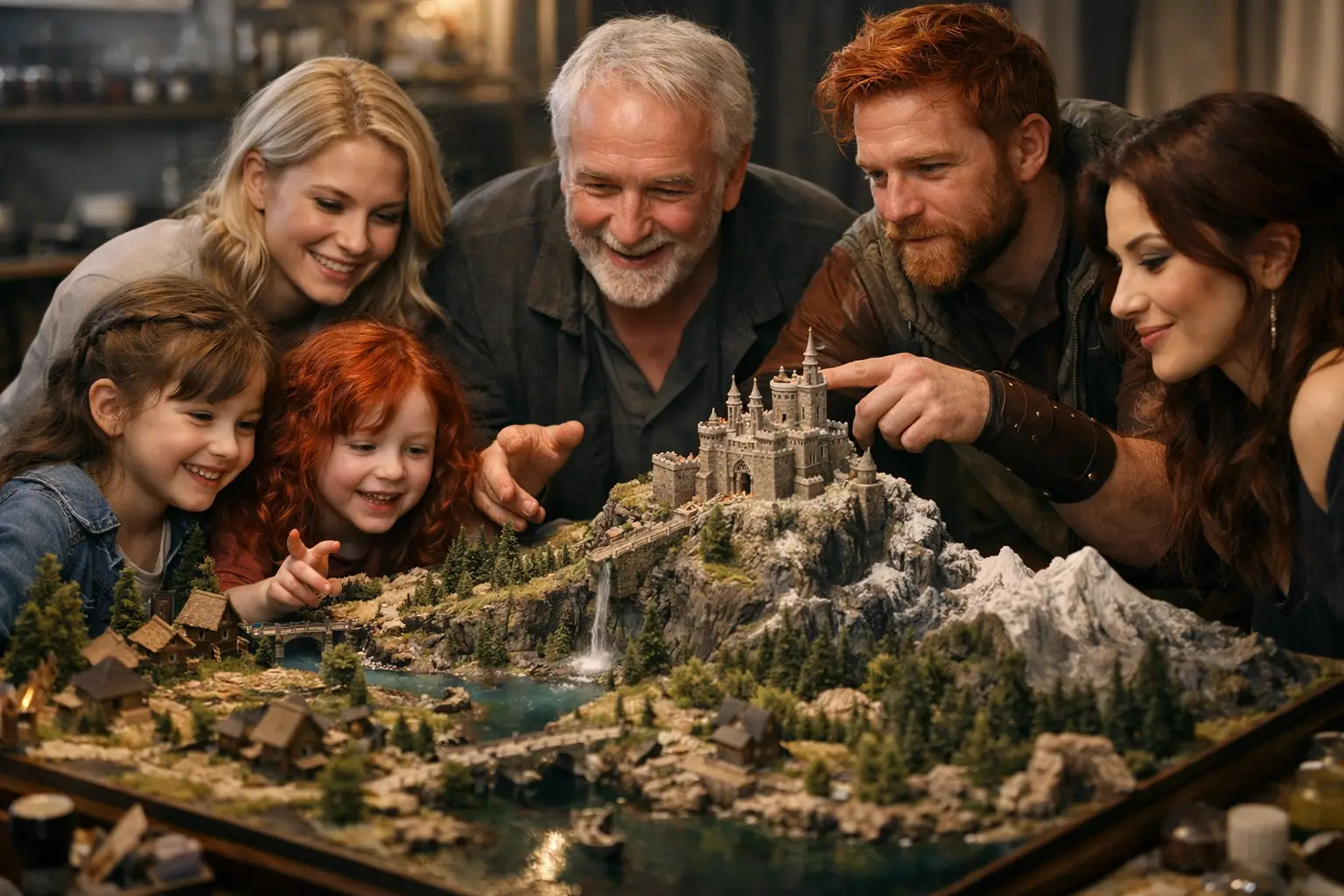
Custom Tabletop Worldbuilding Service: Worlds That Remember
The city remembers who burned the archive.
Not because the Game Master wrote a dramatic reveal for session twelve, but because six months later the missing census records still distort trade, succession, and suspicion in the district where your party once thought they were solving a smaller problem.
That is the promise behind a custom tabletop worldbuilding service.
It does not simply provide lore on demand. It creates a world with memory, pressure, and consequence – a setting that continues to move even when the players have left the room.
For many groups, that difference is the line between a pleasant campaign and one that lingers for years. Plenty of games offer adventures. Fewer offer a world that feels as though it was waiting for you before your characters arrived, and will go on bearing the marks of your choices long after a single arc has ended.
Why a custom tabletop worldbuilding service matters
A setting can be beautifully written and still feel dead at the table.
This is one of the quiet frustrations of modern roleplaying. There is no shortage of maps, lore packets, and campaign guides, yet many of them function as decoration rather than dramatic structure.
They tell you what a kingdom is called, but not what that kingdom fears.
They describe a religion’s symbols, but not how grief, debt, famine, or power shape belief in daily life.
A custom tabletop worldbuilding service approaches the problem differently. Instead of starting with static background, it begins with dramatic function.
What pressures define this world? Which institutions hold power? Where do myths contradict official history? What would change if the players interfered?
When those questions are answered well, the setting stops behaving like a painted backdrop.
It becomes a machine for story.
That matters especially for groups who want more than disposable entertainment. Horror campaigns need social texture to make dread feel plausible. Political campaigns need faction logic or every alliance feels arbitrary. Mystery games need hidden histories that reward investigation rather than collapsing under scrutiny.
Even intimate character stories need a world capable of pushing back.
What you are really buying
People often hear the phrase and imagine a commissioned gazetteer, a handful of place names, perhaps a pantheon and a regional map.
Those can be part of the work, but they are not the heart of it.
What you are really buying is coherence under pressure.
A strong service builds the invisible architecture beneath the visible fiction. It asks how economies function, how rumours travel, how institutions preserve power, how old conflicts continue to shape new ones, and how player action can alter all of that without breaking the world.
In practical terms, this means the setting can absorb improvisation. It can withstand curiosity. It can surprise even the person running it.
This is also where quality varies sharply.
Some services excel at producing evocative lore but struggle when play begins. Others focus so heavily on utility that the world feels sterile. The best work holds both truths at once.
It is playable and atmospheric, disciplined and strange, structured enough to support long campaigns while leaving room for discovery.
The difference between generic lore and living-world design
Generic lore answers questions because a setting document is expected to answer them.
Living-world design answers them because players will eventually test them.
That distinction changes everything.
If a city guard exists only to fill a paragraph, they remain flavour text. If they exist as a social force with loyalties, shortages, rivalries, and political limits, they become story material.
If a cult is merely mysterious, it is decoration. If it recruits from specific wounds in society and competes with other systems of meaning, it becomes dramatically real.
This is where bespoke design earns its value.
A custom world can be shaped around the themes your group actually wants to explore – memory, corruption, faith, colonial aftermath, industrial dread, dynastic decline, cosmic insignificance, or the cost of survival.
Rather than forcing your campaign into a prefabricated setting, the setting is built to generate the kind of pressure your campaign needs.
For some groups, that means a slow-burn Gothic county where every family archive conceals a crime. For others, it means a frontier colony balancing trade, belief, and violence across contested land.
In a science-fiction horror frame, it may mean sealed bureaucracies, inherited doctrine, and station politics fraying under stress.
The point is not novelty for its own sake.
The point is precision.
How a custom tabletop worldbuilding service supports long campaigns
Long-form play exposes every weakness in a setting.
Improvised names become forgotten noise. Contradictions pile up. Important factions drift. Early player choices lose relevance because nothing in the world was built to remember them.
A serious custom tabletop worldbuilding service is designed to resist that collapse.
It creates continuity systems, recurring pressure points, and meaningful consequences that can be tracked over time. Factions change their behaviour. Locations evolve. Information spreads unevenly. Old events become legends, lies, propaganda, or trauma depending on who is retelling them.
This is especially valuable for campaign runners who want emotional continuity rather than episodic reset.
If a character spares a rival, that rival should not vanish into the fog of convenience. If a district is destabilised, someone should profit from it. If a sacred site is desecrated, belief should react.
The world should remember.
That memory is what gives campaigns weight. It tells players that their choices matter not because the story says they do, but because the world behaves as though they do.
Who benefits most from bespoke worldbuilding
Not every table needs this level of design.
A short campaign, a pulpy romp, or a beginner-friendly one-shot may be better served by speed and simplicity. There is no virtue in overbuilding for a game that only needs momentum.
But for narrative-heavy groups