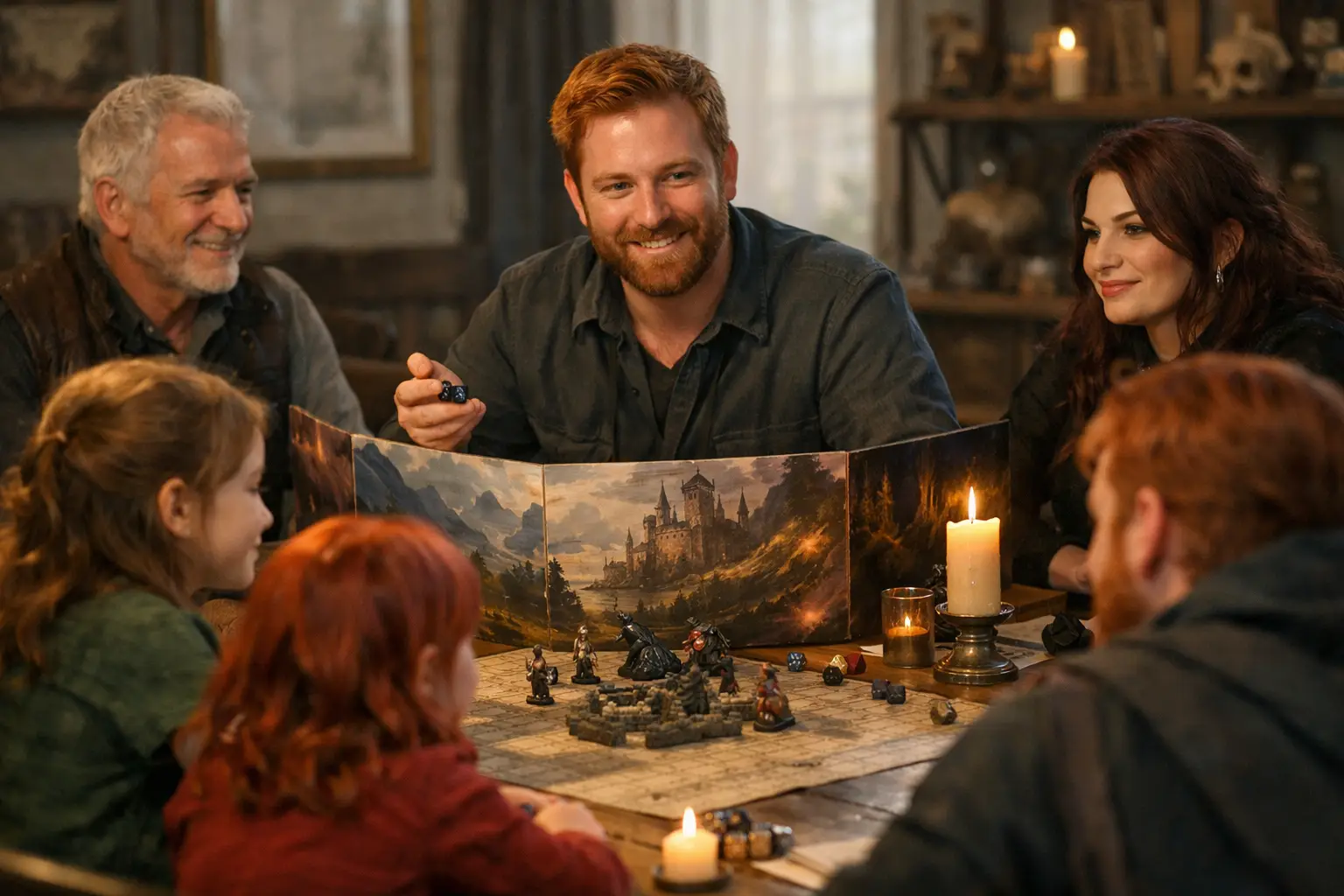
How to Find a Professional Dungeon Master: Choosing the Right Guide for Your Story
A campaign can live or die before the first session. Not because the setting lacked promise or the rules were wrong for the table, but because the person behind the screen could not carry the weight of tone, trust, pacing, and consequence.
If you are wondering how to find a professional Dungeon Master, you are not merely shopping for someone to read boxed text and track initiative. You are looking for a guide, a host, a designer of pressure and possibility, and in the best cases, a steward of stories that will stay with your group long after the dice stop rolling.
That changes the search.
What a professional Dungeon Master actually does
A professional Dungeon Master is not defined by charging money alone. Payment is only the outer sign that a service is being offered with structure, preparation, reliability, and intention. The real difference lies in craft.
A strong professional DM prepares with care, communicates clearly, manages group dynamics, understands tone, and adapts play to the people at the table. They know when to push, when to pause, and when to let silence do the work. They are part facilitator, part storyteller, part referee, and part emotional architect.
The very best become world architects.
Their preparation rarely comes from a single source. History, mythology, science, archaeology, psychology, folklore, urban legends, horror literature, pulp adventure, game history, internet folklore, and decades of tabletop experience all become tools. None of these disciplines exists in isolation. Each explains the world from a different perspective, and together they create campaigns that feel coherent, surprising, and alive.
Some focus on light, social play. Others build mystery, political intrigue, cosmic horror, or long-form character drama. Some run polished adventures with efficient consistency. Others create living worlds where factions move between sessions and player choices leave marks that do not vanish at the end of the night.
Neither approach is automatically superior.
What matters is whether the DM’s philosophy matches what your group is truly seeking.
How to find a professional Dungeon Master who fits your table
The most common mistake is to begin with price.
Cost matters, of course, but fit matters first.
A cheaper DM who cannot hold your group’s attention or support your preferred style will cost more in frustration than a premium one who understands exactly what kind of experience you want.
Start by defining the campaign you are actually trying to buy.
Is your group looking for a casual weekly escape, a horror story with emotional bite, a beginner-friendly introduction, or a long-running world with consequences that build over months? Do you want tactical challenge, dramatic character arcs, investigative tension, or something closer to interactive theatre?
If your answers are vague, your search will be vague too.
Once you know what you want, examine how a DM presents their work. A professional should be able to explain their style in plain language. You should be able to tell whether they specialise in published adventures, original settings, tactical combat, investigation, horror, political intrigue, or narrative immersion.
If everything sounds generic, that is usually a warning sign.
The best Dungeon Masters do not try to be everything for everyone.
They know exactly what they do well.
Look closely at consistency. Do they describe a clear onboarding process? Do they mention Session Zero, expectations, scheduling, communication, and player comfort?
A memorable campaign begins long before initiative is rolled.
Where to look for a professional Dungeon Master
There are several sensible places to search, but each comes with trade-offs.
Dedicated professional GM platforms make pricing, availability, and supported game systems easy to compare. They are often the fastest route to finding a table. The downside is that marketplace profiles can reduce years of experience to a few paragraphs of marketing copy.
Community recommendations often tell a richer story. Discord servers, RPG communities, conventions, and long-term player referrals reveal something advertisements rarely can: whether players actually stayed.
You can also learn a great deal from a DM’s own work.
Articles.
Campaign descriptions.
Setting guides.
Videos.
Research notes.
If someone claims to run atmospheric horror, their writing should create atmosphere. If they promise historical depth, look for more than dates and costumes. Look for institutions, culture, economics, social pressure, folklore, and consequence.
If they speak about living worlds, ask yourself one simple question:
Does this feel like someone who studies worlds—or someone who only prepares encounters?
The difference becomes obvious surprisingly quickly.
Questions worth asking before you book
The right questions reveal more than ratings ever will.
Ask what kind of players the DM enjoys running for.
Ask how they resolve conflicting expectations.
Ask what preparation happens between sessions.
Ask what changes in the world while the players are absent.
That last question often separates memorable campaigns from disposable ones.
In many adventures, the world waits patiently for the heroes.
In stronger campaigns, kingdoms continue governing, factions continue scheming, rumours continue spreading, and enemies continue preparing whether the players are watching or not.
If you care about immersion, ask how the DM builds atmosphere.
If you care about character drama, ask how they encourage personal stories without forcing them.
If your group includes beginners, ask how they teach rules without interrupting the flow of play.
If you hope to play for months—or even years—ask how they keep a campaign coherent over time.
Practical questions matter too.
How are cancellations handled?
What happens when someone misses a session?
How long are sessions?
Which platform is used?
Professionalism is visible not only in storytelling but also in organisation.
Green flags and red flags
The clearest green flag is thoughtful specificity.
A professional DM should be able to explain the experience they create, the players it suits, and the boundaries of what they offer.
Honesty builds trust.
Another green flag is intellectual curiosity.
The strongest Game Masters rarely draw inspiration from a single place. They combine history with mythology, science with folklore, archaeology with horror, game design with literature, and even modern urban legends or internet folklore when those perspectives strengthen the world.
Great campaigns often emerge where disciplines meet.
Red flags usually appear in smaller details.
Poor communication.
Vague promises.
An inability to explain expectations.
Dismissing player comfort.
Claiming mastery of every genre equally.
Or focusing entirely on performance while ignoring consequence.
Beautiful maps.
Excellent voices.
Dramatic monologues.
All of these are wonderful.
None of them matters if the world forgets everything the players have done.
Price, value, and what you are really paying for
Professional GM rates vary because the work varies.
A beginner-friendly one-shot is not the same service as a deeply researched campaign with custom maps, original material, persistent world state, and development between sessions.
When judging value, consider preparation time, reliability, creative depth, adaptability, research, technical expertise, and emotional labour.
You are not paying only for four hours around a virtual table.
You are paying for memory.
Consistency.
Preparation.
Atmosphere.
Structure.
Improvisation.
And the ability to transform player decisions into lasting consequences.
That said, higher prices do not automatically guarantee better experiences.
Some Dungeon Masters invest heavily in presentation.
Others invest heavily in substance.
The best combine both.
The best fit is rarely the most generic one
If your group simply wants a pleasant evening rolling dice, many competent Dungeon Masters can provide exactly that.
But if you are searching for something deeper—a campaign where history matters, mysteries reward curiosity, consequences reshape the world, and every decision echoes beyond a single session—then your standards should rise accordingly.
The right professional Dungeon Master does more than entertain.
They create trust.
They encourage imagination.
They challenge assumptions.
They help strangers become companions.
And they build worlds that continue living even after everyone has logged off.
Studios such as Mythveil Chronicles are built around exactly that philosophy: combining history, science, mythology, folklore, horror, pulp adventure, game history, urban legends, and modern storytelling into living worlds where every choice leaves a mark.
That is not the only valid way to run tabletop roleplaying.
But for many players, it is the difference between playing through an adventure and remembering a campaign for years afterward.
Take your time.
Read carefully.
Ask thoughtful questions.
Pay attention to how a Dungeon Master thinks—not only how they advertise.
The right campaign does not begin when initiative is rolled.
It begins when you choose the person worthy of opening the first door.
—
🜍 Continue Your Journey
Every Mythveil story is part of a larger world.
Choose where your journey leads next.
📖 Read
Research, essays, and living worlds.
🎲 Play
Join professionally hosted tabletop RPG campaigns.
https://startplaying.games/gm/dunchan
🎥 Watch
Videos, behind-the-scenes content, and new adventures.
https://www.youtube.com/channel/UCH5WU7p7PFrPz0egOONUwqA
💛 Support
Help independent research and worldbuilding continue to grow.
Patreon
https://www.patreon.com/c/mythveilchronicles_bydunchanhuntergames
Ko-fi
https://ko-fi.com/mythveilchronicles
—
🤝 Collaborate
Interested in workshops, consulting, conventions, publishing, education, or creative partnerships?
https://www.linkedin.com/in/francisco-jos%C3%A9-z-b05aab371/