
English · Deutsch · Italiano · Español
The Long Winter · Week 3 — What Sleeps Beneath the Ice
Stacy & Caelwyn
On an Imperial ice world, a scientific survey reveals the outline of a city deep beneath a glacier. No surviving Imperial map records it. The ice has hidden something for centuries, perhaps millennia. But preserving a secret and keeping it safe are not the same thing.
THE CITY THAT SHOULDN’T BE THERE
CAELWYN:
“Stacy, tell me that’s a mountain.”
STACY:
“It isn’t a mountain.”
“An unusually geometric rock formation?”
“Look at the survey.”
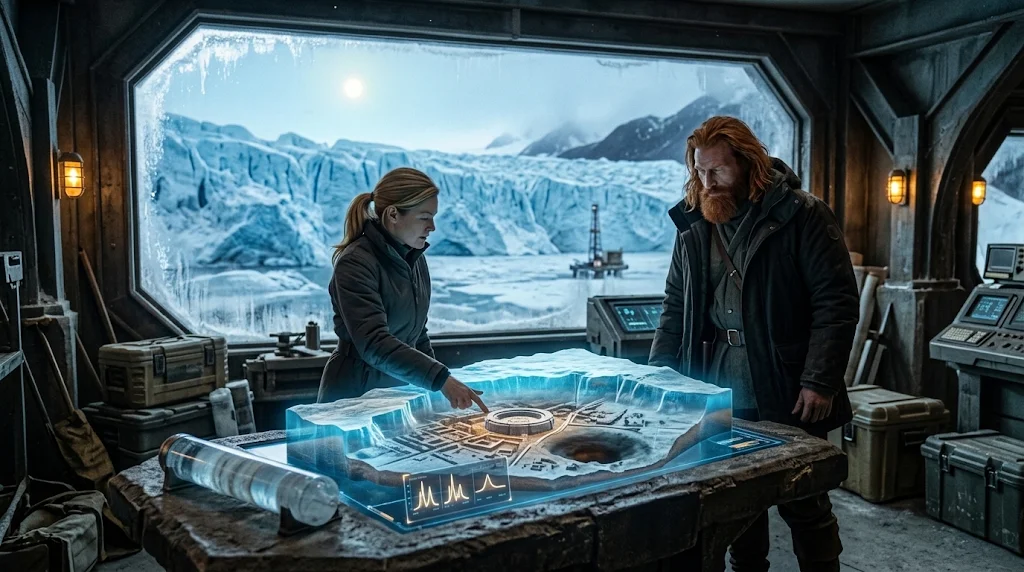
Inside a cold Imperial research station, a holographic cross-section of the glacier glows above the table. Beneath immense layers of blue ice lies a pattern of straight passages, circular chambers and structures resembling towers.
CAELWYN:
“That’s a city.”
STACY:
“It’s an artificial-looking structure. We haven’t confirmed its age, origin or function.”
“Which is your scientific way of saying it’s a city.”
“It’s my scientific way of not announcing a discovery before we understand it.”
Caelwyn studies the illuminated streets.
CAELWYN:
“There’s nothing about it in the Imperial archives?”
STACY:
“Nothing in the records available to this station.”
“Then perhaps somebody erased it.”
“Or the records were lost. Or the settlement predates the records. Or it was never entered into them.”
He smiles.
CAELWYN:
“You do make conspiracies work rather hard for their supper.”
STACY:
“They should bring evidence.”
THE ICE REMEMBERS
CAELWYN:
“Then how long has it been down there?”
STACY:
“We don’t know yet. But the ice may help us establish a chronology.”
She lifts a transparent cylinder from a refrigerated container.
CAELWYN:
“An ice core.”
STACY:
“Layers of snow compressed into ice can preserve traces of past environments: dust, gases, chemical signals and material deposited by volcanic eruptions.”
“So the glacier is an archive.”
“An imperfect one. Ice moves, layers deform and melt events can disturb the record. But careful analysis may tell us when the city was buried.”
Caelwyn turns the cylinder in his gloved hands.
CAELWYN:
“An entire history written in snow.”
STACY:
“Written, compressed and sometimes torn apart.”
“And no librarian to complain.”
“Plenty of scientists will complain if you handle that core without gloves.”
He looks at his hands.
CAELWYN:
“I am wearing gloves.”
STACY:
“Then we may yet remain friends.”
THE ICE ALSO DESTROYS
CAELWYN:
“Cold preserves things, doesn’t it? Perhaps the city is almost untouched.”
STACY:
“Sometimes low temperatures slow chemical and biological processes. But a glacier is not a museum display case.”
She highlights fractures in the buried structures.
STACY:
“Moving ice exerts pressure, transports debris and can crush buildings. Freezing and thawing can damage stone. Water can enter cracks, expand and break material apart.”
CAELWYN:
“So the ice is both guardian and executioner.”
STACY:
“That’s rather dramatic.”
“Accurate, though?”
“Close enough.”
He examines the central chamber.
CAELWYN:
“And the fact that some walls still seem intact?”
STACY:
“Interesting. It could reflect the building materials, the local conditions, protective engineering or errors in our interpretation of the scan.”
“Or something is maintaining the place.”
STACY:
“A hypothesis. Not a conclusion.”
WHAT HUMANITY FORGOT
CAELWYN:
“In the forty-first millennium, an unrecorded city could belong to almost anyone.”
STACY:
“Exactly.”
“An abandoned human colony. A relic from a forgotten age of technology. Perhaps a structure left by a civilisation older than Imperial settlement.”
“Or something entirely different.”
Caelwyn studies a circular feature at the city’s centre.
CAELWYN:
“People will immediately say Necrons.”
STACY:
“Because Necron tomb complexes are a real danger in this universe. But not every ancient ruin is a Necron tomb.”
“And the Adeptus Mechanicus would be rather interested in a lost machine.”
STACY:
“Possibly dangerously interested. But we still need to identify what we’re looking at.”
“Imperial records have gaps. Human history has gaps.”
“And the absence of a record isn’t proof that someone deliberately concealed it.”
Caelwyn folds his arms.
CAELWYN:
“Then our first discovery may be how little we know.”
STACY:
“That’s often where good research begins.”
TWO KINDS OF SLEEP
The hologram shifts towards a sealed chamber beneath the city’s central structure.
CAELWYN:
“Suppose something is still inside.”
STACY:
“An object, a machine or a living organism?”
“Any of those.”
“Then we must distinguish preservation from survival.”
She brings up images of frozen biological material.
STACY:
“Cold can preserve some tissues under suitable conditions. But ordinary freezing damages many cells. A frozen organism isn’t automatically alive, and a preserved body isn’t necessarily capable of waking.”
CAELWYN:
“Unless it has technology we don’t understand.”
STACY:
“Advanced stasis systems are another matter. Warhammer contains technologies and beings that can remain dormant for extraordinary periods.”
“Then we have two kinds of sleep.”
STACY:
“Go on.”
“The sleep of something dead that the ice remembers, and the sleep of something waiting to wake.”
Stacy looks towards the chamber.
STACY:
“That’s a useful distinction. But our instruments haven’t told us which one we’re dealing with.”
WHO HAS THE RIGHT TO OPEN IT?
CAELWYN:
“Let’s imagine the excavation team can reach the city.”
STACY:
“Then the difficult decisions begin.”
“Surely knowledge belongs to everyone.”
“Knowledge may benefit everyone. Excavation can also put people at risk.”
She indicates the settlement above the glacier.
STACY:
“Opening a sealed chamber could destabilise ice, release hazardous material, disturb an archaeological site or activate something we don’t understand.”
CAELWYN:
“And the Imperium would probably declare the discovery its property.”
STACY:
“Different Imperial authorities might make competing claims. That doesn’t answer what is safe or just.”
“What about the families living above it?”
“They deserve to know if the investigation threatens their homes.”
“Even if an Inquisitor disagrees?”
Stacy gives him a long look.
STACY:
“We’re discussing what ought to happen, not predicting what Imperial bureaucracy will permit.”
CAELWYN:
“Ah. An important distinction in the Imperium.”
“Very.”
He watches the buried streets.
CAELWYN:
“Then perhaps the first duty of an explorer is not to open the door.”
STACY:
“It’s to understand what opening it could do.”
THE SOUND FROM BELOW
The research station’s seismic monitor flickers.
CAELWYN:
“Was that an earthquake?”
STACY:
“Wait.”
Three sharp pulses appear on the display.
A pause.
A fourth.
CAELWYN:
“That’s a rather deliberate rhythm.”
STACY:
“Rhythm alone doesn’t establish intention. Ice fractures, machinery vibrates and instruments can register repeating patterns.”
“Could it come from the city?”
“Possibly. We need more sensors and independent measurements.”
The monitor settles.
Then a second instrument, connected to a distant station, registers the same sequence.
CAELWYN:
“Three. A pause. One.”
STACY:
“We still don’t know what caused it.”
He looks down at the buried central chamber.
CAELWYN:
“Then we shouldn’t call it a message.”
STACY:
“Not yet.”
A long silence follows.
CAELWYN:
“But we should listen.”
STACY:
“Very carefully.”
THE QUESTION WE LEAVE OPEN
Ice can preserve traces of the past, conceal extraordinary discoveries and destroy the very things it seems to protect. In Warhammer 40,000, a forgotten city might offer knowledge, danger or both.
CAELWYN:
“If you found a world beneath your world, would you open it?”
STACY:
“And before you did, would you ask who might have to live with the consequences?”
Beneath the glacier, the ancient streets remain dark.
The instruments continue recording.
And somewhere below, a fourth pulse has just answered the first three.
PLAY EPIC. FEEL THE STORY.
Every discovery changes the choices available to you. Some secrets can save a world; others can endanger everyone who lives on it.
In Black Tide: Shadow of Leviathan, knowledge, duty and consequences matter as much as courage. The world remembers what you uncover—and what you choose to do with it.
Explore Black Tide on Mythveil Chronicles · Join the campaign on StartPlaying
Real TTRPG. Real story. Real choices. Real consequences.