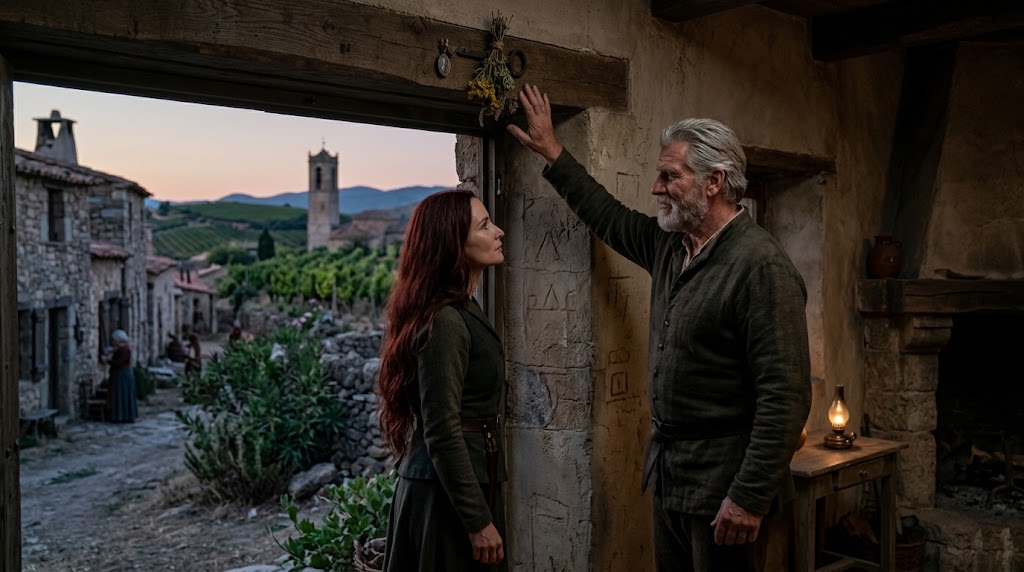
Andaluria: Blood & Desire · October · Week 1 — The Rules We Remember
SEAN:
“Don’t touch that.”
ELJARA:
“It’s a dried plant above a door.”
SEAN:
“Exactly.”
ELJARA:
“That explains nothing.”
SEAN:
“It tells you somebody wanted it there.”
Sometimes people do not merely remember a warning.
They build it into the house.
Across the Iberian Peninsula, old protective practices can still be found in doors, roofs, chimneys, churches and household objects.
In Basque tradition, the eguzkilore could hang above a doorway, associated with protecting the household from witches or other nocturnal dangers.
In the Pyrenees, some traditional chimneys carry forms popularly known as espantabrujas — “witch scarers.”
Elsewhere, communities built esconjuraderos or comunidors, places from which threatening storms and hail could be confronted through religious ritual.
Different regions. Different histories. Different beliefs.
But the same fascinating idea:
Protection can become architecture.
ELJARA:
“Which means the building remembers even when the people don’t.”
SEAN:
“Until somebody renovates it.”
ELJARA:
“There it is.”
And the Mediterranean gives us other traditions of protection.
Within Islamic societies, Qur’anic recitation, duʿāʾ and forms of ruqya have been used to seek protection and healing through God. Amulets, written texts and talismanic practices also existed, although Muslim scholars and communities disagreed — and still disagree — about where legitimate devotion ends and forbidden magic begins.
So an object hanging in a house may be many things at once.
Faith.
Protection.
Family memory.
Identity.
Habit.
Or simply the thing your grandmother told you never to throw away.
SEAN:
“Andaluria makes this easier.”
ELJARA:
“Hardly.”
SEAN:
“The question, I mean.”
Because in Andaluria the monsters are real.
And if supernatural dangers have been real for centuries, ordinary people would adapt.
If something cannot cross a particular threshold, people will change their doors.
If bells drive something away, bell towers become defences.
If a burial performed incorrectly can bring danger home, knowing how to bury someone becomes more than ceremony.
If an old mark protects a house, eventually the mason needs to know how to make it.
Perhaps the first generation remembers the monster.
The second remembers the protection.
The third turns it into tradition.
The fourth calls it decoration.
The fifth removes it.
Nothing happens.
The monster has been gone for two hundred years.
Then one night it comes back.
And suddenly the important question is not:
“Who can kill it?”
It is:
“Does anyone remember how the door used to be made?”
ELJARA:
“Your grandmother would.”
SEAN:
“She usually did.”
Some protections may be superstition.
Some may be faith.
Some may be memories whose explanations disappeared generations ago.
But in a world where monsters genuinely exist, the strangest object in an old house may not be decoration at all.
Perhaps Grandmother could not explain why it belonged above the door.
She just knew exactly where to put it.
WORLDS THAT REMEMBER
At Mythveil Chronicles, history does not wait for the adventurers to arrive. People adapt. Communities remember. Traditions change, knowledge disappears, and consequences can sleep far longer than anyone expects.
Your characters inherit that world.
What they preserve — and what they tear down — becomes part of what happens next.
Real TTRPG. Real story. Real choices. Real consequences.
A living world that moves on — with or without you.