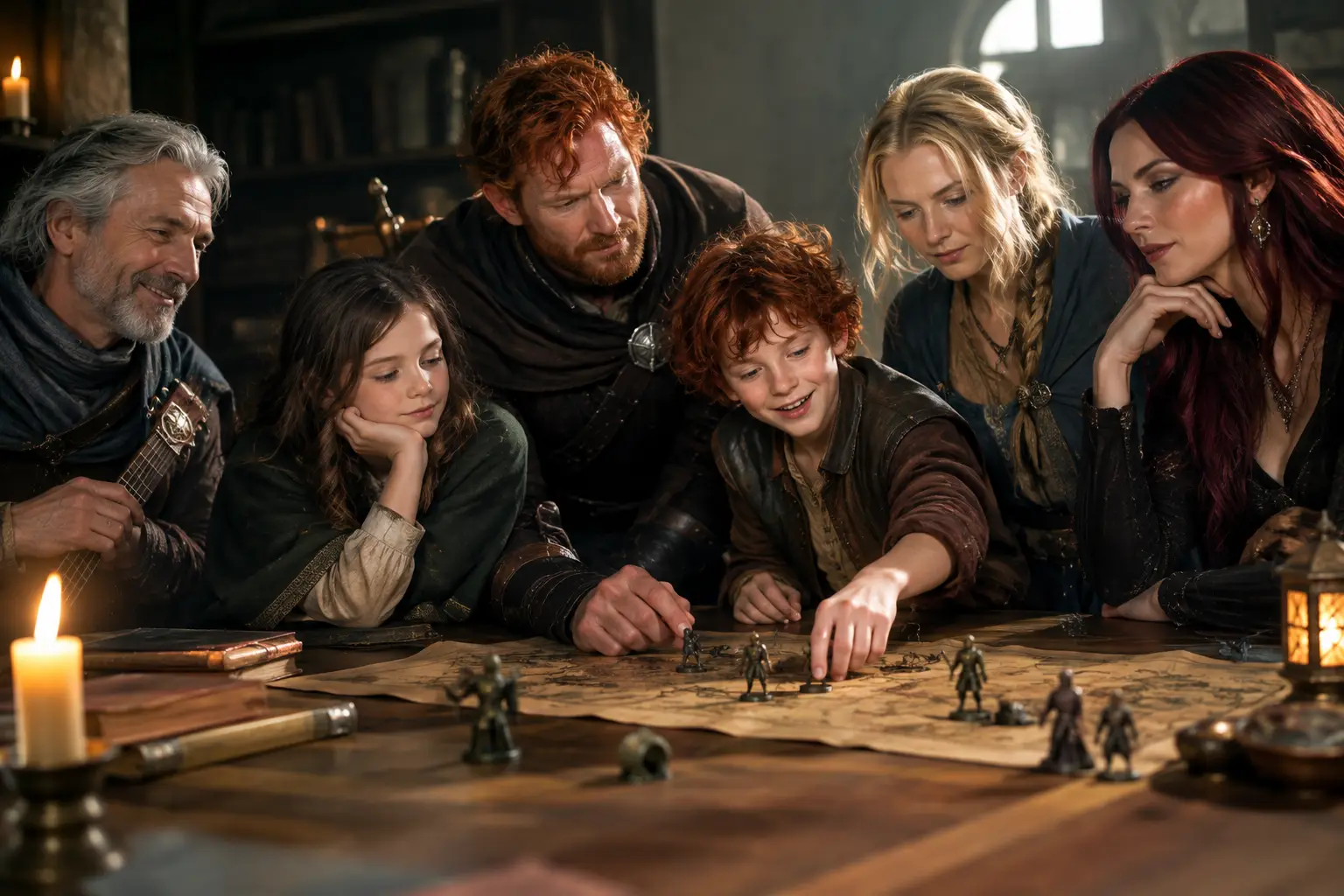
A Guide to Campaign Consequence Mapping for GMs
A city gate closes at dusk.
The party is still outside, carrying proof that the magistrate has been selling prisoners to a cult. They chose to expose him publicly rather than quietly buy his silence.
That choice should not vanish when the next session begins.
A guide to campaign consequence mapping begins here: with the deliberate work of deciding what the world remembers, who benefits, who is wounded, what shifts beneath the surface, and what new doors open in the dark.
Consequence mapping is not a method for punishing players or forcing a plot back onto its rails.
It is a way of protecting the meaning of their agency.
In a living campaign, actions travel.
A promise reaches the ears of a rival.
A stolen relic alters a village’s faith.
A spared enemy becomes a witness, an ally, or the architect of a later grief.
A public accusation changes who dares to speak.
A dead official leaves behind a chair that several people have been waiting years to occupy.
The world does not need to react loudly to every decision.
But it should react truthfully.
At Mythveil, that process begins before the players make the choice.
The world was already moving.
What campaign consequence mapping actually does
At its simplest, campaign consequence mapping connects a player action to visible and invisible changes in the campaign world.
It asks not merely:
What happens next?
but:
What has changed because this happened?
The distinction matters.
Plot tends to look forward in a straight line.
Consequence looks outward.
Through people.
Institutions.
Places.
Resources.
Relationships.
Memory.
Time.
This is especially valuable in horror, political intrigue, investigative play, and long-form character drama.
In a Call of Cthulhu campaign, destroying evidence might preserve public order while leaving a dangerous truth unchallenged.
In Warhammer Fantasy Roleplay, saving a district from plague may earn gratitude from its residents and suspicion from a noble family that profited from the panic.
In Delta Green, a successful operation can still damage trust, careers, families, and sleep.
The aim is not complexity for its own sake.
A campaign becomes unreadable if every purchase, insult, missed clue, and badly chosen sandwich creates six new political movements.
Map consequences where emotional weight, faction pressure, moral uncertainty, influence, or future story potential already exists.
Let ordinary moments remain ordinary.
Let pivotal moments cast a longer shadow.
But before you can map consequences well, you need to know what the action is landing in.
You need a world with structure.
Build the influence map before you map consequences
A player action cannot change a living world if the world has no idea where its power lives.
This is why Mythveil begins with research and Influence before consequence mapping.
Research tells us what kind of world exists.
Influence tells us where people in that world can actually make things happen.
Do not begin by inventing five colourful factions because the campaign appears to need five colourful factions.
Begin with the setting.
Who controls law?
Who controls money?
Who can move people?
Who controls violence?
Who controls information?
Who decides what is respectable?
Who controls access to food, transport, medicine, faith, education, property, crime, magic, or the supernatural?
Who appears to be powerful?
Who is powerful without appearing to be?
Which institutions depend on one another while quietly despising each other?
Which old conflicts still shape present decisions?
Which groups have resources but no legitimacy?
Which have legitimacy but very little ability to act?
The answers create the Influence Domains of that particular setting.
Those domains should change from world to world.
A modern city might care about Politics, Law, Finance, Media, Police, Organised Crime, Religion, Healthcare, Technology and Transport.
A fantasy province might care about Nobility, Guilds, Temple, Military, Trade, Underworld, Arcana and Rural Communities.
A Vampire chronicle may need Court, Clan, Domain, Mortal Institutions, Media, Crime, Finance, Occult Networks and perhaps the quieter power of Harpies, Boons and reputation.
The labels are not sacred.
The question is:
Where can power actually be exercised here?
Research gives the world a past.
Influence reveals where power lives in its present.
Influence is not just a number
You can track Influence numerically.
Sometimes that is useful.
Politics 4.
Crime 6.
Media 2.
Lovely.
Now what?
The interesting part is not the number.
It is what that influence allows someone to do.
Political Influence might allow a faction to delay a vote, pressure a department, secure a permit, bury an inquiry, appoint an ally or demand a public hearing.
Financial Influence might move credit, freeze an account, buy property, fund a project, ruin a debtor or keep a failing institution alive for another month.
Media Influence might place a story, suppress one, create attention, redirect blame or turn a private scandal into public knowledge.
Criminal Influence might provide smugglers, contraband, surveillance, intimidation, stolen goods, unofficial routes or people who know which door is never locked.
Religious Influence might offer legitimacy, sanctuary, moral authority, ritual access or a congregation prepared to listen.
Influence is therefore not simply how powerful someone is.
It is a map of what kinds of actions they can plausibly take.
That matters enormously when consequences begin.
Because when a player action touches a part of the world, the response should come from capabilities that were already there.
Not from whatever the Game Master needs for the next scene.
Factions turn influence into intention
Influence tells you where power exists.
Factions tell you who is trying to use it.
A faction is not simply a group with a logo, a uniform and a paragraph of lore.
It is a group capable of pursuing goals.
Ask:
What does this faction want?
What does it fear?
What does it need?
What resources can it use?
Which Influence Domains can it reach?
Who stands in its way?
Who does it depend on?
What would it rather not admit publicly?
What happens if nobody interferes with it?
A church, clan, criminal network, government office, guild, corporation, secret society or neighbourhood movement may all qualify.
The scale matters less than the ability to act.
A faction is defined less by what it is called than by what it can do.
And this is where living-world design begins to become interesting.
Because factions should already be doing things before the players arrive.
A faction is not one person with many bodies
This distinction becomes essential once consequences start spreading.
A faction has an interest.
Its leader has an interpretation of that interest.
Individual NPCs have personal ambitions, fears, loyalties, debts and relationships.
Those things do not always agree.
The institution wants stability.
Its leader wants re-election.
The deputy wants the leader’s position.
The treasurer wants everyone to stop asking questions about the missing money.
A junior clerk still believes in the institution’s original ideals.
A veteran officer wants revenge for something that happened fifteen years ago.
All of them belong to the same faction.
So when players affect that organisation, there may not be a single faction reaction.
The leader approves.
The deputy undermines the decision.
The clerk secretly helps the players.
The veteran officer begins watching them.
The treasurer would very much like everyone to stop setting expensive things on fire.
Now consequence is no longer:
Faction becomes hostile.
It is human.
That gives a Game Master far more to work with.
Let the world move before the players do
Once you have Influence Domains, factions, leaders and important NPCs, ask one of the most useful questions in campaign design:
What happens if the players do absolutely nothing?
A faction pursues a goal.
Another responds to a shortage.
A political rival tests the limits of a new leader.
A gang expands into an unprotected district.
A priest begins organising against corruption.
An ambitious NPC acts against the best interests of their own organisation.
A cult searches for a safer supply route.
The world moves.
That movement is the foundation of consequence mapping.
The players are not dropping a stone into perfectly still water.
The water already has currents.
Their action changes them.
This is why consequence mapping in a living campaign should not begin by asking:
What consequence should I give the players?
Ask instead:
What existing movement did their action disturb?
That single change in perspective prevents an enormous amount of forced plotting.
A guide to campaign consequence mapping in five moves
1. Name the action without judging it
Begin with a clean record of what the players actually did.
Avoid loading the description with your own interpretation.
“The group released the evidence against the magistrate publicly” is useful.
“The group foolishly destroyed the magistrate’s career” is not.
Perhaps they did not destroy it.
Perhaps part of the city refuses to believe the evidence.
Perhaps the magistrate turns himself into a martyr.
Perhaps his enemies benefit.
Perhaps his own faction sacrifices him before anyone can investigate further.
Record the action.
Not the meaning you expect it to have.
Then ask why the moment matters.
Was it public or private?
Did it alter access to a resource?
Break a promise?
Expose information?
Shift a relationship?
Reveal a character’s values?
Remove someone from a position of power?
Create fear?
Give another faction an opportunity?
A consequence map needs an anchor.
Without one, you are tracking noise.
2. Ask who noticed, who lost, who gained — and who misunderstood
Most lasting consequences become alive through perspective.
The same event can mean rescue to one group, humiliation to another and opportunity to a third.
Rather than inventing abstract repercussions, look at the people and factions already present.
For each significant action, consider several circles.
The first contains those directly affected.
The rescued prisoner.
The betrayed patron.
The magistrate.
The damaged neighbourhood.
The second contains connected people and organisations.
Relatives.
Employers.
Political allies.
Rivals.
Local authorities.
Cult members.
Creditors.
Comrades.
The third contains the wider systems surrounding them.
Media.
Trade.
Public sentiment.
Religious institutions.
Crime networks.
Regional politics.
And then add one more question:
Who misunderstood what happened?
This is often where the most interesting consequences begin.
The players expose the magistrate.
The families of prisoners believe they have exposed corruption.
The city watch believes they have destabilised civic authority.
A rival politician sees useful symbols.
The cult claims foreign agitators fabricated the evidence.
A newspaper decides the real story is incompetence.
Someone who was not there tells the tale with absolute confidence by breakfast.
These reactions do not all need to appear immediately.
Often the first circle moves quickly.
The second investigates.
The third notices patterns later.
That delay creates credibility.
Powerful people do not always retaliate before breakfast.
Sometimes they deny.
Sometimes they recruit.
Sometimes they wait.
Sometimes they send flowers first, which is rarely reassuring.
3. Map reaction, counteraction and time
A consequence is rarely a single response.
It is usually a chain.
Player Action.
NPC Reaction.
Faction Response.
Counteraction.
Observation by another faction.
New opportunity.
New pressure.
Consider the magistrate.
The players release the evidence.
The magistrate flees.
His deputy assumes temporary authority.
The city watch begins hiding records because several officers were involved.
The cult loses access to prisoners.
So the cult turns to smugglers.
The smugglers suddenly become more valuable.
A merchant faction notices unusual traffic through the warehouses.
An honest clerk in the city watch discovers that documents are disappearing.
None of that requires the Game Master to decide:
The consequence is that assassins attack next Thursday.
The action has entered a living system.
People are solving problems.
Protecting themselves.
Taking advantage.
Panicking.
Making mistakes.
That is consequence.
Map it across time.
An immediate result is what the players can see now.
The magistrate falls.
The gate closes.
The cult loses a shipment.
A developing pressure is already moving beneath the next few sessions.
A succession struggle.
Frightened guards.
A disrupted criminal network.
Competing stories about what happened.
A delayed echo emerges later.
A former servant recognises the party in another city.
The cult’s replacement supply route becomes part of a larger smuggling economy.
A new official builds an entire political career on promising that the old scandal will never happen again.
Delayed does not mean inactive.
A delayed consequence is not something waiting on a calendar.
It is a process already travelling through the world.
4. Track the new world state, not merely the incident
A long campaign is not a diary of interesting events.
It is the history of a world becoming different.
Do not merely write:
Session 12: The magistrate was exposed.
Track what changed.
Magistracy: Leadership unstable.
City Watch: Public trust damaged. Internal investigation feared.
Cult: Prisoner supply lost. Increasing reliance on criminal routes.
Smugglers: Strategic value rising.
Families of prisoners: More politically visible. Greater willingness to organise.
Opposition: New opportunity to challenge the ruling bloc.
Media: Scandal now part of public conversation.
NPC — Captain Voss: Blames the party for his brother losing his post.
This is much more useful four months later than a summary of the scene.
The incident is past.
The changed state is present.
This is also where Influence shifts.
A faction may lose access to one domain and compensate through another.
A political organisation loses legitimacy but gains support from frightened elites.
A cult loses institutional access and becomes more dependent on Crime.
A newspaper gains credibility because it published documents others were afraid to touch.
A neighbourhood organisation gains influence because people finally believe collective action can work.
Now the players have not simply completed an event.
They have altered the starting conditions of future play.
Consequences can make separate stories collide
This is one of the most powerful results of living-world consequence mapping.
Suppose the campaign already contains a separate conflict involving dockworkers.
It has nothing to do with the magistrate.
The players expose the prisoner trade.
The cult loses its official supply.
It turns to the harbour.
Suddenly the cult needs smugglers.
The smugglers become involved in the docks.
The dockworkers notice unusual activity.
A storyline about corruption in the magistracy has now collided with a storyline about labour unrest.
Not because the Game Master reveals:
Actually, these things were secretly connected all along.
They were not.
The connection exists because events in play created it.
That is emergence.
Not retcon.
When mapping consequences, ask:
Which existing pressure has this action now touched?
Which faction suddenly cares about something it ignored last month?
Which old storyline now shares a person, location, resource or enemy with this one?
You are not mapping branches.
You are mapping collisions.
That is why a consequence map should look less like a tree and more like a network.
5. Let the players encounter what the world has become
A consequence that exists only in private notes has no narrative life.
Players need to encounter the changed world.
But this does not mean handing them a report saying:
Politics +2.
Cult Influence -1.
Smugglers +1.
Public Trust +3.
Useful behind the screen.
Dead at the table.
Give the consequence form.
A proclamation disappears overnight.
A trusted contact becomes cautious.
Prices rise in a market.
A shrine fills with offerings.
A shop refuses service.
A guard recognises the party.
A newspaper publishes an editorial.
A child repeats a version of the story that is already wrong.
A recurring antagonist arrives with different allies.
A neighbourhood paints a name on a wall.
Choose the form to fit the genre.
Horror often works through traces, omissions, dreams, reports and people who cannot quite explain what they saw.
Political campaigns thrive on invitations, petitions, rumours, changing alliances and public ceremonies.
Character-led stories may let consequences enter through a letter, a family visit, a familiar place or a silence that used to be easy companionship.
Make the signal clear enough to be felt.
Do not explain every causal thread at once.
Players enjoy discovering that the stranger at the inn is connected to something they did six months ago.
They do not enjoy being forced to guess whether anything they ever do matters.
Bardic Resonance: what happened is not the same as what it means
At this point, consequence mapping moves into memory.
Something happened.
Then people interpreted it.
Those are not the same thing.
The magistrate was exposed.
That is the event.
But what does the city think happened?
The prisoners’ families say brave outsiders revealed corruption.
The city watch says irresponsible adventurers destabilised public order.
The cult says the evidence was fabricated.
The opposition says the scandal proves the government is rotten.
A tavern singer decides the whole thing involved a forbidden romance, three horses and a bishop.
By Friday, the bishop may also believe this.
This is Bardic Resonance.
Events become stories.
Reputation.
Rumour.
Propaganda.
Warning.
Chronicle.
Folklore.
Eventually perhaps myth.
The player controls the action.
The player does not control every meaning other people assign to it.
This matters because social consequences are often consequences of interpretation rather than fact.
An act of mercy can become proof of weakness.
A strategic retreat can become cowardice.
A disastrous failure can become heroic sacrifice.
A selfish decision can accidentally inspire a movement.
The world remembers through people.
People edit.
Bardic News gives the changed world back to the players
Bardic Resonance becomes playable when some part of that interpreted world returns to the table.
At Mythveil, it is useful to think in terms of Global News and Personal News.
Global News tells the players what has changed beyond their immediate view.
The city council has opened an inquiry.
Two officials have resigned.
Smuggling activity has increased around the southern docks.
The church has called for public testimony.
A new political movement is demanding prison reform.
Personal News brings consequence directly into character relationships and opportunities.
A former prisoner sends a letter.
A guard refuses to open the gate.
A politician invites the party to dinner.
A shopkeeper gives them food without charging.
A stranger warns them:
“The magistrate was never the problem. He was just the man keeping the door open.”
Now the consequence has completed a cycle.
The players acted.
The world changed.
People reacted.
Factions moved.
Influence shifted.
Events became stories.
Those stories travelled.
And some part of the changed world has returned to the players.
Now they choose again.
That is where campaign consequence mapping becomes more than record keeping.
It becomes play.
The full living-world loop
The Mythveil approach can therefore be understood as a sequence of connected layers.
Research creates the world.
Influence reveals where power lives.
Factions turn power into intention.
Leaders and NPCs make intention human.
The Influence Game puts those intentions into motion.
The World Tick allows the world to continue even when players are looking elsewhere.
Players encounter that moving world.
They choose.
Choice becomes action.
Action touches people, relationships and Influence Domains.
NPCs react.
Factions respond.
Others produce Counteraction.
Influence shifts.
Separate pressures may collide.
A new world state emerges.
Bardic Resonance turns events into social memory.
Bardic News returns part of that changed world to the players.
And the players choose again.
Not in the same world.
That is the point.
The difference between consequence and punishment
Players should be free to make difficult, dangerous and even disastrous choices.
Freedom is not the same as immunity.
If they burn a bridge, the bridge should be gone.
If they save a hated rival, somebody may question their judgement.
If they expose a corrupt institution, the institution may destabilise.
If they choose mercy, mercy may carry complications.
But consequence is not punishment.
The crucial test is whether the response grows from established people, interests, resources and circumstances.
Not from the Game Master’s desire to correct player behaviour.
If the players succeed, allow the success to remain real.
They expose the magistrate.
He falls.
Prisoners are freed.
That victory does not need to become secretly meaningless because the universe immediately generates Magistrate II, now with extra hit points.
But success changes conditions.
The vacancy exists.
Other people want it.
The cult needs another route.
The city has to decide what comes next.
These are consequences of success precisely because the success mattered.
A world that remembers should not train players to avoid achievement.
Consequence mapping should preserve agency, not secretly replace it
A common failure in consequence-driven play is to use consequences as disguised instructions.
The players expose the magistrate.
The Game Master wants them to investigate the cult next.
So every consequence points towards the cult.
That is still railroading.
It simply wears a more sophisticated coat.
Good consequence mapping creates pressures and opportunities.
Not commands.
One group may decide to protect frightened city guards.
Another may investigate the cult.
Another may enter local politics.
Another may decide that the entire city is impossible and leave.
The world should react to all of those choices.
The map helps you understand what is moving.
It does not tell the players what they must care about.
Player attention matters.
A living world can contain twenty moving stories.
The campaign becomes the subset the players choose to touch.
The others continue.
Sometimes they return.
Sometimes they collide.
Sometimes they resolve without the players ever seeing them.
That is not wasted preparation.
That is what makes the world feel larger than the party.
Keep the map lighter than the world
Living-world design can become wonderfully complicated.
Your notes should not.
Do not build a bureaucratic machine so elaborate that you need a junior civil servant to run Session 14.
A lightweight consequence map can work perfectly well.
For each major faction, track:
Current goal.
Important resources.
Important relationships.
Relevant Influence Domains.
Current pressure.
Recent change.
Likely next action.
For major NPCs:
What do they want?
What changed for them?
Who do they blame, trust or need?
What can they realistically do?
For important locations:
Who controls them?
What is changing?
Why does that matter?
After each session, record only significant movement.
What changed?
Who noticed?
Who reacts?
What pressure is already developing?
What story is beginning to circulate?
What might reach the players next?
If nothing changed, that is not automatically a problem.
Some sessions are intentionally quiet.
Characters need ordinary life.
Relationships need time.
Not every dinner should destabilise the northern grain market.
But when something important happens, the world should be capable of carrying it forward.
Leave room for hope and transformation
Not every echo needs to be a wound.
A campaign becomes exhausting if every meaningful action creates only loss.
Brave choices can inspire courage.
Mercy can produce loyalty.
A hard-won truth can free somebody from an old lie.
A district damaged by violence can become safer because people saw the characters return instead of abandoning it.
A faction can reform.
An enemy can become an ally.
An old institution can discover people inside it who still believe it is worth saving.
Consequence means change.
It does not mean punishment.
This is especially important in long campaigns.
If every relationship ends in betrayal, players stop forming relationships.
If every victory creates a worse disaster, players stop wanting victories.
If every act of kindness becomes a weapon against them, they eventually learn not to be kind.
A living world needs darkness.
It also needs reasons to keep living in it.
Map the world that remains
The finest consequences do more than complicate the next adventure.
They reveal identity.
They show players who their characters have become.
They show them what the world now believes about them.
They expose unfinished debts.
New loyalties.
Changed institutions.
Places that remember.
People who remember incorrectly.
Stories that have escaped their authors.
Months later, an old choice may return carrying cost, opportunity, gratitude, resentment and a version of events nobody at the table remembers quite that way.
That is when consequence mapping has done its job.
Not because the Game Master successfully predicted every branch.
Not because every choice had a dramatic punishment attached.
Because the world remained coherent enough to change.
A consequence map is not a tree of punishments waiting for the players.
It is a record of how their actions changed a world that was already moving.
Research gives that world a past.
Influence shows where power lives.
Factions give power intention.
NPCs complicate intention with human desire.
Players interfere.
People respond.
The world changes.
Bardic Resonance gives those changes meaning.
Bardic News gives the changed world back to the players.
And then comes the question that keeps a living campaign alive:
What do you do now?
MYTHVEIL
We create worlds people want to live in.
Stories that remember. Worlds that change.
Read: https://mythveilchronicles.com/
Play: https://startplaying.games/gm/dunchan
Watch: https://www.youtube.com/@MythveilChronicles
Support: https://www.patreon.com/MythveilChronicles
Collaborate: https://www.linkedin.com/in/francisco-jos%C3%A9-z-b05aab371/