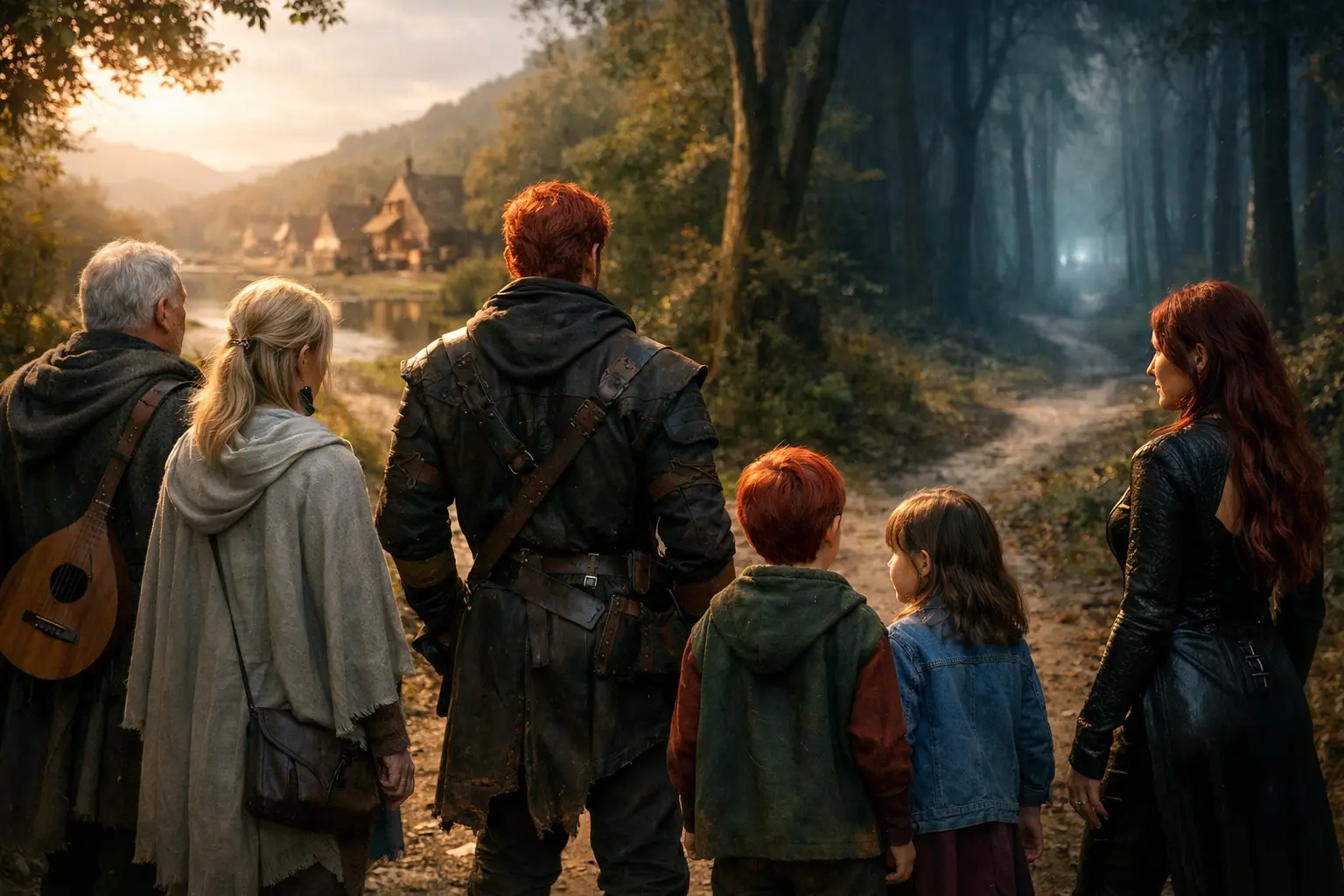
Do Choices Matter in Worlds That Remember?
The magistrate’s seal breaks beneath a trembling hand.
Months earlier, the party spared a smuggler in an alley behind the river market. Tonight, his testimony may save them from the gallows.
But the family of the man he killed has also been waiting.
They have brought a knife.
Do choices matter in roleplaying games?
They must.
Not because every decision deserves a dramatic twist. Not because the Game Master should keep a private ledger of sins and release wolves whenever somebody chooses incorrectly. And certainly not because players should be punished for acting without information their characters could never have possessed.
Choices matter because a living world remembers that they happened.
But at Mythveil, that process begins earlier than the choice itself.
It begins when the character becomes part of the world.
A background creates relationships. Group questions create connections between characters. Research gives those relationships history. Influence gives institutions and factions interests of their own. NPCs bring personal desires that may agree with those interests, contradict them, or complicate them magnificently.
Then the players act.
People react.
Factions respond.
Others react to those responses.
Stories collide.
Rumours spread.
What actually happened slowly becomes what people believe happened.
And eventually some part of that changed world returns to the players.
That is when a choice becomes more than a branch in a plot.
It becomes history.
Choice without consequence is decoration.
Consequence without choice is merely a script.
A living campaign needs both.
Why Do Choices Matter in Roleplaying Games?
A tabletop campaign is not meaningful simply because players roll dice, inhabit characters, or defeat threats.
Meaning emerges when an action changes the relationship between character and world.
A promise becomes a political liability.
A stolen relic acquires a name.
A village remembers who stayed when the plague carts came through the gates.
A frightened child remembers who stopped to listen.
A faction remembers who embarrassed it in public.
And an enemy may remember the one moment when the characters could have killed them and chose not to.
This is the difference between an adventure that is consumed and a story that is lived.
But meaningful choice begins before Session One’s first dramatic crossroads.
It begins with the character.
A background should be more than a biography.
“I served in the army” is information.
“My former sergeant saved my life, now works for a faction I distrust, and still believes I owe him” is play.
“My family lives in this district” is information.
“My sister runs the clinic there, hates the city council, and thinks my friends are a terrible influence” is play.
The purpose of a character background is not merely to explain where the character came from.
It gives the world handles.
People they love.
People they dislike.
Debts.
Promises.
Institutions.
Mistakes.
Places they belong.
Places where they are no longer welcome.
Things they would very much prefer not to lose.
Research creates the broader world around those connections.
The character anchors part of that world to the player.
Now the campaign already has somewhere to apply pressure.
Group Questions Turn Characters Into a Community
Strong individual backgrounds do not automatically create a strong group.
Five beautifully written characters can still meet in a tavern and behave as though an employment agency has accidentally seated them at the same table.
Group questions solve a different problem.
They create relationships between the characters and, often, between their histories.
Not only:
How do you know each other?
Ask instead:
Who once helped you when you did not deserve it?
Who in the group knows a secret about you?
Whom would you trust with your money but never with a weapon?
Which person outside the group connects two of you?
What happened in your shared past that you still remember differently?
Who disappointed you but never apologised?
Who do you believe is a better person than they believe themselves to be?
Now something interesting begins to happen.
Backgrounds overlap.
Relationships appear.
Contradictions appear.
And those contradictions create impulses for play before the Game Master has presented the first formal problem.
One character’s brother may serve in the city watch.
Another character’s father may have been imprisoned by that same watch.
A group question may reveal that the brother was present during the arrest.
Nobody needed to write an adventure called The Brother in the Watch.
The material already exists.
The player characters are no longer visitors to the setting.
They belong to it.
Choice Is Not the Same as Unlimited Freedom
Meaningful agency does not require limitless options.
A living world has boundaries.
Geography.
Law.
Prejudice.
Scarcity.
Old grudges.
Social customs.
Institutional power.
Supernatural forces.
And, inconveniently, other people.
A vampire court will not abandon centuries of protocol because somebody rolls extremely well and gives a spirited speech.
A Delta Green operation cannot necessarily erase the consequences of exposure because someone found a particularly persuasive explanation.
In a grim Warhammer town, saving one family before the flood rises may mean another family receives no help at all.
Limits do not remove choice.
They give it shape.
Freedom becomes hollow when nothing resists it.
If every plan succeeds because the story must continue, choices become cosmetic.
If every obstacle is immovable because the Game Master has already chosen the outcome, choices become theatre.
The useful space lies between them.
The players need enough information to understand the pressure.
Then they decide what they value.
They may not be able to save the whole district.
They can still decide which door to open.
Whom to trust.
Which evidence to destroy.
Whether to tell the truth.
Whether to keep a promise.
Whether an enemy deserves another chance.
Those are not smaller decisions simply because they do not determine the fate of the universe.
Very often they reveal more about a character than saving the universe does.
The World Must Have a Memory
Consequence becomes powerful when it survives beyond the session in which it was created.
This is where many campaigns lose their sense of reality.
Something extraordinary happens.
The players react.
The session ends.
Next week the world has politely reset itself.
Real lives do not work that way.
Convincing fictional worlds should not either.
Memory travels through different channels.
A faction can remember an insult as a strategic grievance.
An NPC can remember an act of kindness as the beginning of loyalty.
A family can remember the person the characters failed to save.
A ruined chapel can become a landmark associated with their mistake.
A character can carry guilt long after everyone else has stopped mentioning the event.
And not every consequence needs to arrive immediately.
Some choices should sleep.
The mercenary spared in an early session may return years later as a commander.
The archive burned to conceal a secret may become important only when a scholar desperately needs a document that no longer exists.
The debt forgiven in a moment of compassion may become the reason an entire neighbourhood shelters the party when the authorities come looking.
A choice does not need an immediate consequence to matter.
It needs a causal future.
That distinction is important.
A living world does not constantly shout:
REMEMBER THAT THING YOU DID?
It remembers quietly.
Until memory matters.
A Choice Is an Action Inside a Social System
Consider the smuggler from our opening.
The group catches him.
In a simple decision tree, the choice might be:
Kill him.
Hand him over.
Let him go.
But in a living campaign, the smuggler already exists inside a network.
One character knows his sister.
Another lost somebody to the smuggler’s gang.
The smuggler occasionally works for a faction with which the group is negotiating.
The brother of one player character serves in the city watch and has been searching for this man for months.
Now letting him go is no longer Option C.
It is an action inside a social system.
The players spare him.
The smuggler reacts.
Perhaps he is grateful.
Perhaps he interprets mercy as weakness.
Perhaps he believes the characters have recruited him.
Perhaps he tells somebody else a version of what happened that bears only a passing resemblance to reality.
His faction may react.
The city watch may react.
The victim’s family may react.
The player character’s brother may now have to decide whether to conceal what happened.
His superior may notice.
And somebody who had absolutely nothing to do with the original encounter may suddenly acquire an interest.
That is how choice becomes movement.
Action Creates Reaction — and Reaction Creates Counteraction
A living campaign should not treat consequence as one direct line between player and Game Master.
Player acts.
GM delivers consequence.
Next choice.
Real social systems are messier.
The player acts.
An NPC reacts.
A faction reacts to that NPC.
Another faction observes the reaction.
Someone misunderstands what happened.
Someone else sees an opportunity.
An ally pushes further than the players intended.
An enemy changes strategy.
A neutral party becomes involved.
That is counteraction.
And counteraction does not simply mean the villain strikes back.
The city watch may become suspicious.
The smugglers may become friendly.
A political faction may decide the characters can be useful intermediaries.
The dead man’s family may decide that justice has failed.
A priest who knows both families may try to prevent violence.
Now several people are acting for different reasons.
The original choice continues to generate motion.
This is where meaningful agency becomes considerably more interesting than selecting from prepared branches.
The players are not simply choosing which consequence the GM has already written.
Their action can create a situation that did not previously exist.
Choices Can Create New Stories
Suppose the characters protect the smuggler.
Months pass.
He becomes an informant.
His testimony later saves them during a trial.
That is already a satisfying consequence.
But now the victim’s family acts.
One member seeks revenge.
Another wants legal justice.
A third believes the feud has gone far enough.
An ambitious politician notices the case and turns it into evidence that the city has lost control of organised crime.
A criminal faction tries to silence the smuggler.
The city watch becomes politically compromised.
Suddenly a choice made in an alley has helped create a storyline that did not exist when the choice was made.
This is an important distinction in the Mythveil approach.
A meaningful choice does not merely unlock prepared content.
It can generate new content through consequence.
Sometimes that new storyline remains small.
Sometimes it grows.
Sometimes it collides with another story that has been running independently for twenty sessions.
And from that collision something entirely new emerges.
The campaign begins to produce history rather than simply reveal the Game Master’s backstory.
NPCs Make Consequence Human
Factions matter, but players rarely love or hate organisational charts.
People make systems emotionally legible.
A faction may have an objective.
Its leader may interpret that objective differently from everybody else inside it.
The institution wants stability.
The leader wants prestige.
The treasurer wants solvency.
The captain wants revenge.
The reformer wants the institution to live up to principles it abandoned years ago.
The junior clerk just wants her brother to survive.
All of these people can belong to the same faction.
So when players make a choice that affects that organisation, there may be no single faction reaction.
The leader approves.
The captain is furious.
The clerk quietly helps.
The reformer thinks the characters have proved her point.
The treasurer mostly wants everyone to stop setting expensive things on fire.
This is where long campaigns gain depth.
Players build relationships not only with factions but with individuals inside them.
A friendly NPC may oppose the official policy of their own organisation.
An enemy may agree with the characters on one specific issue.
A leader may damage their own faction because personal ambition wins.
A subordinate may disobey an order because of a relationship established thirty sessions earlier.
Consequence becomes personal because institutions are carried by people.
And people are gloriously unreliable.
Guardian and Nemesis Turn Accumulated Choice Into Pressure
As player actions accumulate, the world can become imbalanced.
A faction grows dominant.
A political system becomes rigid.
A region falls into chaos.
One solution works so consistently that nothing challenges it anymore.
This is where Guardian and Nemesis become useful within the Rexborn Framework.
They are not mechanisms for punishing success.
If every victory immediately causes the universe to produce a larger enemy, players will eventually discover the safest strategy available:
Never achieve anything.
That would be unfortunate.
Guardian and Nemesis instead help us think about the forces generated by change.
Dominance creates opposition.
Power creates responsibility.
Chaos creates desire for stability.
Rigid stability creates reform movements.
A collapsing institution produces people trying to preserve it, replace it, exploit it, or escape it.
Nemesis can emerge as pressure, opposition, crisis, or disruption.
Guardian can appear through preservation, renewal, continuity, adaptation, or forces trying to restore workable balance.
Crucially, these forces can emerge through existing NPCs and factions.
The reformer was already there.
The rival already existed.
The younger generation has watched the old leadership fail for years.
Player choices did not summon them from nowhere.
Those choices altered the conditions under which they decide to act.
Consequence Needs Proportion
A world that remembers can still become exhausting if every decision creates catastrophe.
If buying the wrong bread causes three assassins, a plague, and a constitutional crisis, the players will eventually stop buying bread.
Consequences need proportion.
And proportion depends on genre.
In cosmic horror, an apparently small act of curiosity can expose a character to knowledge that cannot be forgotten.
In political drama, an offhand remark at dinner can genuinely damage an alliance.
In a coming-of-age mystery, walking a friend home may matter because it changes trust.
The consequence should arise from the world’s logic and emotional temperature.
There must also be room for grace.
An old enemy may decide not to retaliate.
A failed plan may reveal an unexpected path.
A community may forgive what an institution cannot.
A person may simply choose to be kinder than expected.
If every consequence is punitive, the campaign mistakes cruelty for seriousness.
Mercy also changes worlds.
So does patience.
So does keeping a promise nobody expected you to keep.
Grand choices can change history.
Small choices reveal identity.
Both belong in a world that remembers.
The Game Master’s Responsibility
For the Game Master, making choices matter is not about preparing every possible branch.
That way lies flowcharts, madness, and eventually a wall covered in string.
Prepare the world beneath the branches.
Understand what important people want.
Understand what factions need.
Understand which resources are under pressure.
Know which relationships are fragile.
Know what continues happening if nobody intervenes.
Then, when players do something unexpected, ask:
Who notices?
Why does it matter to them?
What can they actually do about it?
And who might react to their reaction?
A stolen ledger is not merely loot.
To a clerk, it may be proof.
To a rival, leverage.
To an informant, danger.
To a religious order, sacrilege.
To the player characters, it may simply have seemed like the useful-looking book on the desk.
That is enough.
You do not need a pre-written outcome for every possibility.
You need enough internal life for the world to answer.
Bardic Resonance: What Happened Is Not the Same as What People Remember
There is another layer between action and memory.
Interpretation.
The players know what they intended.
The world does not.
Suppose they spare the smuggler.
What happened?
They allowed him to live.
Simple.
What does it mean?
That depends whom you ask.
One person says:
“They showed mercy.”
Another:
“They work with criminals.”
Another:
“They can be negotiated with.”
Another:
“They are weak.”
Perhaps none of those interpretations exactly matches why the players made the choice.
That does not make them invalid.
It makes them social.
Bardic Resonance is the process by which events become reputation, rumour, story, propaganda, warning, folklore, ritual, or myth.
Facts travel through people.
People modify them.
A political faction frames the event one way.
A tavern song frames it another.
A family tells the story differently around its dinner table.
A newspaper simplifies it.
A priest moralises it.
A frightened witness gets half of it wrong.
Six months later somebody who was not present is explaining what happened with complete authority.
Civilisation has been functioning like this for quite some time.
The important thing is that player actions gain a social life beyond the players’ control.
They choose what they do.
They cannot completely choose what it means to everybody else.
Bardic News Gives the Choice Back to the Player
This is where the loop closes.
The world should eventually reflect part of that accumulated reaction back to the players.
Not necessarily as a mechanical report.
Not:
Smuggler Reputation +2.
City Watch Influence -1.
Family Vengeance Clock +1.
Those things may exist behind the screen.
What reaches the player should feel like the world.
A stranger buys them a drink.
A shopkeeper refuses service.
A newspaper calls them criminal sympathisers.
A mother asks for help because she heard they give people second chances.
A guard quietly lets them through because the smuggler once saved his cousin.
Someone sings a terrible song about them.
Worse, it rhymes.
This is Bardic News.
The players encounter what their actions have become after passing through NPCs, factions, time, memory, prejudice, politics, and culture.
And that changed information becomes the starting condition for the next choice.
The player acts.
The world reacts.
Others counteract.
Time passes.
The event gathers meaning.
The world reports some version of itself back.
The player decides again.
But neither the world nor the character is exactly the same.
The Character Remembers Too
A world that remembers is only half of long-form play.
Characters accumulate history as well.
After forty sessions, a character should not simply possess more abilities than they did in Session Two.
They should have more reasons.
They have lost people.
Trusted people.
Been betrayed.
Been forgiven.
Made promises.
Broken promises.
Accepted responsibility.
Learned which institutions deserve trust and which merely possess excellent stationery.
Perhaps a decision that would have been unthinkable in Session Five becomes unavoidable in Session Fifty.
Not because the player’s alignment changed.
Because the character lived.
This changes the next decision entering the system.
The same person is not making it.
A character background begins the relationship between character and world.
Play rewrites it.
Eventually the backstory becomes less important than the history created at the table.
That is one of the great rewards of a long campaign.
Do Choices Matter When the Story Is Shared?
They matter more.
Tabletop stories belong to everyone at the table.
One player’s choice creates space for another character to reveal courage, doubt, jealousy, compassion, ambition, or betrayal.
Consider the difference between deciding whether to enter a dungeon and deciding whether to tell the group that the thing beneath it knows your real name.
The second decision changes more than route.
It changes the emotional weather of the table.
Who believes you?
Who already suspected?
Who becomes frightened?
Who thinks you have withheld information for too long?
Who puts a hand on your shoulder anyway?
A strong choice does not merely move plot.
It gives other people something meaningful to respond to.
That is why consequence-driven play is not an argument for grimness.
It is an argument for presence.
Players listen more carefully when they believe relationships matter.
They invest in places when they believe those places can change.
They take risks for reasons that cannot be reduced to treasure or advancement.
They begin to understand that they are not travelling through a story.
They are participating in a world.
From Character to World and Back Again
The Mythveil approach can therefore be understood as a loop.
The character background connects the player to the world.
Group questions connect the characters to each other.
Research gives those relationships history and context.
Influence sets factions and institutions in motion before the players arrive.
NPC goals complicate faction goals with human desire.
The player chooses.
Choice becomes action.
Action creates NPC reaction.
Reaction creates faction response.
Faction response creates counteraction.
Other factions observe and act.
Guardian and Nemesis turn accumulated pressure into preservation, opposition, renewal, instability, or crisis.
Time moves.
Bardic Resonance transforms events into social memory.
Bardic News carries part of that changed world back to the players.
And the players choose again.
That is what it means for choices to matter in a world that remembers.
Not that every choice produces punishment.
Not that the Game Master has prepared three doors and generously allows the group to select one.
The players open a door.
And because they opened it, the building changes.
Someone hears it.
Someone enters.
Someone leaves.
Someone locks another door upstairs.
A rumour begins that the house is haunted.
Three sessions later, a faction tries to buy the property.
Twenty sessions later, somebody asks why the characters started all of this.
They may have an answer.
They may not.
But the world does.
Choice without consequence is decoration.
Consequence without choice is a script.
And consequence becomes truly powerful when it does more than answer a decision.
It changes the world that will receive the next one.
Give your players a world capable of carrying their choices forward.
Let it remember what they did.
Let people react.
Let factions move.
Let stories emerge.
Let memory change meaning.
Then return that changed world to the players and ask the most important question in roleplaying games:
What do you do now?
MYTHVEIL
We create worlds people want to live in.
Stories that remember. Worlds that change.
Read: https://mythveilchronicles.com/
Play: https://startplaying.games/gm/dunchan
Watch: https://www.youtube.com/@MythveilChronicles
Support: https://www.patreon.com/MythveilChronicles
Collaborate: https://www.linkedin.com/in/francisco-jos%C3%A9-z-b05aab371/