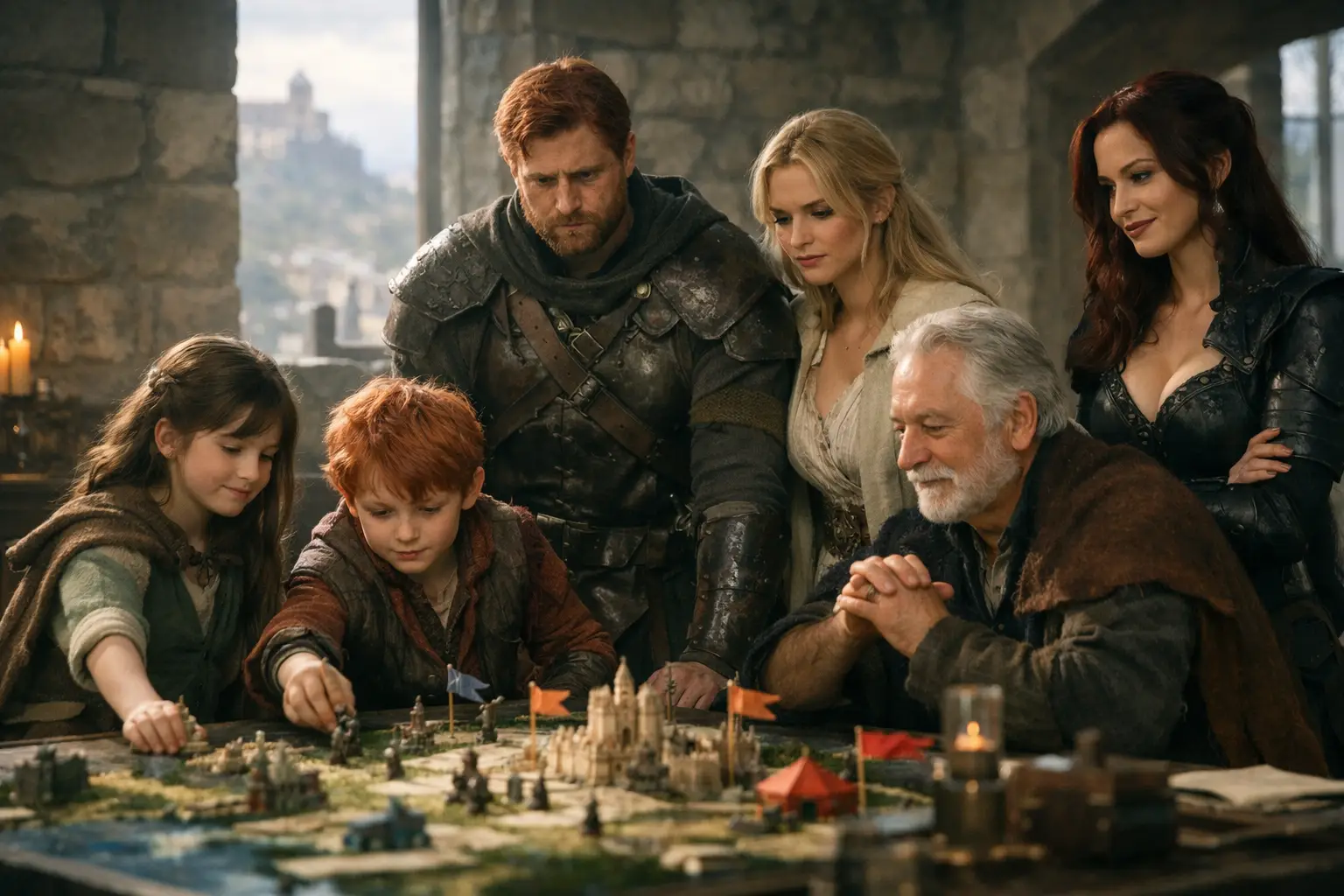
How Faction Influence Works When the World Remembers
From NPC motives and faction reach to opposed Influence, Bardic News and history
A sealed letter reaches the party three weeks after they exposed a magistrate.
It is not a quest hook.
It does not contain a conveniently underlined name, a meeting place and twelve gold pieces up front.
It is a warning.
The magistrate’s patrons have closed the river gates. A rival guild is offering protection at a price. Two merchants who previously supplied the party have suddenly become unavailable. Someone has begun asking questions about their families.
Nothing here was waiting in a box labelled Consequences.
People acted.
That is the difference.
In a living campaign, factions are not mission dispensers, static reputation bars or enemies waiting in assigned rooms. They are groups of people with interests, fears, resources, relationships and memories.
When the players change the world, those groups notice.
Sometimes.
They interpret what happened.
Differently.
Then they try to do something about it.
Sometimes they succeed.
Sometimes somebody else stops them.
That is where faction influence becomes a game.
> Influence is the way the reach of a person, group or institution enters the world and changes what can happen.
And once several actors begin pushing against one another, the setting stops behaving like a backdrop.
It starts behaving like a society.
Influence is not reputation
Reputation answers one useful question:
What do people think of you?
Influence answers another:
What can they actually do?
Those questions often touch, but they are not the same.
A church may despise the characters but lack the reach to hurt them outside a few parishes.
A merchant guild may like them very much but be unable to protect them from the city watch.
A hated noble house may still control land, courts, river traffic and appointments.
A beloved neighbourhood organiser may possess almost no formal authority but be able to fill a square with people before sunset.
Influence is therefore contextual.
It belongs to particular parts of society.
Politics does something different from Religion.
Media does something different from Crime.
Finance does something different from Street.
University, Transport, Law, Medicine, Military, High Society or Arcane networks each create different kinds of reach.
That texture matters.
If every form of power becomes one number, a city quickly begins to feel like a spreadsheet wearing a hat.
The point is not merely how much power somebody has.
The point is where their hands can reach.
> Influence creates reach, not obedience.
A powerful actor can attempt more.
It does not mean the world automatically agrees.
Build the faction before you give it power
This is where faction design has to come before influence mechanics.
A faction is not a crest.
It is not three lines under the heading Goals.
It is not “the evil guild”.
Before we ask what a faction can do, we need to know what kind of thing it is.
What does it want?
What does it fear?
What does it believe?
What does it know?
What does it wrongly believe it knows?
What does it need in order to continue existing?
What resources can it reach?
Where is it vulnerable?
Who does it depend upon?
Who does it owe?
Who does it hate?
Who does it distrust but still need?
What would make it cautious?
What would make it aggressive?
What might split it internally?
That last question matters.
Real organisations are rarely single minds.
A church may contain reformers, careerists, mystics and frightened administrators.
A guild may contain wealthy masters who want stability and younger members who want confrontation.
A police organisation may contain an ambitious investigator, a tired superior who wants the whole matter buried and an internal faction that sees the crisis as an opportunity for more authority.
A faction becomes interesting when its internal pressures matter as much as its external ones.
> You cannot simulate a faction you have not understood.
Research helps here.
History explains where institutions came from.
Religion explains what people consider sacred or forbidden.
Economics explains what they cannot afford to lose.
Law explains where formal power begins and ends.
Profession explains what an organisation notices.
Culture explains what behaviour appears normal to its members.
Faction design becomes much stronger when it grows from a researched world rather than from the needs of next Thursday’s encounter.
NPCs are where faction power becomes human
A faction does not act by itself.
People act.
That distinction changes everything.
The city council may possess Political Influence.
But somebody still decides what to do with it.
A bishop.
A magistrate.
A fixer.
A union organiser.
A clerk.
A journalist.
A crime boss.
A professor.
A frightened deputy who has been sleeping badly for three weeks.
This is where the NPC architecture we use at Mythveil becomes part of the Influence Game.
Do not begin with:
What personality trait does this NPC have?
Begin with:
What life made this person notice the world in this particular way?
Their period matters.
Their culture matters.
Their education matters.
Their profession matters.
Their family matters.
Their scars matter.
Their ambitions matter.
Their relationships matter.
Their institutional position matters.
A lawyer notices different leverage from a priest.
A soldier sees different danger from a merchant.
A coroner looking at a corpse does not see what the grieving sister sees.
Neither is necessarily wrong.
They are standing in different lives.
> Profession changes attention. Biography changes interpretation. Position changes capacity.
Now connect that person to a faction.
The institution gives them access.
Their biography determines how they use it.
A hard-line bishop and a cautious bishop may command the same religious structures and produce completely different consequences.
A paranoid sheriff and a politically ambitious sheriff may have the same Police Influence.
One hides the problem.
The other turns it into a task force.
The Influence score has not changed.
The world has.
That is why NPCs must not disappear behind faction statistics.
> The institution gives capacity. The person decides what to attempt with it.
Influence is divided into domains because societies are divided into systems
Influence works best when it has clear spheres.
The precise list should fit the setting.
A modern city might use areas such as Politics, Police, Media, Finance, Church, Legal, University, Health, Street, Transport and Underworld.
A fantasy city might replace some of these with Temple, Guilds, Nobility, Arcana, Mercenaries, Port, Court and Peasantry.
A science-fiction setting might need Corporate, Military, Data, Transport, Colonial Administration, Media, Research and Criminal networks.
The names are less important than the principle.
Each domain represents a social or institutional field through which an actor can perceive and affect the world.
In the Rexborn version we have been developing, Influence can be rated on a scale from 1 to 10.
Low ranks represent modest reach.
A contact.
A local official.
A small group.
A limited favour.
Higher ranks mean progressively greater access, wider networks and stronger capacity.
But rank is not automatic victory.
A politician with Political Influence 6 may be capable of attempting something significant.
That does not mean the attempt succeeds.
This is crucial.
Otherwise Influence stops being a game and becomes permission.
> Influence measures capacity. The roll determines performance in the moment.
First question: does the information reach them?
Before a faction acts on an event, it needs some version of that event.
Sometimes the answer is obvious.
The bishop was in the room.
The guild master received the letter.
The police captain personally interviewed the witness.
No roll is needed merely to establish that they heard something they directly experienced.
But most of a living city exists away from the immediate scene.
That is where Influence becomes useful as an abstraction.
Suppose a drunk in a riverside tavern begins telling people that the evidence against the magistrate was forged.
The local priest was not there.
No named NPC has yet carried the rumour to him.
But the priest has Religion 6.
That gives a 60 per cent chance that this piece of resonance enters his sphere strongly enough to reach him.
Perhaps someone mentions it after Mass.
Perhaps a worried parishioner asks his advice.
Perhaps it surfaces in confession.
We do not need to invent the entire chain before the roll.
The successful Influence check establishes that the wider social network carried the story far enough.
If the roll fails, it has not reached him through that sphere.
Not yet.
This keeps the city alive without forcing the Game Master to track every baker, cousin, coachman and mildly talkative aunt.
> Direct contact tells us that information arrived. Influence tells us whether the wider field carries it further.
Second question: can they do anything with it?
Now the priest has heard the story.
The dice do not tell us what he thinks.
His character does.
Perhaps he believes the magistrate was corrupt.
He also believes that outsiders destroying public authority without lawful process will tear the town apart.
So he does not become “pro-magistrate”.
He becomes concerned about order.
He decides to preach about lawful judgement.
That is his action.
Now comes the second Influence roll.
Religion 6.
Sixty per cent.
If it succeeds, his attempt becomes socially effective.
People talk about the sermon.
It carries authority in circles where the tavern rumour did not.
Perhaps other clergy repeat it.
Perhaps respectable families begin asking questions.
If it fails, he may still have preached.
The action simply failed to generate enough leverage to change the relevant world state.
This gives us the lightest usable version of the system:
> Hear it. Act on it. Done.
Indirect information?
Roll to hear it.
Want to do something meaningful with it?
Roll to act.
Direct information?
Skip the first roll.
That is enough for a Game Master running without simulation tools.
The Influence Game begins when somebody pushes back
The priest’s sermon succeeds.
Now the magistrate’s former patrons hear about it.
They see an opportunity.
They begin saying:
“Even the Church doubts the accusations.”
That is not what the priest said.
It does not need to be.
People do not merely transmit information.
They use it.
The workers’ association notices what is happening.
Its leaders believe the magistrate’s patrons are trying to restore the old order.
They respond publicly:
“The guilds and clergy are rewriting the crimes of a corrupt official.”
Now we have more than reaction.
We have action and counteraction.
This is the Influence Game.
> The Influence Game begins when several actors try to make the same part of the world move in different directions.
One actor amplifies.
Another blocks.
A third redirects.
A fourth supports.
A fifth waits to see who weakens first.
Influence can be used to open doors.
Close them.
Spread information.
Suppress it.
Mobilise people.
Delay a process.
Gain access.
Deny access.
Protect a person.
Isolate them.
Move money.
Freeze money.
Begin an investigation.
Stop one.
Legitimise a claim.
Make the same claim look ridiculous.
At that point, opposing actors roll against one another.
A powerful faction can fail.
A weaker one can succeed.
Both sides can succeed in different ways.
That last result is often more interesting than a clean victory.
The priest’s message spreads.
The workers’ counter-message also spreads.
The town does not become convinced.
It becomes divided.
That is a perfectly valid world state.
Sometimes the result of Influence is not control.
It is conflict.
Factions do not act on truth. They act on their version of truth
This is one of the reasons the system becomes powerful over long campaigns.
A faction does not require omniscience.
It requires enough information to form an interpretation.
One actor knows what really happened.
Another believes a rumour.
A third knows the rumour is false but finds it politically useful.
A fourth barely cares about the original event and only sees the opening created by everyone else’s argument.
Then all four act.
> The world does not only react to what happened. It reacts to what people believe happened.
This separates Influence from truth.
A powerless witness may know exactly what happened.
A powerful institution may act on nonsense.
The nonsense remains false.
Its consequences do not.
That difference is central to living social systems.
A false accusation can produce a real arrest.
A misunderstood ritual can produce a real religious panic.
A fabricated scandal can destroy a real alliance.
A mistaken military report can close a real road.
> A false interpretation can create true consequences.
NPCs stop factions becoming monoliths
Now return to the people inside those organisations.
The magistrate’s patrons may want revenge.
Their chief accountant may want the entire affair to disappear because trade is collapsing.
Their younger heir may secretly think the magistrate deserved what happened.
A senior guard may follow orders.
A junior guard may owe one of the players his life.
The faction therefore has a direction without needing every member to agree.
That gives the players room to work.
They can negotiate with internal rivals.
Convince individuals.
Expose contradictions.
Create allies inside hostile structures.
Turn cautious people against extremists.
Or accidentally unite a divided faction by frightening everybody at once.
The game becomes far richer than:
Faction hostile: -3.
> A faction has an identity. Its people decide how cleanly that identity survives contact with reality.
Leadership matters as well.
A cautious leader may contain a crisis.
An opportunistic leader may exploit it.
An aggressive leader may retaliate.
A fanatic may sacrifice the faction itself rather than compromise.
If leadership changes, the same resources can suddenly move in a different direction.
The organisation survives.
Its behaviour changes.
That is institutional continuity with human variation.
Players use Influence too
The players should not remain outside this system.
Long campaigns naturally give characters reach.
They gain friends.
Debts.
Titles.
Contacts.
Favours.
Reputation.
Money.
Offices.
Safehouses.
Access to institutions.
Trust.
Fear.
Information.
Perhaps one player has Church 2.
Another has Street 3.
A third has Police 1.
Individually those may appear modest.
Together they can create options the party did not possess when the campaign began.
A character with Police Influence can find out what the authorities know.
Someone with Street Influence can hear what the neighbourhood thinks.
Someone with Church Influence may discover that parishioners are frightened long before the city council notices.
Player Influence means they are no longer merely targets of faction politics.
They are participants.
Eventually, a long-running group may effectively become a faction of its own.
Not because the sheet says so.
Because other people now plan around them.
> Some actors do not merely use Influence. They become influential.
And that creates responsibility.
If people rely on the characters, what happens when the characters leave?
If their word can start a riot, do they use it?
If one ally asks them to silence another, what does loyalty mean now?
Power becomes interesting when it creates obligations.
With a human GM, keep it small
A living city can become absurdly complicated if you try to simulate everything.
Do not.
For manual play, keep the Influence Game focused on the movements that matter.
After a significant event, look at the relevant factions and NPCs.
Ask:
Who definitely knows?
Who might learn about it through Influence?
What does it mean to them?
What do they want to do?
Can they do it?
Who actively opposes them?
That is enough.
You do not need to know whether seventeen unrelated shopkeepers have heard the rumour.
You need to know whether the bishop has.
Whether the city watch has.
Whether the guild that controls the river gates has.
Whether the workers’ organiser has.
> Roll where the answer can move the world.
That is the useful manual rule.
AI allows the same system to run at greater depth
With a simulation assistant, the underlying logic does not need to change.
The resolution can.
A human GM may track three or four important faction reactions.
An AI-assisted simulation can track more parallel movements:
different versions of the same event,
different faction knowledge states,
multiple NPC interpretations,
internal faction divisions,
delayed information,
several Influence actions,
supporting actions,
opposed actions,
failed actions,
secondary consequences,
changes in relationships,
new openings created by previous moves.
This does not mean asking AI to write the next episode.
That would miss the point.
The simulation should work from the world already built.
The researched setting.
The faction identities.
The NPC biographies.
Their current goals.
Their relationships.
Their Influence.
The events that actually happened.
Then it asks:
> Given everything we now understand, what would these actors actually try next?
The rolls determine which attempts work.
The new world state follows.
AI does not replace the method.
It lets the same method operate at a finer resolution.
> Without AI, simulate the movements that matter. With AI, you can simulate more of the world that produces them.
The world must report back
There is still one step missing.
The simulation can be brilliant.
The factions can make perfectly coherent decisions.
The NPCs can act according to their biographies.
Influence can rise, fall, collide and redirect.
None of that matters much if the players never see it.
That is where Bardic News enters.
Bardic News turns changed world state back into playable experience.
The river gates are closed.
The players see queues of stranded boats.
A merchant who once welcomed them suddenly refuses entry.
A sermon mentions “those who place themselves above lawful judgement”.
A pamphlet calls them heroes.
Another calls them traitors.
A friend sends a warning.
A newspaper publishes a distorted version of the event.
Someone has scratched their names off a public memorial.
A rival guild offers protection.
At a price.
> Bardic News is how the world gives consequence back to the players.
It should speak in the media of the setting.
A fantasy city has sermons, rumours, songs, letters, proclamations and market gossip.
A modern setting has reports, headlines, internal messages, social media, official statements and whispered professional conversations.
A science-fiction world may use corporate feeds, sensor reports, broadcasts, military briefings and network chatter.
The medium matters because it colours the message.
Institutions remember functionally.
People remember personally.
Stories remember badly.
All three can be useful.
Bardic News creates the next move
Now the players know something has changed.
Not necessarily the whole truth.
Enough to act.
They can challenge the priest.
Break the river blockade.
Negotiate with the guild.
Expose the patrons.
Threaten them.
Join them.
Find out who is asking about their families.
Do absolutely nothing and allow the conflict to continue without them.
That last option matters.
A living world should not stop moving because the party chose another road.
The factions continue.
NPCs continue.
Influence continues.
The next time the players return, the situation may be better.
Or much worse.
Either way, it should be understandable.
> Every new action enters a world already changed by the actions that came before it.
This is how Influence becomes memory
At first, Influence creates immediate consequences.
A gate closes.
A witness disappears.
A newspaper changes its tone.
A priest takes a position.
A guild makes an offer.
Then action produces counteraction.
Counteraction creates new opportunities.
Those opportunities produce further player choices.
Over time, the original event sinks deeper into the world.
Perhaps the river blockade leads to shortages.
The shortages strengthen the workers’ association.
The association gains council representation.
The old merchant families respond by forming a political alliance.
The players support one side.
Years later, that alliance still exists.
The original magistrate is barely remembered.
But the institutional landscape created by his fall remains.
That is deeper than reputation.
That is structural memory.
> Memory becomes history when yesterday’s consequences become part of today’s causes.
The strongest living worlds do not remember because somebody keeps a perfect log.
They remember because the past remains active inside the present.
A friendship still opens a door.
An old betrayal still closes one.
A law still exists.
A faction founded during a crisis still meets every Thursday.
A child grew up hearing a particular version of what the characters did.
A leader who survived them now governs differently because of it.
The original action has become part of the architecture of the world.
The full cycle
The complete movement is simple enough to describe.
The players act.
People and institutions perceive fragments.
Those fragments become interpretations.
Relevant actors hear about them through direct contact or Influence.
NPC identity and faction identity determine what the event means to them.
They decide what to attempt.
Influence rolls determine whether their actions succeed.
Opposed Influence determines what happens when others resist.
The world state changes.
Bardic News returns those changes to the players.
The players act again.
Then the factions answer again.
Action.
Counteraction.
New action.
New consequence.
Again and again.
> Player Action → Interpretation → Influence Reach → Faction and NPC Response → Influence Action and Opposition → Changed World → Bardic News → New Player Action
Run that cycle long enough and you stop needing to manufacture campaign history.
The campaign begins producing history of its own.
Influence is where the world gets hands
A faction without motives is scenery.
A motive without reach is intention.
Influence gives that intention a way into the world.
NPCs decide how that power is actually used.
Opposition prevents power becoming automatic.
Bardic News makes the result visible.
And repetition turns consequence into history.
That is how faction play becomes more than political decoration.
That is how NPCs become more than dialogue.
That is how institutions begin to feel older than the scene in which the players first encountered them.
And that is how a world begins to remember.
MYTHVEIL
We create worlds people want to live in.
Stories that remember. Worlds that change.
Read: https://mythveilchronicles.com/ Play: https://startplaying.games/gm/dunchan Watch: https://www.youtube.com/@MythveilChronicles Support: https://www.patreon.com/MythveilChronicles Collaborate: https://www.linkedin.com/in/francisco-jos%C3%A9-z-b05aab371/