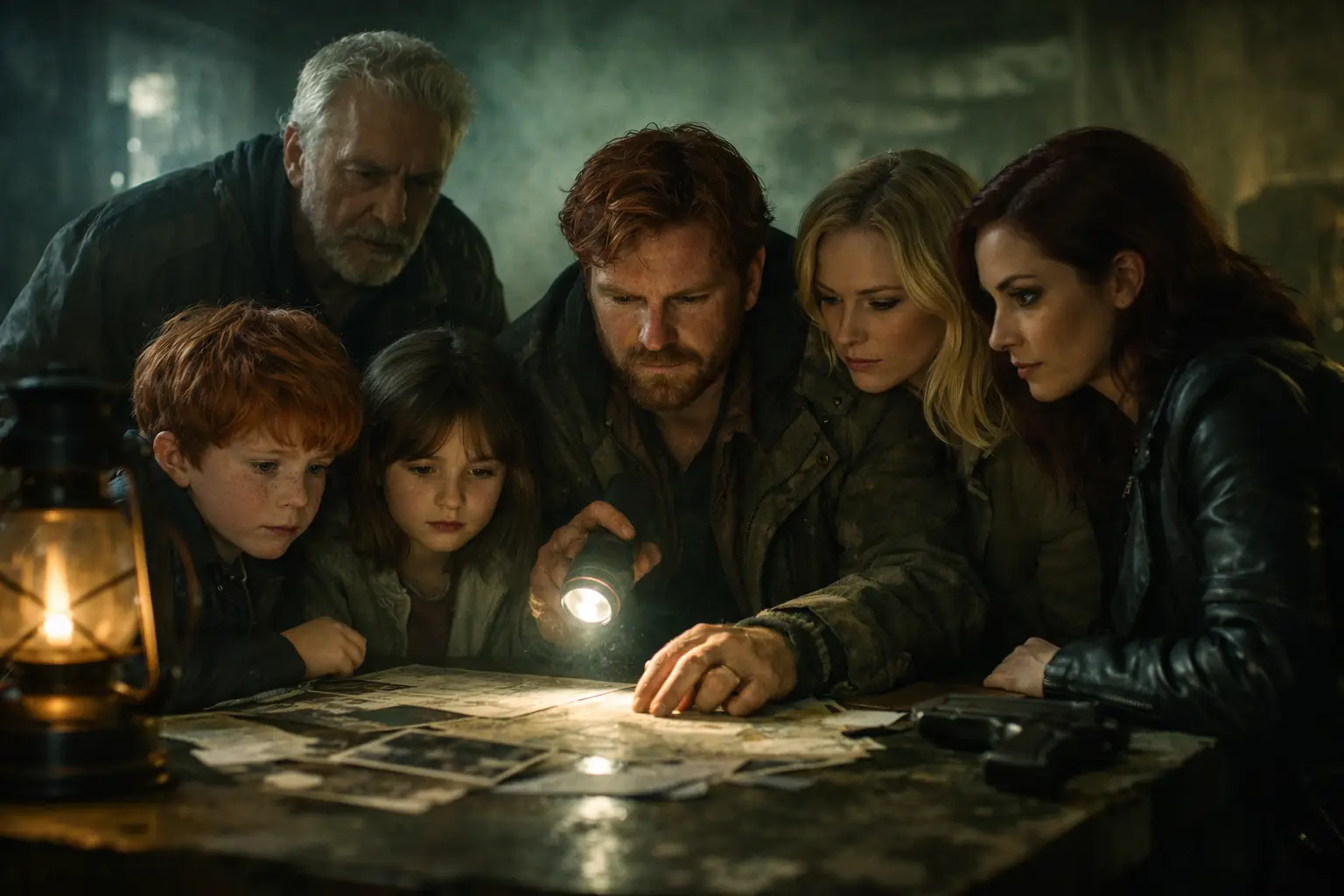
How Bonds, institutions and a living world turn operations into years of human history
The body is lying in a house that technically belongs to the FBI now.
That is inconvenient, because Agent Mercer is not FBI.
As far as the federal agents walking towards him are concerned, he is a local patrol officer who has already spent rather too long near their crime scene. His actual Handler, meanwhile, has just sent him four words:
Stay close. Find out.
His phone buzzes again.
This time it is his wife.
Do not forget the flowers.
Anniversary. Tonight.
There are, at this point, several different ways Mercer’s day can become unpleasant, and the corpse may not be the most complicated one.
That is Delta Green.
Not merely Call of Cthulhu with assault rifles and federal badges. Not merely a sequence of covert missions separated by scenes at home. Delta Green becomes something much richer when cosmic horror, work, family, friendship, authority, secrecy and institutional power are allowed to occupy the same world.
The game already gives us much of what we need.
Mythveil takes those foundations seriously enough to build a life around them.
What Delta Green does exceptionally well
Delta Green is built around competent people confronting facts that should not exist.
Its agents come from recognisable professions. They may work in law enforcement, medicine, intelligence, academia, the military or other fields that give them both useful expertise and an established place in society.
That matters.
A police officer does not merely possess a better skill percentage for police work. They know how a crime scene is supposed to function.
A doctor knows what a body should permit.
An analyst understands what can be placed in a report, who receives it and what happens once somebody signs their name beneath it.
Then the Unnatural refuses to behave properly.
That collision between impossible facts and ordinary systems is one of Delta Green’s greatest strengths.
Its violence is dangerous enough to remain frightening. Its investigations reward professional competence. Sanity matters because knowledge and exposure can change the person who survives them.
And then there are Bonds.
Bonds are where Delta Green becomes more than procedural cosmic horror.
An agent does not suffer alone. Fear, secrecy and psychological damage can travel into the relationships that once helped them remain human.
A spouse.
A child.
A sibling.
A close friend.
A colleague.
The people who have absolutely no idea why someone they love came home at four in the morning smelling of petrol and refusing to discuss Nebraska.
Mechanically, Bonds are elegant.
For a long campaign, however, they can become much more.
Delta Green sits somewhere between Call of Cthulhu and World of Darkness
This is not an absolute distinction between the games, but it is a useful one for campaign design.
Call of Cthulhu often begins with the mystery.
Something is wrong.
Investigators encounter evidence, follow it and gradually discover a network of history, people and impossible truths around the problem.
World of Darkness often begins from the opposite direction.
The social world already exists. Characters belong to communities, supernatural societies, political structures, relationships and rivalries. The story grows from what happens when something disturbs that network.
Delta Green can sit beautifully between them.
It keeps the cosmic terror.
There really are things out there that human beings were never meant to understand.
But the agent confronting them already belongs somewhere.
They have an employer.
A career.
A superior.
A partner.
A child.
A mortgage.
A professional reputation.
A Cell.
Perhaps an ex who still knows their mother.
The horror therefore operates in two directions at once.
> The monster may be cosmic. The consequences are painfully human and institutional.
That is where Mythveil begins.
Build the person before you build the operation
The first mistake in a long Delta Green campaign is often beginning with the scenario.
We have an excellent published operation.
We need four agents.
So we create four agents who can play it.
For a short game, that can work perfectly well.
For a campaign intended to live for years, reverse the order.
Build the people first.
And do it with the players, not for them.
A character background should be a conversation.
Borrow the spirit of connection questions used by games such as Daggerheart: ask questions that immediately create relationships and lived experience instead of demanding an autobiography.
Where do you work?
Why did you choose that profession?
Which part of the job do you actually enjoy?
Who at work thinks more highly of you than they should?
Who did you upset on the way to your last promotion?
What do you do on a Sunday when nobody wants anything from you?
Who would you ring at three in the morning if calling Delta Green was not an option?
What promise have you made that your work could eventually force you to break?
Now we are not creating a collection of skills.
We are creating a person who occupies a place in the world.
> Your profession determines not only what you know. It determines where you stand in the world and what happens when you step outside that position.
That distinction becomes enormously important later.
Build the Bonds with the player
Do the same with Bonds.
Do not begin and end with:
Sarah — Wife — Bond 12.
Ask who Sarah is.
How did they meet?
What does she love about the agent?
What drives her spare?
What does she do for a living?
What does she want that has nothing to do with Delta Green?
Who matters to her?
Which member of her family dislikes the agent?
What has she forgiven already?
What would surprise her most about the person she married?
What does she think the agent actually does during those unexplained absences?
The player establishes the known relationship with us.
Then research, worldbuilding and play connect Sarah to the larger world.
Perhaps she is a solicitor.
Now we need to know what sort of law she practises, where she works, what kinds of clients her firm represents and which institutions her professional life might reasonably touch.
Perhaps she is a nurse.
A teacher.
A journalist.
An engineer.
A stay-at-home father.
A small-business owner.
Every answer creates a different social world.
> The player creates the relationship with us. Research connects that relationship to the world.
Then we develop the Bond as we would any important Mythveil NPC.
Biography.
Socialisation.
Profession.
Relationships.
Wants.
Needs.
Fears.
Knowledge.
Position.
Mannerisms.
Their own interpretation of what is happening.
Not because every Bond needs a thirty-page dossier.
Because every Bond should be capable of behaving like a person.
> Mythveil begins when a Bond stops being a number and becomes a life.
Build the Cell with the whole group
Then bring the players together.
A Delta Green Cell should not begin as four security clearances sitting around a briefing table.
It should begin as a network of people.
Again, questions work better than declarations.
Which agent would you trust with your child?
Who once covered for a mistake you made?
Whose judgement do you respect even when you disagree?
Who has already been inside your home?
Which member of the Cell does your partner know?
Who would you willingly meet for a drink if Delta Green disappeared tomorrow?
Who irritated you the first time you met?
Who knows something about you that Delta Green does not?
Those answers can create friendship.
Suspicion.
Debt.
Respect.
Rivalry.
Protectiveness.
Attraction.
Perhaps, eventually, love.
Agents remain human inside the Cell. They can become friends, lovers, partners, spouses or parents. They can fall out, reconcile or discover after forty sessions that the people who were assigned to the same terrible job have become the closest family they have.
None of that needs to be scheduled.
The purpose of the questions is simply to give those possibilities somewhere to grow.
> A Cell should begin as a relationship network, not four biographies waiting for the same mission.
Now research the lives the players have created
Only now do we know what research the campaign actually needs.
This prevents a common worldbuilding mistake: researching everything because everything theoretically exists.
We do not need to model the whole United States.
We need to understand the world these particular people can touch.
If a player is a local police officer, research the relevant police structure.
If a Bond works in a hospital, understand enough of that hospital and its professional setting for it to behave credibly.
If another agent works for a federal organisation, understand that organisation where the campaign may actually encounter it.
If somebody’s husband teaches at a university, that institution may matter.
A child’s school might matter.
A law firm might matter.
A private contractor might matter.
A church, union, newspaper, laboratory or veterans’ group might matter.
But only when there is a reason.
> Research the world these people can actually touch.
Detail should follow contact.
Simulation should follow consequence.
That keeps the world deep without turning the Handler into an unpaid civil service.
The micro game makes the world personal
At this point we have the campaign’s micro game.
The agents.
Their Bonds.
Their Cell.
Their colleagues.
Friends.
Families.
Lovers.
Children.
Rivals.
The places they actually visit.
This is the world the players feel directly.
A weakening Bond therefore means more than reducing a number.
Suppose Sarah and the agent begin drifting apart.
Perhaps she stops asking a colleague for favours on his behalf.
Her family begins taking sides.
A mutual friend becomes less available.
The agent loses access to somebody he knew only through Sarah.
Perhaps she confides in someone new.
Perhaps she leaves.
Perhaps she stays and starts asking better questions.
The social world changes because the relationship changed.
And this works in the other direction too.
A Bond can strengthen.
Two families become closer.
A new friendship creates access.
A child is born.
Two agents marry.
Someone is invited into a social circle that was previously closed.
> The Bond changes the character. The relationship changes the network. The network changes what becomes possible.
That is where a personal mechanic becomes part of a living world.
But Delta Green also needs a macro game
The intimate world is only half the picture.
These characters belong to organisations larger than themselves.
Police departments.
Federal agencies.
Military commands.
Hospitals.
Corporations.
Universities.
Courts.
Media organisations.
Delta Green itself.
Perhaps other groups with interests in the Unnatural.
The macro game asks a different set of questions.
Who are the relevant institutions?
What are they actually responsible for?
What can they do?
What can they not do?
Where does their authority begin and end?
Who works with whom?
Who competes?
Who distrusts whom?
What information can each organisation obtain?
What resources can it deploy?
What would make it react?
And, crucially:
How does that institution see the player character?
We only need institutions that can directly or indirectly affect the agents, their Bonds, their Cell, another relevant institution or the situation currently moving through the campaign.
The rest may remain background.
> Do not model every institution that exists. Model the institutions the campaign has given a reason to matter.
The macro game is not there for its own sake.
It gives personal decisions a larger world capable of answering them.
A patrol officer is not an FBI agent because Delta Green says so
Imagine one of our agents works for the local police.
A suspicious death initially falls inside his orbit.
Then the FBI takes jurisdiction.
Delta Green still wants him close.
Now we have a real problem.
Delta Green may regard him as a useful and trusted asset.
His own department regards him as one of theirs.
The FBI sees a local patrol officer who keeps turning up at a federal investigation and appears remarkably interested in information he has no obvious right to see.
Those are three different realities occupying the same person.
> Delta Green may know who the agent really works for. The FBI does not.
Now research matters.
What can the local officer legitimately access?
What changes once the FBI takes control?
Can he remain at the scene?
Can he view particular records?
Who would notice if he tried?
What consequences could follow inside his own department?
What can Delta Green realistically do to help him without drawing even more attention?
Perhaps Delta Green can provide a contact.
Perhaps somebody can make a phone call.
Perhaps the answer is simply:
Find a way.
The important thing is that secret membership does not magically erase the agent’s visible social position.
> Influence is contextual. Authority in one system does not automatically transfer into another.
Our patrol officer may have excellent local contacts.
His sergeant trusts him.
He knows the medical examiner.
His brother-in-law works for the prosecutor’s office.
All of that may be useful.
At federal level, however, he may possess almost no formal reach.
So he uses relationships to solve an institutional problem.
And every relationship he uses can create consequences.
The FBI agent remembers his name.
His sergeant receives an uncomfortable telephone call.
A Bond wonders why federal officers have started asking questions.
Delta Green is pleased because he got the information.
One successful action has produced three different effects.
> Every access point can also become an exposure point.
Now Delta Green feels very different from simply playing Call of Cthulhu in the modern day.
Influence connects the small world to the large one
This is where the micro and macro games meet.
Institutions create capacity.
Relationships create access to that capacity.
The FBI can do things a patrol officer cannot.
But the player does not possess “the FBI”.
They may know one person who works there.
That relationship has history, trust, limits and risk.
Sarah’s law firm may possess useful information or access.
But the agent does not own Sarah’s professional network simply because she is a Bond.
He may ask.
She may help.
She may refuse.
She may ask why.
Influence therefore does not mean control.
> Influence creates reach, not obedience.
A personal action can produce institutional consequences.
An institutional decision can hit a relationship.
The patrol officer asks his brother for a file.
The file access is noticed.
An internal review begins.
Delta Green interferes.
Another agency notices the interference.
What began as a conversation between brothers has become institutional pressure.
The direction also reverses.
Sarah’s firm merges with another firm.
A new corporate client arrives.
Months later, that client appears in a Delta Green investigation.
Nobody needed to decide in advance that “the Bond will now be threatened”.
Two parts of the same living world have simply collided.
> Micro actions can create macro consequences. Macro movements can create intimate consequences.
That is when the world begins to feel larger than the scenario.
Then bring in the story
Only now do we take the published Delta Green operation.
Not because story is unimportant.
Because now it finally has somewhere meaningful to land.
Keep the strong material.
The event.
The mystery.
The threat.
The people.
The locations.
The evidence.
The causes that made the situation possible.
The scenario becomes the red thread running through a world that already contains people, relationships and institutions.
> Do not build the characters around the scenario. Build their lives first, then weave the scenario through them.
Ask where the operation touches this world.
Does it reach the police officer through work?
Does a Bond encounter something before Delta Green does?
Does an organisation from a character’s background gain jurisdiction?
Does a company involved in the case already employ someone the Cell knows?
Does the Cell possess an unusual route into the investigation because of relationships created months earlier?
The important thing is not to personalise the adventure by replacing “Dr Smith” with “Sarah”.
That is cosmetic.
> Do not personalise the scenario by changing a few names. Personalise the world before the scenario arrives.
Then even an unchanged published operation becomes different.
Because it has entered a different life.
The red thread is not a railway
A published scenario still provides direction.
There is something happening.
There are causes.
People want things.
The threat possesses behaviour.
Evidence exists.
That is our red thread.
But the red thread is not a prescribed journey.
The players may trust somebody the book expects them to distrust.
They may protect someone expected to die.
They may involve an institution the original story assumes remains ignorant.
They may use a Bond to solve a problem the adventure expected them to approach professionally.
They may refuse Delta Green’s preferred solution.
They may eventually decide Delta Green itself is part of the problem.
The campaign can turn through 180 degrees.
Let it.
> Preserve the causes. Do not preserve the route.
A robust scenario should survive player contact.
The players should be able to change what the event becomes.
> The scenario provides the red thread. The characters, their relationships and the world decide where that thread actually leads.
That is not abandoning the story.
That is allowing the story to become theirs.
Life does not stop while the Unnatural is happening
This is where the finished campaign should begin to feel less like a sequence of missions and more like something closer to Grimm, Buffy, Sailor Moon or Persona.
Those stories understand a simple truth.
Relationships, work, love, school, friendship and supernatural danger do not take turns being important.
They are important together.
Or, less elegantly:
> Think of The Sims with a deeply unpleasant monster expansion installed.
The agent still goes to work.
The children still need taking to school.
Someone falls in love.
Someone has sex with somebody they probably should not.
A marriage recovers.
Another does not.
Two Cell members have a baby.
A promotion creates new authority and new scrutiny.
A family dinner becomes a small war.
And somewhere in the middle of that, somebody discovers a body whose fingerprints belong to a person who died in 1987.
The Unnatural does not activate a different game mode.
> The Unnatural becomes one more unpleasant problem to solve somewhere between taking your son to school, getting through another day at work and remembering to buy the bloody flowers for your anniversary.
Some days the flowers remain the more dangerous problem.
That humour matters.
People do not stop living because the campaign is horror.
And ordinary life should not exist merely so the Handler can destroy it later.
Let people have good years.
Let children be born without immediately becoming hostages.
Let people laugh.
Let somebody genuinely enjoy a promotion.
Let a relationship heal.
Otherwise suffering becomes predictable, and predictable suffering becomes dull.
The world needs things worth protecting before horror can mean anything.
What happens when a Bond changes?
This question may be the clearest difference between basic Delta Green and the Mythveil approach.
Delta Green already tells us that horror can damage a Bond.
Mythveil asks:
What happens to the world when that relationship changes?
A marriage is not a pool of emotional hit points.
A friendship is not a Sanity shield.
A Bond is a person embedded in other relationships, workplaces, families and institutions.
Change that Bond and some part of the network may move.
The consequences do not have to be dramatic every time.
Perhaps Sarah simply stops calling.
Perhaps that is enough.
Perhaps three months later the agent discovers that a professional contact he took for granted was never his contact at all.
It was hers.
A small change has altered what he can do.
That is Influence.
That is worldbuilding.
That is personal horror.
And none of it required a monster.
The world should keep moving around the red thread
The scenario is not the only thing happening.
Relevant institutions have their own priorities.
Bonds have their own lives.
The Cell changes internally.
Work continues.
People get promoted.
Companies merge.
Children get older.
Colleagues retire.
An internal investigation that started because of something the agents did three sessions ago continues even while the group is concentrating on the current horror.
But keep this disciplined.
We do not simulate everything.
We follow movement that can meaningfully touch the characters, their Bonds, the Cell, the relevant institutions or the current situation.
> The world grows where play creates pressure.
After a session, the Handler can ask a simple question:
What is now true that was not true before?
The answer might concern the operation.
Or a marriage.
Or a career.
Or an institution.
Often it concerns several at once.
That new world state becomes the ground beneath the next session.
Why this makes Delta Green something different
Call of Cthulhu can certainly support relationships, institutions and long campaigns. World of Darkness can certainly support cosmic mystery.
The distinction here is about emphasis.
Call of Cthulhu often asks:
> What happens when ordinary people discover the impossible?
A Mythveil Delta Green campaign can add another question:
> What happens when people embedded in families, professions and powerful institutions discover the impossible — and then have to keep living inside those structures?
That creates a different sort of horror.
The agent knows the truth.
The FBI possesses jurisdiction.
His sergeant controls his working life.
His wife controls nothing officially and may still be the person whose judgement matters most to him.
Delta Green needs something done.
His child needs collecting at three.
None of these realities cancels the others.
They collide.
That is the game.
Delta Green review: the long-term verdict
Delta Green is already one of the strongest modern horror roleplaying games.
Its professions give agents competence and social position.
Its institutions turn secrecy into something practical rather than decorative.
Its dangerous violence keeps force frightening.
Its Bonds create a bridge between cosmic horror and the people the agents are trying to remain.
For long-term play, Mythveil follows that bridge further.
Create the character and their Bonds with the player.
Create the Cell with the whole group.
Research the lives those choices have established.
Build the people and institutions those lives can actually touch.
Understand what those institutions can do, where their power ends and how they perceive the characters operating inside or around them.
Let relationships create access.
Let Influence turn access into possibility and exposure.
Then bring the scenario into that world as a red thread.
Let the players pull it.
Let the world pull back.
Let the thread change direction.
The micro game makes the horror personal.
The macro game gives that personal life a larger world of institutions, limits and competing interests.
Influence connects the two.
The story provides continuity.
The world provides possibility.
The players provide direction.
Then Delta Green stops feeling like modern Call of Cthulhu with government paperwork.
It becomes something else:
a living institutional and personal horror game in which cosmic horror happens to people who already belong to a world — and every attempt to contain it changes that world with them.
The operation is important.
But these people are the campaign.
Give them lives.
Give them people worth loving.
Give them institutions capable of helping, resisting and misunderstanding them.
Give the story roots deep enough to survive when the players turn it through 180 degrees.
Then let something impossible walk through the front door.
MYTHVEIL
We create worlds people want to live in.
Stories that remember. Worlds that change.
Read: https://mythveilchronicles.com/ Play: https://startplaying.games/gm/dunchan Watch: https://www.youtube.com/@MythveilChronicles Support: https://www.patreon.com/MythveilChronicles Collaborate: https://www.linkedin.com/in/francisco-jos%C3%A9-z-b05aab371/