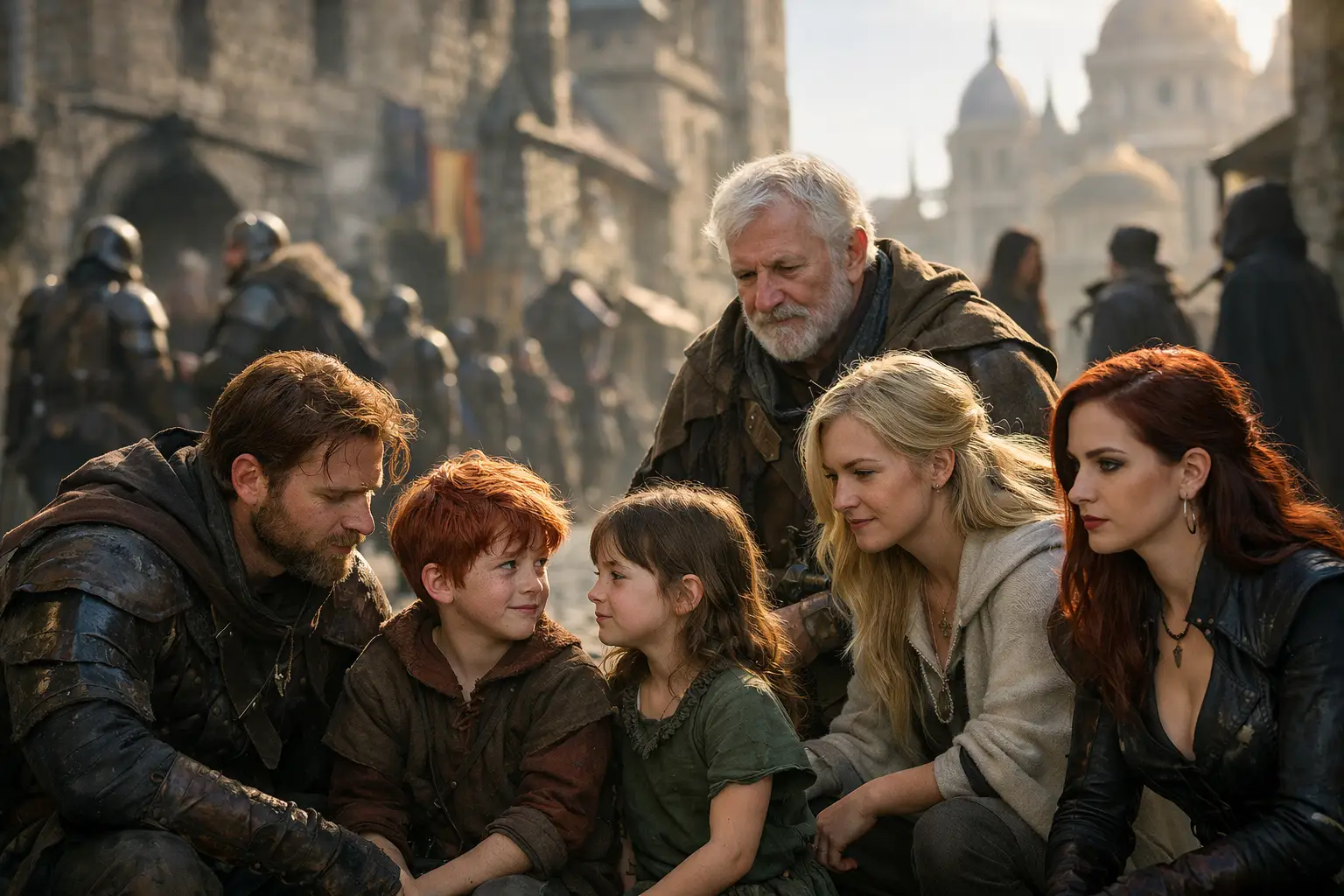
A Faction Conflict Case Study in a Living City
How research became factions, factions became pressure, and player action changed Edinburgh
Edinburgh Castle is already crowded before the players arrive.
Not with monsters.
With meanings.
It is a fortress, a national symbol, a tourist destination, a place of memory and authority. In our World of Darkness version of Edinburgh, it is also entangled with vampire politics, faerie interests, old supernatural wounds and the Stone of Destiny.
None of those factions were placed there because a campaign needed a confrontation at a castle.
The castle came first.
Then the city.
Then the research.
The factions followed.
That distinction is the foundation of this case study.
A faction conflict becomes much more durable when it grows from the place in which it occurs. Instead of beginning with five rival groups and searching for territories to give them, we began by asking what Edinburgh already was: politically, economically, historically, culturally, religiously, technologically and in the stories people tell about it.
Our research repeatedly returned to a dual image of Edinburgh: the rational, intellectual and increasingly technological “Athens of the North” beside the older “Auld Reekie” of narrow streets, plague memory, witchcraft stories, vaults and ghosts. In the campaign material, that tension becomes one of the fundamental engines of the supernatural city.
World of Darkness then gives us a fictional lens through which those existing forces can become supernatural.
But the method does not require World of Darkness.
The same process can build a city for fantasy, science fiction, historical horror, superheroes or an entirely original setting.
> Do not begin with factions. Begin with the city.
First research the city before deciding who controls it
A useful city model starts with a deceptively simple question:
Why is this city the way it is?
For Edinburgh, the answer cannot come from one field.
Geography matters.
Politics matters.
Religion matters.
Finance matters.
University culture matters.
Architecture matters.
Tourism matters.
The history of medicine matters.
Scottish national identity matters.
The festivals matter.
The old underground spaces matter.
And the stories told about those spaces matter.
That requires transdisciplinary research.
Academic history can tell us how institutions formed. Archaeology can show what occupied a location earlier. Economics can reveal where money and dependency move. Religious studies and theology can distinguish traditions that would be flattened by a generic category such as “Christianity”. Political history can explain why a parliament or court possesses particular significance.
But that is only one layer.
A living city is also formed by folklore, ghost stories, urban myths, popular literature, pulp, newspapers, tourism, radio, film, television, comics, games, fandom, internet culture, Creepypasta and the stories residents tell about themselves.
Edinburgh is particularly useful because these layers are unusually visible. Historical trauma, intellectual prestige, literary culture, modern festivals and commercial ghost culture coexist rather than replacing one another.
> A city is both a place and the stories people have learned to tell about that place.
This is why research cannot be reduced to deciding which account is factually correct.
We must distinguish fact from folklore, institutional memory from popular memory, modern mythology from historical evidence.
But a story does not have to be historically true to become socially powerful.
If people visit a place because they believe it is haunted, the belief has entered the economy.
If a community treats a historical event as foundational, that interpretation has political weight.
If decades of films, books and tourism have taught visitors how an “occult Edinburgh” should feel, that expectation exists even before the supernatural is introduced.
> Research is not only about establishing reality. It is about understanding the meanings that act upon reality.
Then ask what the city means inside the fictional setting
Only after understanding those forces do we add World of Darkness.
For readers unfamiliar with the setting, World of Darkness is a modern gothic universe in which vampires, werewolves, mages, ghosts, faeries, hunters and other supernatural groups exist largely beneath ordinary society. They possess different needs and metaphysical assumptions, but all of them still require places, institutions, resources, relationships and human societies in which to operate.
That makes the important question:
> What does this existing city mean inside this fictional universe?
Not:
“Where can we put some vampires?”
Edinburgh’s position as a financial centre gives us one answer.
Its enormous cultural life gives another.
Its ghost traditions give another.
Its modern data infrastructure gives another.
Its underground architecture gives another.
Its religious and political history gives several more.
That produces factions which belong to Edinburgh rather than simply occupying it.
> The setting should enrich the city, not replace it.
Cultural Edinburgh becomes a survival system
Take the city’s festival economy.
In ordinary Edinburgh, festivals are cultural events, institutions, employment, tourism, money, reputation and enormous temporary movements of people.
In World of Darkness, that existing structure acquires additional meanings.
The Toreador, a vampire clan strongly associated with art, culture, beauty and social prestige, find the festivals almost ideal. Crowds provide anonymity. Cultural institutions provide status and influence. Art and high society provide networks through which power can move.
The Kithain, the faerie people of Changeling, need imagination and emotional creative energy known as Glamour. For them, a city that repeatedly concentrates performance, artistic experimentation, national mythology and millions of acts of imagination is not simply culturally interesting. It is part of their survival.
Our Edinburgh material therefore gives the Toreador ruler, the Rose Prince, and the Kithain ruler, Princess Iona, a reason to maintain an uneasy understanding: both depend upon the cultural ecosystem even though they are not the same faction and do not ultimately want the same things. The NPC structure explicitly connects Iona’s survival strategy to the festivals and the Rose Prince’s domain to cultural and festival influence.
That creates an important design principle:
> Research creates dependency before faction conflict creates story.
The relationship is interesting because cooperation and conflict can both grow from the same dependency.
The festivals prosper?
Both benefit.
Surveillance increases?
Both become vulnerable in different ways.
One group tries to control the festivals too aggressively?
The former ally may become an opponent.
A good alliance is therefore not:
“These factions like one another.”
It is:
> “For the moment, their needs overlap.”
Financial Edinburgh creates a different faction
The next force emerges from another part of the city.
Edinburgh’s financial institutions make money and institutional access plausible channels of power.
Now we introduce another World of Darkness element.
The Ventrue are vampires traditionally associated with hierarchy, elite institutions, finance and political authority. In our campaign history, the supernatural power structure of London has collapsed under attack, leaving Ventrue refugees looking for a new base.
Research and fictional history now intersect.
Why would displaced financial elites choose Edinburgh?
Because the city can actually support what they need.
The resulting Black Thistle Society, led by Brother Tantalus, is therefore not simply “the evil rival vampire faction”. Our NPC material describes Tantalus as a London exile using Scottish financial institutions and political connections to rebuild Ventrue power, while ultimately serving a larger project connected to the lost London ruler Mithras.
Now compare him with the Rose Prince.
Both want supernatural society to survive.
Both want Edinburgh to remain viable.
Both have reasons to fear uncontrolled exposure.
But they disagree profoundly about the correct answer.
The Rose Prince needs stability.
Tantalus believes stability requires stronger Ventrue control.
> Shared survival does not imply shared strategy.
That is a much stronger faction conflict than simple personal hatred.
Modern Edinburgh creates a surveillance force
Now move to an entirely different research field.
Modern Edinburgh is also a university and technology city.
Our setting research connects its data and AI infrastructure to the Usher Building and transforms that into the fictional operational centre of a surveillance-oriented supernatural force.
For readers outside World of Darkness, the Technocracy is a faction of mages devoted to an ordered, rational, controlled model of reality. ANTIGEN, in our campaign, represents a modern hunter and intelligence apparatus searching for supernatural anomalies.
That means AI research, health data and surveillance do not merely become cyberpunk decoration.
They create a new force in the city:
legibility.
The more measurable Edinburgh becomes, the more dangerous it becomes for things that survive by remaining statistically impossible.
Dr. Elaine Ashdown, our human-facing NPC at this layer, therefore has power because she controls access to information systems, not because she carries a larger weapon than the vampire prince. The NPC research describes her role around sensitive data, surveillance and anomaly detection.
Now the social system begins reacting to itself.
The Rose Prince responds by forcing vampires towards analogue communication and crowded events.
That protects them from one form of surveillance.
But it also creates another vulnerability: vampires now depend more heavily on human intermediaries who must still exist in the digital world. The influence material explicitly identifies this trade-off between analogue security and vulnerable mortal networks.
This is an important rule for faction simulation:
> Every protection changes the field.
A successful defence can create a new weakness.
A gain can create a dependency.
A faction does not merely gain or lose abstract points.
Its possible future actions change.
Historical death creates another network
Edinburgh also carries an unusually visible history of death.
Greyfriars.
Covenanter memory.
The history of anatomy.
Burke and Hare.
Cemeteries.
Ghost narratives.
Commercial hauntings.
In our fictional Edinburgh, these become natural foundations for the Hecata, vampires associated with death and necromancy.
Their operative face is Dr. Silas Krain.
But Krain becomes interesting precisely because he is not simply “the necromancer villain”.
The setting material gives him an interest in exploiting the dangerous supernatural energy around Greyfriars, but also an interest in stabilising it before it becomes uncontrollable. Lord Cynon, an ancient vampire embedded in the judicial structure, blocks his work for reasons connected to his own influence.
Now the conflict becomes morally and strategically useful.
Krain may be attempting to contain something genuinely dangerous.
He also wants to own what he contains.
Cynon may oppose dangerous necromantic experimentation.
His interference may simultaneously increase the risk of a catastrophe.
The player-facing question is no longer:
Do we stop the bad necromancer?
It becomes:
Which dangerous actor are we willing to empower in order to deal with a problem that none of them created entirely by themselves?
> Factions do not need to disagree about whether a problem exists. They can fight over what should be done with it.
That principle works in any setting.
Two environmental factions can agree that the river is dying and still fight over the solution.
Two noble houses can agree that the kingdom needs a ruler and still go to war over who it should be.
Two corporations can recognise the same technological threat and attempt mutually incompatible responses.
The underground creates alliances that ideology would reject
Researching a city also means looking vertically.
Edinburgh does not end at street level.
Vaults, closes, tunnels, sewers and buried structures create another landscape.
In our World of Darkness model, that becomes the territory of Brother Cinch, a Nosferatu vampire whose influence comes through information and the subterranean network, and Rant, a technologically capable werewolf fighting corruption beneath and around the city.
Vampires and werewolves are not natural allies in this setting.
That is precisely why the alliance is interesting.
The campaign documents describe Cinch and Rant forming a pragmatic partnership because both face threats beneath the city which neither can safely solve alone. The same alliance is considered intolerable by the Technocracy, creating another reaction elsewhere in the network.
This gives us another general rule:
> Pressure can create alliances that ideology would never produce.
Faction design becomes much more interesting when alliances emerge from problems rather than from predefined friend-or-enemy lists.
Do not turn the city into an NPC encyclopaedia
At this point Edinburgh already contains a large number of supernatural forces.
That creates a dangerous temptation.
Write everyone.
Do not.
Our Influence model can allow many factions to exist and move without giving every group twenty named NPCs.
> Simulate broadly. Detail locally.
A background faction needs enough information to move coherently:
What does it want?
What supports it?
What does it fear?
What does it currently know?
What does it falsely believe?
Where can it exert Influence?
What does it depend upon?
What would make it react?
That can be enough.
NPC depth follows player contact.
> Detail should follow contact.
If the player characters currently deal with Cinch, then Cinch needs a life, voice, relationships, personal goals and the ability to act differently from his faction.
If they only know that a distant organisation exists, that organisation may remain a faction model.
If they later penetrate its structure, then additional people become necessary.
> Elaborate the interface, not the entire institution.
This also helps solve a common city-design problem.
The most important NPC is not necessarily the person with the highest rank.
It is the person whose decisions can reach the player characters.
> Importance comes from connection, not rank.
NPCs prevent factions from becoming machines
A faction has collective interests.
A person has a life.
Those are not identical.
The Rose Prince may want stability.
That does not mean every Toreador interprets stability the same way.
Iona may want to preserve Glamour.
One of her representatives may still hate a particular mortal cultural institution.
A police officer can work within a hunter network and still conceal a supernatural creature for personal reasons.
A Ventrue operative can believe in Tantalus’ political goals and refuse one particular order.
This is why our earlier NPC work remains important in a faction case study.
> Faction identity creates pressure. NPC identity determines how that pressure becomes action.
The office creates possibilities.
Biography influences how those possibilities are used.
Relationships can redirect institutional pressure.
And players interact with those relationships directly.
That is where a social model becomes roleplaying instead of simulation software.
Now let one event enter the network
We can finally run a case.
The existing Edinburgh material provides an excellent one.
Brother Tantalus and the Black Thistle Society want access to the Stone of Destiny at Edinburgh Castle. Within our supernatural interpretation, the Stone is much more than a national artefact: it is connected to old occult power and to Tantalus’ plan for restoring Mithras. Princess Iona has her own reasons to protect it, while the Rose Prince has reasons to prevent an event at the Castle from destabilising his entire domain.
The important part is that we do not begin by writing what the players will do.
We begin with the current state.
Black Thistle: wants the Stone.
Rose Prince: wants stability and secrecy.
Iona: wants the Stone and its surrounding cultural-metaphysical structure protected.
Cinch: wants his underground network secure.
Rant: is connected to Cinch and cares about threats moving through the undercity.
Ashdown / ANTIGEN: watches for unusual patterns.
Other factions continue to exist, but they do not all need immediate screen time.
Then something happens.
Suppose the players discover credible evidence that Black Thistle is preparing an operation against the Stone.
That is not a plot decision.
It is an event entering the network.
The Influence Game asks who now has reason to move
The first mistake would be to ask:
“What would make the best next scene?”
Instead ask:
> Who has just gained a reason to act?
Tantalus may try to identify the leak.
The Rose Prince may need to suppress the information before panic creates exposure.
Iona may demand action because her interests are directly threatened.
Cinch may become involved if the operation uses tunnels or hidden infrastructure.
Rant may become involved because Cinch asks for help.
ANTIGEN may notice unusual movement around people, infrastructure or data associated with the Castle.
Anarchs may discover fragments of the situation and see an opportunity while established powers are distracted.
Nobody is reacting because the GM needs another encounter.
They are reacting because the information changed what they know and what they can lose.
This is where the Influence Game creates pressure points and reaction points.
A pressure point appears where needs collide.
A reaction point appears where an actor now has a reason to decide.
And decisions create gains and losses.
Tantalus shuts down one information leak?
He gains secrecy.
Perhaps he loses a trusted operative.
Iona forces greater security around the Stone?
She gains protection.
Perhaps ANTIGEN now notices the abnormal security pattern.
The Prince suppresses public disturbance?
He gains stability.
Perhaps Iona concludes that he is protecting Tantalus.
Cinch helps the Prince?
He gains political credit.
Perhaps his alliance with Rant becomes more visible.
> The Influence Game does not merely measure power. It creates the pressure and reaction points through which the city moves.
Then the players make everything worse — or better
This is the part we cannot prepare.
The players might tell Iona.
They might warn the Prince.
They might negotiate with Tantalus.
They might steal the Stone first.
They might fabricate evidence implicating another faction.
They might expose Black Thistle publicly.
They might decide that Tantalus has a point.
They might ignore the situation completely.
Or they may devise something we never considered.
That is not a failure of preparation.
It is the test of whether the city is alive.
> The world creates the situation. The players create the choice.
Because we understand the factions, their dependencies and the relevant NPCs, we do not need a branch for every possible decision.
We ask what their action changes.
Then the Influence Game moves again.
A failed operation can still transform the city
Suppose Tantalus never gets the Stone.
It would be easy to conclude:
“Plot prevented. Status quo restored.”
But a living city rarely works that way.
Perhaps Black Thistle loses an operative.
Cinch learns that their tunnel network has been compromised.
Iona discovers that the Rose Prince withheld information from her.
ANTIGEN registers an unusual cluster of activity around the Castle.
Rant now owes Cinch a favour.
The Prince survives politically but appears weaker.
Tantalus now knows the player characters are dangerous.
The Anarchs hear that the supposedly untouchable elders can bleed.
The Stone never moved.
The city did.
> The event does not have to succeed in order to change the world.
This is the difference between resolving a scenario and updating a living world.
The World Tick asks what has become true
The Influence Game creates movement.
The World Tick establishes the new state after that movement.
> The Influence Game models movement. The World Tick records what that movement has made true.
We now ask:
Who gained?
Who lost?
Which relationships changed?
Which faction gained Influence?
Which lost access?
Which NPC now owes someone a favour?
Who feels betrayed?
Who possesses new information?
Which tensions increased?
Which weakened?
What resources moved?
Which new vulnerability exists?
What new opportunity has appeared?
What is now publicly known?
What is merely suspected?
The result is not “the end of the chapter”.
It is Edinburgh B.
A new starting state.
The next session begins in that world, not in the Edinburgh that existed before the players acted.
Bardic Resonance lets Edinburgh tell the story in its own language
But players should not receive the World Tick as a report.
They should experience it through Edinburgh.
This is where the city’s research becomes important again.
Different cities communicate differently.
Edinburgh has newspapers.
University networks.
Festivals.
Tourism.
Political rhetoric.
Churches.
Ghost tours.
Alternative clubs.
Local folklore.
Online communities.
Performance.
A disturbance around the Stone may therefore return to the players as:
a newspaper report about a security incident,
a tour guide repeating a new story about tunnels beneath the Castle,
a Fringe performer making a joke uncomfortably close to the truth,
a sermon about national relics and desecration,
an Anarch rumour circulating in Cowgate,
an official statement that explains almost nothing,
a Creepypasta claiming that figures were seen beneath Castle Rock,
or a song that turns the entire event into something it never was.
This is Bardic Resonance.
> Bardic Resonance asks what an event becomes as its meaning moves through the world.
And those interpretations can generate new Influence.
The Creepypasta brings people to a location.
The rumour damages Tantalus.
The official denial increases suspicion.
The song makes the player characters famous among people they have never met.
The city remembers through its own cultural machinery.
> Bardic Resonance should speak in the media, myths and social habits of the world that carries it.
The method works without vampires
Remove World of Darkness.
The structure remains.
Imagine a fantasy capital.
Research its river, trade, temple system, guilds, immigration, wars, class relations, climate and myths.
Those forces produce factions.
A merchant coalition.
A temple reform movement.
A dockworkers’ brotherhood.
A royal tax administration.
Smugglers.
A displaced ethnic community.
A military order.
Then identify dependencies.
Who needs grain?
Who needs legitimacy?
Who controls ships?
Who controls credit?
Who controls violence?
Give NPCs only to the groups the players currently reach.
Then allow an event to enter the network.
Run the reactions.
Record gains, losses and tensions.
Apply the World Tick.
Let rumours, songs, proclamations and sermons carry the result.
The city changes.
The same method works for a science-fiction colony.
A superhero metropolis.
A cyberpunk arcology.
A western town.
A historical city with no supernatural element at all.
The genre changes the forces.
The method remains.
A practical way to build any living city
Edinburgh taught us not to begin with the supernatural map.
Begin with the city.
Research what it physically is.
Then what it historically became.
Then how people make a living there.
Then how authority works.
Then what communities believe.
Then what the city remembers.
Then what stories it tells about itself.
Then what modern media and popular culture have taught people to expect from it.
Only then ask what those forces mean inside your fictional setting.
From there:
Discover factions rather than assigning them.
Identify what each needs, protects, fears and depends upon.
Find where those needs collide or overlap.
Keep background factions broad until player contact requires detail.
Give reachable factions NPCs with personal goals and relationships.
Remember that those NPCs need not act exactly as their faction expects.
Use Influence to create pressure, reaction, gains and losses.
Let players enter the same field rather than standing outside it.
Use the World Tick to establish the changed state.
Use Bardic Resonance to let that state return through the city’s own voices.
Then research again when the changed city produces a question you cannot yet answer.
That is the loop.
We did not write Edinburgh’s conflict
That may be the most important lesson from the case.
We did not begin by deciding that Toreador should fight Ventrue, that faeries should worry about festivals, that a necromancer should clash with the courts, or that a vampire information broker should cooperate with a werewolf.
We researched the city.
Then we asked what World of Darkness did to the forces already present there.
Edinburgh’s culture created dependencies.
Its finance created opportunities.
Its political history created memory.
Its underground created territory.
Its technology created surveillance.
Its dead created another economy.
Its folklore created meaning.
The setting transformed those forces into supernatural pressures.
Factions formed around them.
NPCs gave those factions human decisions.
Influence let their actions collide.
Players entered the field.
The World Tick made their consequences part of the city.
Bardic Resonance taught Edinburgh how to remember them.
> We did not write a conflict for Edinburgh. We researched Edinburgh deeply enough to discover the forces that could conflict, gave those forces motives and human faces, and then let the players enter the field. The story is what happened when the city answered them.
You do not need Edinburgh.
You need to understand your city deeply enough that it can do the same.
Stories that remember. Worlds that change.
Read: https://mythveilchronicles.com/ Play: https://startplaying.games/gm/dunchan Watch: https://www.youtube.com/@MythveilChronicles Support: https://www.patreon.com/MythveilChronicles Collaborate: https://www.linkedin.com/in/francisco-jos%C3%A9-z-b05aab371/