London, 1936.
A pencil lies on a table.
No crystal ball.
No candles.
No séance.
Just a pencil.
CHIBI
How many dead people has she spoken to?
RESEARCHER
We do not say that she has spoken to dead people.
CHIBI
How many people who might possibly be dead has she possibly spoken to?
MARA
Chibi.
CHIBI
What?
I’m improving the methodology.
Eleanor Finch smiles.
ELEANOR
None.
CHIBI
None?
ELEANOR
I’ve never spoken to anyone.
Sometimes my hand simply writes things I don’t remember thinking.
CHIBI
That’s considerably worse.
Eleanor closes her eyes.
For several minutes, nothing happens.
Then the pencil moves.
Slowly.
RESEARCHER
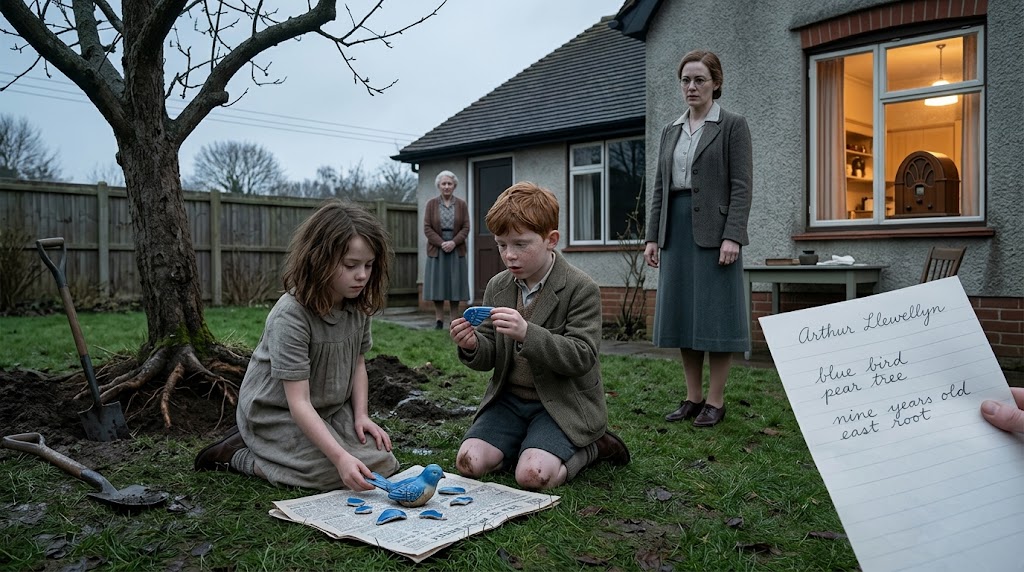
Arthur Llewellyn.
MARA
Who is he?
RESEARCHER
We don’t even know whether he existed.
CHIBI
Then he could be extremely alive.
Not much of a ghost.
The researcher reads the rest.
RESEARCHER
“Blue bird.”
“Pear tree.”
“Mother cried.”
“Nine years old.”
MARA
That’s all?
RESEARCHER
That’s all.
CHIBI
Your ghosts are terrible conversationalists.
Two days later.
Arthur Llewellyn existed.
Born 1851.
Died 1912.
No known connection to Eleanor.
Then she writes again:
UNDER THE EAST ROOT.
I LIED TO MOTHER.
They visit the house where Arthur grew up.
His elderly daughter, Beatrice, reads the notes.
BEATRICE
Most of this means nothing.
Blue bird?
No.
Mother cried?
Could mean anything.
Nine years old?
No idea.
There.
Your ghost has failed.
MARA
What about “east root”?
Beatrice hesitates.
MARA
You know something.
BEATRICE
There used to be a little ceramic bird in the garden.
Blue.
My grandmother loved it.
Father hated it.
CHIBI
Did it break?
Beatrice looks at him.
BEATRICE
Yes.
When Father was a boy.
Grandmother blamed a servant and dismissed her.
Father would never say what really happened.
MARA
How old was he?
BEATRICE
Nine.
I think.
Silence.
They dig beneath the eastern roots of the old pear tree.
Mud.
Roots.
Nothing.
Then the spade strikes ceramic.
A blue fragment.
Another.
A tiny wing.
They put the pieces together.
A little blue bird.
Broken.
Buried.
Forgotten.
BEATRICE
Father did it.
He broke it and let the servant take the blame.
CHIBI
He was nine.
Nine-year-olds are allowed to be cowards sometimes.
Eleanor stares at the fragments.
ELEANOR
I didn’t know.
I swear I didn’t know.
MARA
I believe you.
RESEARCHER
We cannot establish that.
MARA
I didn’t say we could.
I said I believe her.
Later, they sit around the kitchen table.
A wireless plays softly nearby.
CHIBI
So Arthur is a ghost.
RESEARCHER
We don’t know.
CHIBI
Reincarnation?
RESEARCHER
We don’t know.
CHIBI
Telepathy?
RESEARCHER
We don’t know.
CHIBI
You say that a lot.
RESEARCHER
It’s an underrated sentence.
MARA
Eleanor…
did Arthur speak to you?
ELEANOR
No.
MARA
Did you see him?
ELEANOR
No.
MARA
Did you feel him?
ELEANOR
No.
CHIBI
Then how did you know?
Eleanor looks at her hands.
ELEANOR
I didn’t.
That’s what frightens me.
Mara looks towards the wireless.
MARA
If someone speaks on the radio…
are they inside the radio?
CHIBI
No.
MARA
Are they inside this house?
CHIBI
No.
MARA
But we hear them.
CHIBI
Yes.
MARA
Maybe memory works like that sometimes.
RESEARCHER
That’s a metaphor.
Not an explanation.
MARA
I know.
CHIBI
But it’s a good metaphor.
The researcher reluctantly nods.
CHIBI
So maybe Arthur was broadcasting.
MARA
Or maybe the memory was.
RESEARCHER
What’s the difference?
MARA
Arthur is a person.
A memory is information.
Chibi stops smiling.
CHIBI
Oh.
If Arthur has to still exist for the memory to be here…
that’s a ghost.
MARA
Maybe.
CHIBI
But if he doesn’t…
then the memory could still be here even if Arthur isn’t.
Later, walking towards the railway station:
CHIBI
I hope Arthur is still somewhere.
MARA
Why?
CHIBI
Because if he isn’t…
then something remembered him anyway.
Mara stops.
MARA
Say that again.
CHIBI
No.
MARA
Chibi.
CHIBI
You should have listened the first time.
MARA
What if Arthur wasn’t broadcasting?
CHIBI
Then who was?
MARA
Maybe nobody.
Maybe memories can remain somewhere.
CHIBI
Like a library?
MARA
Maybe.
CHIBI
Then the brain isn’t a radio.
MARA
It still could be.
CHIBI
A radio that tunes into a library?
That’s a terrible radio.
MARA
You know what I mean.
CHIBI
If minds are radios…
can we transmit too?
Mara thinks about everything they have followed this month.
Hope.
Fear.
Stories.
Love.
Hatred.
One mind changing another.
MARA
Maybe that’s what we’ve been doing all along.
CHIBI
Talking?
MARA
More than talking.
Maybe every person broadcasts a little.
Memories.
Fear.
Love.
Ideas.
CHIBI
That’s nice.
MARA
It could be.
CHIBI
Could?
MARA
Depends what’s being transmitted.
A train whistle sounds in the darkness.
CHIBI
And what if we hear something that isn’t human?
Mara looks at him.
MARA
Then I hope we remember how to change the station.
QUESTION FOR YOU
If someone revealed a secret that died with a stranger decades before they were born, which possibility would disturb you more:
that the dead can still speak —
or that memories might survive even when the person who made them is gone?
PLAY EPIC. FEEL THE STORY.
For more than a century, researchers have seriously debated reports of automatic writing, mediumship, telepathy and information apparently connected to the dead.
None of that proves that the dead survive.
It does not prove that consciousness is non-local.
And it certainly does not prove that the human mind can tune into some invisible archive of memory.
But Pulp Cthulhu allows one uncomfortable fictional question:
What if the information is real even when our explanation is wrong?
Perhaps the dead speak.
Perhaps memories survive their owners.
Perhaps living minds sometimes receive what was never theirs.
And if the mind really can tune into something beyond itself…
the final question of Inner Fire is not whether humanity is alone in the dark.
It is whether we have been listening to the dark all along.
Join Mythveil Chronicles:
https://startplaying.games/gm/dunchan
Explore the complete essays, research and narrative philosophy behind Mythveil Chronicles:
https://www.patreon.com/c/mythveilchronicles_bydunchanhuntergames