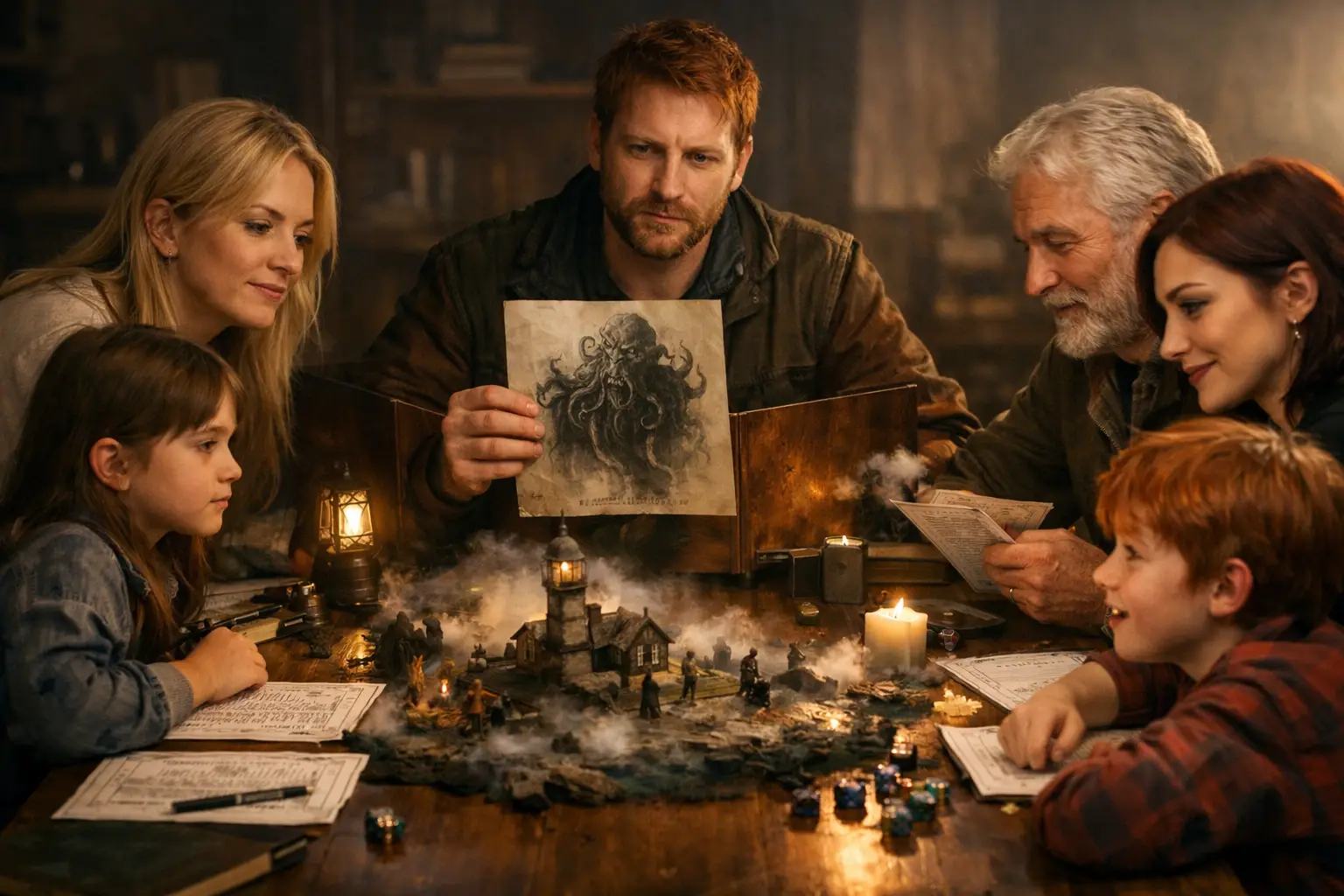
What a Paid Call of Cthulhu Campaign Can Become
MYTHVEIL CHRONICLES
The telegram arrives at 2.13 a.m., its paper wet with rain though nobody heard the letterbox move. It bears the name of a man your investigators watched die six months ago.
Beneath it, in a hand that has begun to haunt the group, are six words:
The coast remembers what you buried.
That is what a paid Call of Cthulhu campaign can become at its best. Not simply a scheduled game with a professional at the head of the table, but a place where an investigator acquires a past, a group creates a shared history, and the world eventually begins telling stories about what they did there.
You are not paying to be told a story.
You are paying for the conditions in which your choices can become one.
A one-shot can offer a perfect night of horror. A door opens, the truth is found, and whatever remains of the investigators limps towards dawn. Long-form play offers something different. Decisions accumulate. Relationships deepen. Places change. A name that meant nothing in the first session can silence the entire table six months later.
The value is not merely more content. It is continuity with consequence.
A Paid Campaign Gives Your Investigator Time to Become Someone
On the first evening, your investigator may be little more than an intriguing possibility.
A former military doctor refuses to abandon a patient. A journalist has an estranged brother in Liverpool. An antiquarian keeps a photograph whose reverse side has been carefully scraped clean. These details are useful, but they are not yet history. They are invitations.
A sustained campaign gives the world time to answer them.
The brother writes after months of silence. The doctor’s ethical line is tested by a patient who may no longer be entirely human. The missing words on the photograph appear in another archive, written beside the name of someone the group has already met.
The Keeper should not seize those details and impose a predetermined tragedy. The point is not to punish players for giving their characters people to love. The point is to bring what the players chose into contact with a world that moves.
The character sheet said the investigator had a sister.
The campaign eventually discovered what that meant.
From the player’s side, this creates a particular kind of attachment. You no longer ask only whether the investigator will survive the next encounter. You wonder what survival will make of them, what they will still believe afterwards, and whether the people who knew them before will recognise the person who returns.
Research Feels Like Trust
A professional Keeper may spend hours researching a period, a city, a religious practice, an archive, a medical procedure, or the ordinary logistics of travel. Players do not need to see those hours. They need to feel their effect.
Research, from the player side, is the confidence that the world has substance beyond the immediate scene.
The archive follows rules. The port has working hours, labour disputes, loyalties, and people who know which questions outsiders should not ask. A village church is not simply a gloomy building placed beside the graveyard. It belongs to a community with its own memory, rituals, grudges, and version of what happened beneath the cliffs.
The player does not need to know how the archive was researched.
They need to trust that the archive existed before their investigator opened the door.
That trust matters because meaningful agency requires conditions that feel real. You can only make a difficult decision when you understand enough of the world to judge what might be lost. Research gives weight to the choice between exposing a family, protecting a witness, angering an institution, or allowing a lie to remain useful for one more night.
History should never become an examination in which the Keeper knows the answer and the players are punished for living in the present century. Good research makes a world more inhabitable, not less accessible. It gives the Keeper enough understanding to guide without lecturing and enough depth to answer the unexpected question.
When a player says, “Could I speak to the dockworkers instead of the harbourmaster?”, the campaign should not collapse because the dockworkers were not in the prepared scene.
The world already knows they are there.
Agency Becomes Responsibility
New players often imagine agency as freedom: the ability to go anywhere and attempt anything. Long-form horror reveals a more powerful form of it.
Agency becomes responsibility.
At first, the group may ask which lead moves them towards the next chapter. Months later, they ask who can safely receive the evidence, which ally is now compromised, and whether revealing the truth will do more damage than concealing it.
A meaningful decision is not one that guarantees the result you wanted.
It is one the campaign cannot pretend you never made.
Suppose the investigators discover that a respected physician has protected a cult in exchange for access to treatments unavailable anywhere else. Exposing him may save future victims while condemning current patients. Silence may preserve lives while allowing the arrangement to continue. Handing the evidence to the authorities may simply transfer the secret to an institution with better filing cabinets and fewer moral objections.
The value of the campaign lies in the fact that these choices do not dissolve when the scene ends.
A player sees trust shift. A contact stops answering. A hospital changes its rules. A rival learns what the group was willing to sacrifice. Someone who was saved becomes grateful, frightened, politically useful, or all three.
This is where paid long-form play can become very different from consuming a prepared story. The Keeper has material, tensions, and possible developments, but the future is not complete until the players act.
You are not selecting dialogue before the next cutscene.
You are helping decide what kind of world can exist afterwards.
The Other Players Become Part of the World
A campaign is not a private performance delivered by one GM to several customers. Its deepest value is created between the people at the table.
Over time, a group becomes an ensemble.
Everyone learns that the doctor will never leave a patient. The journalist always keeps one fact from the rest of the group. The antiquarian laughs when frightened and becomes very quiet when truly afraid. One investigator knows how to calm another after a Sanity loss. A third remembers which lie the group told the police eight sessions ago.
These patterns are not merely character traits. They become shared expectations, pressure points, and sources of trust.
A disagreement about whether to burn a manuscript carries more weight because the players know what knowledge has already cost each investigator. A moment of loyalty matters because betrayal was possible. A joke in the dark is funny not because the campaign has abandoned horror, but because people under pressure sometimes need proof that they are still people.
No Keeper can manufacture this chemistry on command. What professional play can provide is the stable container in which it has time to grow: consistent scheduling, clear moderation, shared boundaries, attention across the table, and enough continuity for relationships to matter.
The campaign remembers the players’ choices. The players begin remembering one another’s.
That is when the group stops feeling like several protagonists standing near the same clue and begins feeling like people who have survived something together.
The World Moves While You Are Away
From the Keeper’s side, the world may be tracked through relationships, factions, resources, unresolved threats, and changes between sessions.
From the player’s side, it is experienced as a simple and powerful feeling:
Something happened while we were not looking.
The group returns to the coast.
The constable they embarrassed now holds a senior position. The innkeeper they protected has sold the building. The old cult symbol has disappeared from the sea wall and begun appearing on fishing boats instead. A newspaper describes the earlier disaster as an industrial accident. One survivor has become a public speaker. Another insists the investigators caused everything.
In a static campaign, returning to a place means reopening the old chapter.
In a living campaign, someone has been writing in the margins.
This does not mean the Keeper must simulate every breakfast, election, and leaking roof. Players do not need a report on every candle burning in every village. They need the meaningful forces to continue.
A faction uses the group’s absence. An ally makes a choice without asking permission. A rumour gains authority because nobody contradicted it. An abandoned investigation is completed by someone with different motives. A victory creates a vacancy, and somebody decides it would be a shame to leave power unattended.
The effect on players is not helplessness. It is urgency and curiosity.
The world does not wait for them, but it is changed by them. Their return matters precisely because life continued in their absence.
Consequence Returns as Story
The strongest moment in a living campaign is often not the original decision.
It is the moment that decision comes back altered.
The investigators know what happened beneath the cliffs. They know who died, what was buried, and why the official account is false. But the town has had six months to create versions of its own.
The church calls it a test of faith.
The council calls it a regrettable landslide.
The newspaper calls it smuggling.
A local child has turned it into a rhyme.
The surviving cult calls it the First Burial and has become worryingly enthusiastic about a second.
This is more than a callback. It is the world interpreting player action through memory, fear, politics, gratitude, resentment, and need.
The investigators remember burying the evidence.
The coast remembers what they buried.
That difference is where long-form horror acquires depth. Players do not merely learn that their choices had consequences. They encounter what other people have made from those choices.
A rescue becomes propaganda. A failure becomes a warning. A compromise becomes tradition. A phrase spoken in exhaustion becomes the motto of people the investigators never intended to inspire.
The players recognise their action, but it no longer belongs only to them.
This is how a campaign begins to feel like history.
What Are You Actually Paying For?
Maps, hand-outs, music, virtual tabletops, sourcebooks, and polished presentation can all improve a game. They are visible, easy to list, and useful.
They are not the whole value.
In a strong paid Call of Cthulhu campaign, players are paying for sustained stewardship:
a reliable place in a continuing story;
a Keeper who remembers the investigators and responds to what they do;
preparation shaped by previous sessions rather than copied unchanged from a chapter;
a table culture protected with care;
historical and cultural depth that supports decisions;
and enough continuity for consequences to mature.
Payment does not guarantee emotional depth. A private campaign can become extraordinary, and a paid game can remain shallow. Money is not a ritual component that summons quality, although several industries continue testing the theory.
What professional play can do is protect conditions that often fail under ordinary pressure: schedule, preparation, moderation, communication, campaign memory, and responsibility for keeping the experience coherent over time.
That reliability matters. A story cannot accumulate if every session is uncertain, every player change resets the group, and every important detail has disappeared by the time it becomes relevant.
You are not paying for the promise that every session will be perfect.
You are paying for someone to take the continuity seriously.
The Player Also Makes a Commitment
A paid seat is not a ticket to passive entertainment.
Long-form play asks something from the player as well.
Show up consistently. Pay attention to the other investigators. Communicate what you enjoy and what is not working. Respect the boundaries of the table. Bring a character who can make decisions, form relationships, and care about something beyond personal survival.
Most importantly, accept that agency includes consequences you did not intend.
This does not mean surrendering control of your character or accepting arbitrary punishment. It means allowing the world and the other players to answer what you chose.
A paid seat gives the player a place at the table.
It does not relieve them of the interesting responsibility of being there.
The best campaigns are collaborations held within a strong creative structure. The Keeper brings research, judgement, continuity, and a world capable of response. The players bring attention, decisions, vulnerability, and the willingness to let their investigators become more complicated than the people first written on the character sheets.
What a Paid Call of Cthulhu Campaign Can Become
Six months ago, the investigators buried something beneath the cliffs.
At the time, it felt like an ending. They had stopped the immediate danger. Protected someone who could not survive public scrutiny. Concealed a truth that seemed safer under stone and salt water.
Since then, the campaign has not been waiting.
People have lied about what happened. Factions have searched for what was lost. A survivor has built a life around the wrong explanation. The dead man’s name has appeared in places where it should not. The coast has acquired its own version of the story.
Now the telegram lies on the table.
The players recognise the handwriting.
They also recognise something more important.
This is not the beginning of a new case.
It is what their old decision has become.
That is the deepest promise of a paid long-form campaign. Not more sessions for their own sake. Not a larger collection of monsters, maps, or revelations. A place where an investigator acquires a past, where a group creates a shared history, and where the world eventually begins telling stories about what they did there.
Bring an investigator with something to lose.
Make the decision that feels dangerous but true.
Then listen carefully when the world answers.
Read. Play. Watch. Support. Or Collaborate.
Read: https://mythveilchronicles.com/
Play: https://startplaying.games/gm/dunchan
Watch: https://www.youtube.com/@MythveilChronicles
Support: https://www.patreon.com/mythveilchronicles_bydunchanhuntergames
Collaborate: https://www.linkedin.com/in/francisco-jos%C3%A9-z-b05aab371/
MYTHVEIL
We create worlds you want to live in.
Stories that remember. Worlds that change.
MYTHVEIL CHRONICLES | .