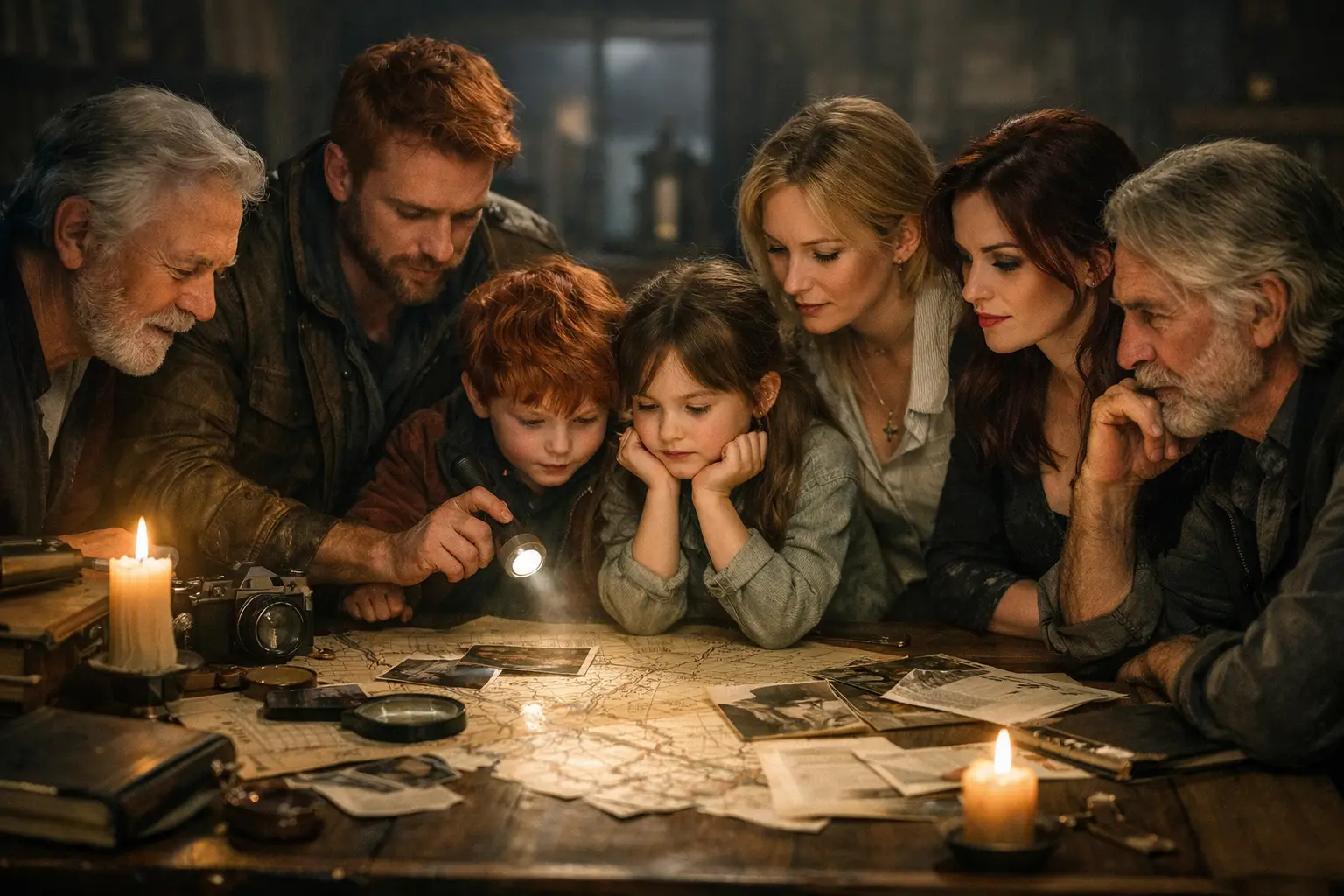
The corpse has been removed. Rain beads on the police tape. On the mantelpiece sits a family photograph with one face cut cleanly away. The question is not whether the players can find the clue. It is what that clue will cost them once they understand it.
The best investigative roleplaying systems recognise that mystery is more than a locked door and a clever answer. They create pressure around knowledge: sanity frays, institutions close ranks, old loyalties turn poisonous, and every revelation redraws the characters’ sense of who they are. The right system depends on the kind of investigation your table wants to inhabit.
For a one-night puzzle, almost any ruleset can carry a detective story. For campaigns where evidence alters factional power, private histories, and the future of a living world, the game’s underlying assumptions matter far more. These seven systems approach investigation with very different ideas about failure, fear, competence, and consequence.
What makes an investigative system worth playing?
A weak mystery scenario treats clues as loot. A strong one treats them as doors. Opening a door should lead somewhere meaningful, even when it leads towards danger.
The most useful investigative games tend to do three things well. First, they prevent a bad roll from stopping the story cold. Second, they give the Game Master tools for escalating tension once the truth begins to surface. Third, they make the investigators feel embedded in a society, whether that means a 1920s university, a police department, an occult underground, or a village whose inhabitants all remember the same impossible winter.
That does not mean every game should guarantee success. Failure can be vital. The distinction is between failing to obtain the next lead and failing to control what follows from it. The former stalls a session. The latter creates drama.
The best investigative roleplaying systems for different mysteries
1. Call of Cthulhu for fragile people facing impossible truth
Call of Cthulhu remains a defining choice for cosmic-horror investigation because its investigators are not action heroes in clever costumes. They are scholars, doctors, journalists, antiquarians, and desperate survivors trying to impose human meaning on something that does not recognise humanity at all.
Its skill-based structure makes searching archives, interviewing witnesses, examining scenes, and pursuing specialised knowledge feel grounded. The Sanity system gives discovery a psychological cost, which is exactly where many Lovecraftian mysteries find their force. A clue may solve the immediate case while permanently changing what a character can bear to believe.
The trade-off is that traditional skill rolls can occasionally conceal essential information behind bad luck unless the Keeper designs with care. Call of Cthulhu rewards prepared mysteries with multiple paths forward. It is strongest when the investigation is rooted in place: a decaying estate, a coastal town, a museum collection, or a family legacy that has been quietly rotting for generations.
2. Trail of Cthulhu for mysteries that keep moving
Trail of Cthulhu uses the GUMSHOE engine, built around a simple but powerful promise: if an investigator has the relevant ability and looks in the right place, they get the core clue. The story does not collapse because the archaeologist rolls poorly while examining the only tablet that matters.
This shifts the drama away from clue retrieval and towards interpretation, resource management, and the consequences of following a lead. Players can spend investigative points for richer details or advantages, while Stability and Sanity separate immediate emotional strain from deeper existential damage.
It is an excellent fit for groups that love cosmic horror but dislike mysteries being derailed by dice. Some players may find its procedural clarity less tactile than a dense skill list, particularly if they enjoy granular simulation. Yet for a campaign built on escalating revelations, Trail of Cthulhu provides an elegant skeleton on which to hang dread.
3. Delta Green for institutional horror and moral injury
Delta Green asks a darker question than most occult-investigation games: what happens when competent people become the barrier between civilisation and the truth? Its agents investigate unnatural threats while balancing careers, marriages, friendships, and the slow erosion of their own lives.
The system’s Bonds are its quiet weapon. Trauma does not simply subtract from a mental-health score. It bleeds into the relationships that once made a character human. That gives every operation a second crime scene: the home left behind, the colleague lied to, the child whose parent has returned carrying a silence they cannot explain.
Delta Green is especially potent for modern conspiracies, procedural investigations, and campaigns where organisations are characters in their own right. It can be unforgiving, and it asks players to engage with bleak material thoughtfully. For tables seeking heroism with a clear moral centre, it may feel oppressive. For those drawn to secrecy, compromise, and consequences that follow agents home, few games are sharper.
4. Night’s Black Agents for spies hunting monsters
Also powered by GUMSHOE, Night’s Black Agents transforms investigative horror into an international spy thriller. The player characters are capable operatives, not helpless witnesses. They can tail suspects through foreign cities, breach secure systems, cultivate assets, and survive a fight when discretion fails.
Its great strength is the Conspyramid, a campaign structure that maps a conspiracy from street-level operatives to its hidden architects. Every discovery can reveal another layer of control, and every disruption sends ripples through the enemy network. This makes it superb for long-form games where the investigation must feel active rather than archival.
The default tone is high-energy and cinematic. That may not suit a table seeking slow, mournful folk horror or ordinary people confronting the uncanny. But if your ideal mystery involves a compromised embassy, a vanished asset, and a vampire financier whose influence reaches into three governments, Night’s Black Agents understands the assignment.
5. Vaesen for folklore with a human heart
Vaesen places investigators in a mythic nineteenth-century Scandinavia where folklore survives beneath the surface of modernity. The mysteries are not merely about identifying a supernatural creature. They are about understanding why a spirit has become hostile, what human wound lies beneath the haunting, and whether restoration is possible.
The rules are comparatively light, leaving room for atmosphere, relationships, and the melancholy of changing landscapes. The investigators’ headquarters grows over time, offering a satisfying sense of continuity between cases. A village visited in spring can remain part of the campaign’s emotional geography years later.
Vaesen is ideal for Game Masters who want mysteries shaped by history, land, class, family obligation, and old belief. It is less suited to players who want detailed forensic procedure or elaborate conspiracy mechanics. Its power lies in the ache behind the monster story: the bargain broken, the grave neglected, the river treated as if it had no memory.
6. Brindlewood Bay for collaborative, character-led mystery
Brindlewood Bay appears deceptively gentle. Its protagonists are elderly women in a mystery club, investigating murders in a coastal community while gradually uncovering a lurking occult conspiracy. Beneath the cosy surface sits a bold design choice: the Game Master does not begin with one fixed solution.
Instead, players gather clues and form a theory. A successful roll determines whether that theory is correct, based on how well the evidence supports it. This makes the mystery a collaborative act of storytelling rather than a test in which players must read the Game Master’s mind.
For groups who value character relationships, improvisation, and shared authorship, it can be revelatory. For groups who want a pre-existing culprit, a meticulously solvable timeline, and forensic certainty, it may feel too open. Brindlewood Bay works best when everyone accepts that the emotional truth of the mystery can matter as much as the factual route to it.
7. Warhammer Fantasy Roleplay for investigations in a corrupt world
Warhammer Fantasy Roleplay is not exclusively an investigative game, which is precisely why its mysteries can feel so alive. Its Old World is crowded with petty officials, religious rivalries, criminal guilds, frightened citizens, inherited prejudice, and corruption both mundane and supernatural. A missing person case can become a dispute between factions before the first cultist appears.
Characters are often vulnerable, socially constrained, and thoroughly entangled in the places they travel. That makes evidence difficult to obtain and dangerous to possess. The truth may be known by someone with no power to speak, buried in a bureaucracy that benefits from silence, or protected by a patron whose help comes with a debt.
Its crunch and occasionally chaotic tone demand more preparation than lighter systems. Yet for a living-world campaign, it offers rich soil. At Mythveil Chronicles, this kind of social density matters: clues should not end a story, but alter who has influence, who now watches the party, and which old promise has become impossible to keep.
Choose the engine that supports your table’s fears
There is no single winner because investigation changes shape with genre. Choose Trail of Cthulhu when you want revelations to flow reliably. Choose Call of Cthulhu when vulnerability and deteriorating sanity are central. Choose Delta Green for the intimate damage caused by necessary secrets, Night’s Black Agents for conspiratorial momentum, Vaesen for sorrowful folklore, Brindlewood Bay for shared deduction, and Warhammer Fantasy Roleplay for a world where every answer has social consequences.
Before selecting a system, ask your players what they want a clue to mean. Is it a path to safety, an invitation to danger, proof that a trusted institution is compromised, or a memory that will change a character forever? The most memorable investigations begin when the evidence is found and the real choice finally arrives: now that you know, what are you willing to become?