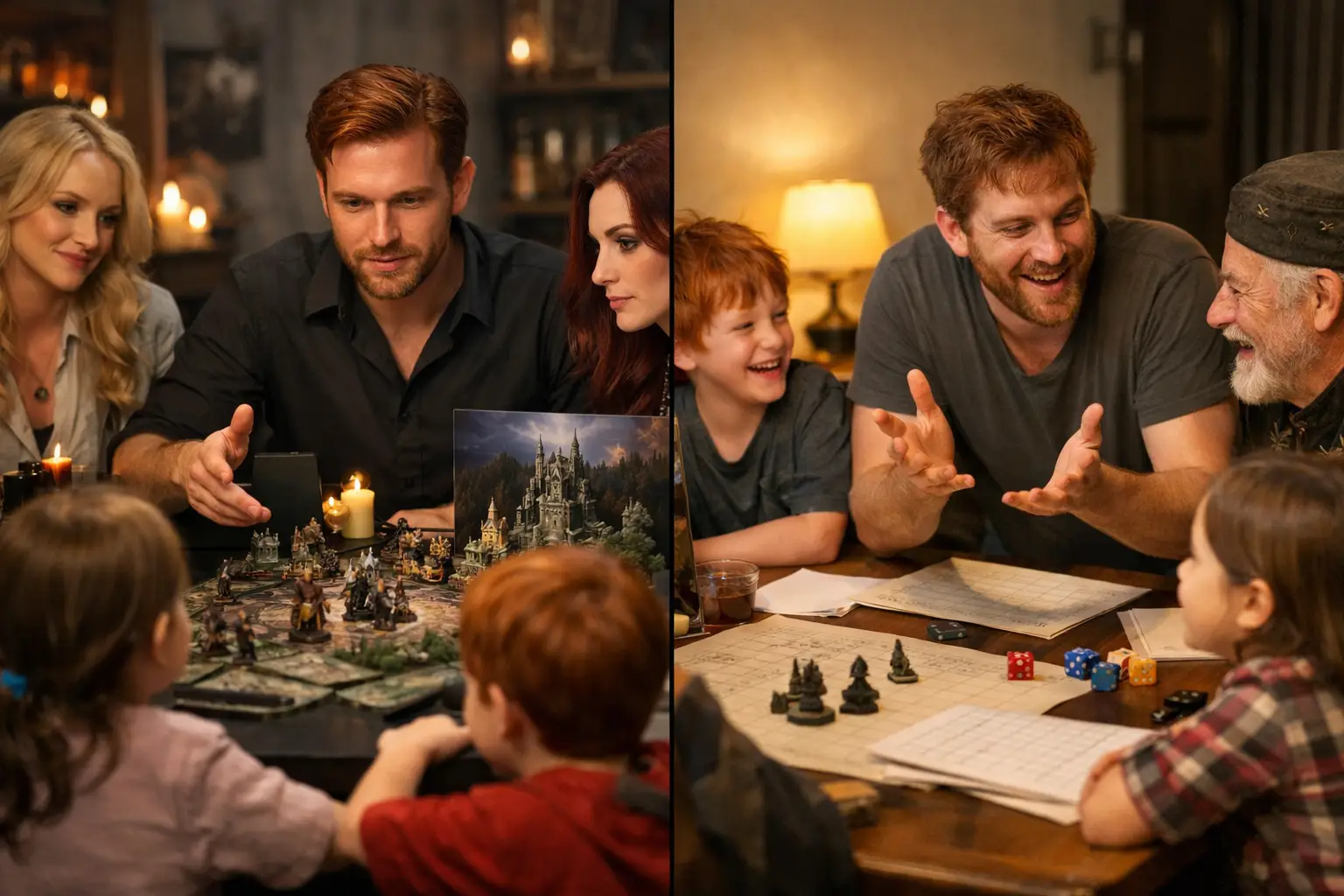
Why Mythveil Games?
The lantern goes out in the old chapel.
Somewhere beneath the floorboards, something answers the investigators’ last mistake.
At that moment, the question is not whether the Game Master can perform the finest villainous voice. It is whether the world around that moment has weight.
Who remembers what the players promised three sessions ago?
Which faction benefits if the investigators fail?
What rumour will travel by morning?
Which frightened witness will decide, months later, that silence is no longer enough?
That is the difference Mythveil games are built around.
Not spectacle for its own sake.
Not a string of encounters waiting to be consumed.
A Mythveil campaign is designed as a living world: a place where choices echo, factions react, and the story does not reset when the session ends.
You are not only booking a game
Many roleplaying games offer an evening of entertainment. That can be wonderful. A good table, a strong scene, a clever plan, a frightening monster, a ridiculous joke at the perfect moment — these things are part of why tabletop roleplaying matters.
But long-form play asks for something deeper.
When players return week after week, month after month, they are not only asking for another adventure. They are asking for a world that can hold their investment. They want old promises to matter. They want allies to remember them. They want enemies to adapt. They want victories to leave marks and failures to change the ground beneath their feet.
That is what Mythveil games are built to support.
The campaign is not treated as a disposable sequence of missions. It is treated as a continuing world with memory, pressure, atmosphere, and consequence.
The village the characters saved should not remain frozen forever in the moment of rescue. It may prosper. It may attract attention. It may become a symbol. It may become a target. The cult the party ignored should not wait politely in a room until discovered. It may recruit, hide, change methods, gain protection, or fracture under its own fear.
The world moves.
And because it moves, player choices gain weight.
The world remembers what players do
Memory is one of the strongest promises a campaign can make.
A character spares an enemy.
A party betrays a patron.
A frightened child is protected.
A dangerous truth is hidden because revealing it would destroy innocent people.
In a thin campaign, these moments vanish once the immediate scene ends. In a Mythveil game, they become part of the world’s living memory. They may return as gratitude, suspicion, propaganda, obligation, revenge, or a song that tells the story wrong but keeps one painful detail alive.
This does not mean every small action becomes a grand plot twist. That would be exhausting and false.
It means meaningful choices are allowed to leave traces.
Sometimes the trace is public. A city speaks the party’s name with admiration or fear. Sometimes it is private. One old ally cannot forgive what everyone else has forgotten. Sometimes it is strange. A rumour reaches a place the players have never visited, carrying a version of events no one at the table expected.
That is where long-form campaigns become powerful.
The players begin to understand that their past is not stored in a recap.
It is alive in the world.
Factions are not quest dispensers
In Mythveil games, factions are not there merely to hand out missions.
They are communities, institutions, orders, cults, guilds, noble houses, secret networks, desperate movements, and fragile alliances with their own pressures. They want things. They fear things. They compete for resources, legitimacy, territory, information, relics, protection, public trust, and control over the story of what happened.
That matters because a living world is not only shaped by what the player characters do.
It is also shaped by who can use what they did.
A dead duke does not simply leave an empty chair. His death exposes pressure points. Someone controls the funeral. Someone controls the seal. Someone commands the guards. Someone has access to the archive. Someone can frame the death as murder, martyrdom, justice, punishment, or divine warning.
The player characters may have caused the event.
They do not automatically control the response.
That is where faction play becomes immersive. The strongest faction does not always move first. Sometimes the best-positioned faction gains the advantage because it has the right clerk, the right priest, the right rumour, the right witness, or the right door already open.
Players feel this through the world.
A friendly official becomes cautious. A newspaper changes one word and turns victory into scandal. A church sermon names the dead differently than the city watch does. A former enemy offers help because the balance has shifted and both sides now fear the same thing.
The campaign stops being a board of static teams.
It becomes a struggle over influence.
Consequence does not mean punishment
Some players hear “consequences” and imagine a hostile Game Master waiting to punish every mistake.
That is not the point.
Consequence is not cruelty.
Consequence is honesty.
If the players save a village, something should be different because the village was saved. If they expose a conspiracy, someone should react because exposure has a cost. If they spare a villain, that mercy should not vanish into nothing. It may create future danger. It may create unexpected loyalty. It may create political embarrassment, public doubt, or a debt no one knows how to repay.
A living world does not punish players for acting.
It honours action by allowing it to matter.
That also means success is not always clean. A raid may stop a ritual but expose a witness. A public accusation may bring down a corrupt official while strengthening the rival who knows how to weaponise the scandal. A heroic rescue may create refugees, obligations, and enemies who now understand what the party values.
The story gains weight because the world responds.
Not randomly.
Not maliciously.
Truthfully.
Atmosphere is built, not performed
Mythveil games use atmosphere seriously: music, images, maps, silence, pacing, tone, and sensory detail all matter.
But atmosphere is not only decoration.
A chapel feels frightening not because the lights are dim, but because the players know why they came there, what they risked to arrive, who warned them away, and what might change if they open the wrong door.
A city feels alive not because it has many districts, but because those districts remember different versions of the same event.
A faction feels dangerous not because its symbol looks impressive, but because it can close a road, bury a report, move a witness, protect a monster, or turn public grief into obedience.
The deeper craft is not simply making scenes look cinematic.
It is making them connected.
The sound beneath the floorboards matters because of what the players did before the lantern went out.
Mythveil games are built for long-form play
One-shots can be brilliant. Short arcs can be sharp, beautiful, and complete.
But Mythveil’s strongest work lives in long-form campaigns.
That is where a world has time to remember. Characters grow complicated. Alliances change. Mistakes ripen. Promises return. Factions adapt. Old enemies become necessary. Safe places become contested. Players begin to understand that the campaign is not only happening in front of them.
It is continuing around them.
This is also where reliability matters. Long-form play requires more than inspiration. It needs preparation, continuity, communication, records, tonal care, and the discipline to keep the world coherent without making it rigid.
Players should be able to invest emotionally because the campaign has a structure strong enough to hold that investment.
They should be able to pursue difficult relationships, write in-character letters, carry guilt over old choices, and plan beyond the next encounter because the world is likely to still be there when they return.
That is one of the reasons Mythveil exists.
To build campaigns that last long enough for consequences to mature.
You do not need to be an expert player
Mythveil games are designed for people who care about story, atmosphere, character, mystery, horror, history, politics, myth, and consequence.
You do not need to know every rule before you arrive.
You do not need to perform perfectly.
You do not need to have the cleverest plan in the room.
A good campaign gives players space to learn, hesitate, fail, recover, and become braver over time. Session 0 is guided. Character creation is supported. Tone and expectations are discussed. Rules serve the scene rather than becoming a wall between the player and the moment.
What matters most is curiosity.
Show up.
Listen.
Choose.
Let the world answer.
What makes Mythveil different?
Mythveil games are built around a simple promise:
Your choices do not disappear.
That promise is supported by a deeper method.
Campaigns are tracked for continuity. Factions move through influence and pressure. Major events create world ticks, moments where the campaign state changes because something meaningful has happened. The result is then reflected back through in-world news, rumours, letters, songs, sermons, reports, tavern talk, public memory, and the strange distortions that turn player action into legend.
At Mythveil, this is close to what we call bardic resonance.
The world sings back after it has been touched.
The players may know what they did.
The world may remember it differently.
A rescued village may turn into a winter song. A spared enemy may become a rumour of secret loyalty. A dead noble may become a martyr in one district and justice in another. A failed ritual may become a children’s rhyme no child should know.
This is where the campaign becomes more than a sequence of sessions.
It becomes a place with memory.
Why choose Mythveil?
Choose Mythveil if you want more than a game that entertains for one evening.
Choose it if you want a campaign where character choices matter beyond the scene in which they happen.
Choose it if you want factions that react, allies that remember, enemies that adapt, and cities that change because of what players did there.
Choose it if you enjoy atmosphere, consequence, long-form storytelling, mystery, horror, political tension, mythic weight, historical texture, and worlds that feel as if they existed before the party arrived.
A Mythveil campaign is not built to rush you from one encounter to the next.
It is built to let you leave a mark.
Most campaigns fade.
Mythveil games are built to remember.
Play in a Mythveil game
At Mythveil Chronicles, games are not treated as disposable adventures.
They are living worlds: built with continuity, atmosphere, faction pressure, player consequence, and long-form memory.
If you want to experience campaigns where choices echo, factions react, and the world remembers what you did, join a Mythveil game.
Play in a Mythveil campaign: https://startplaying.games/gm/dunchan
Learn how to build campaigns that remember
For Game Masters, writers, and worldbuilders who want to understand the deeper method behind living-world design, the Mythveil seminar Campaigns That Remember Your Players is built for exactly that work.
This is a two-hour English-language seminar and workshop about building long-form campaigns where player decisions create social, political, emotional, and factional consequences.
Mythveil Seminar: Campaigns That Remember Your Players Friday · 16:00 MESZ $30 per session 1 / 8 seats filled Beginner-friendly · 18+ · System-agnostic Useful for Dungeons & Dragons, Call of Cthulhu, Delta Green, Vampire, Warhammer Fantasy Roleplay, Cyberpunk, Fallout, and other long-form campaigns.
Reserve your place: https://startplaying.games/adventure/cmqzlufe80063jj04bafujpq0
Read more: https://mythveilchronicles.com
Support the worldbuilding: https://www.patreon.com/c/mythveilchronicles
Collaborate: https://www.linkedin.com/in/francisco-jos%C3%A9-z-b05aab371/
Stories that remember. Worlds that change.