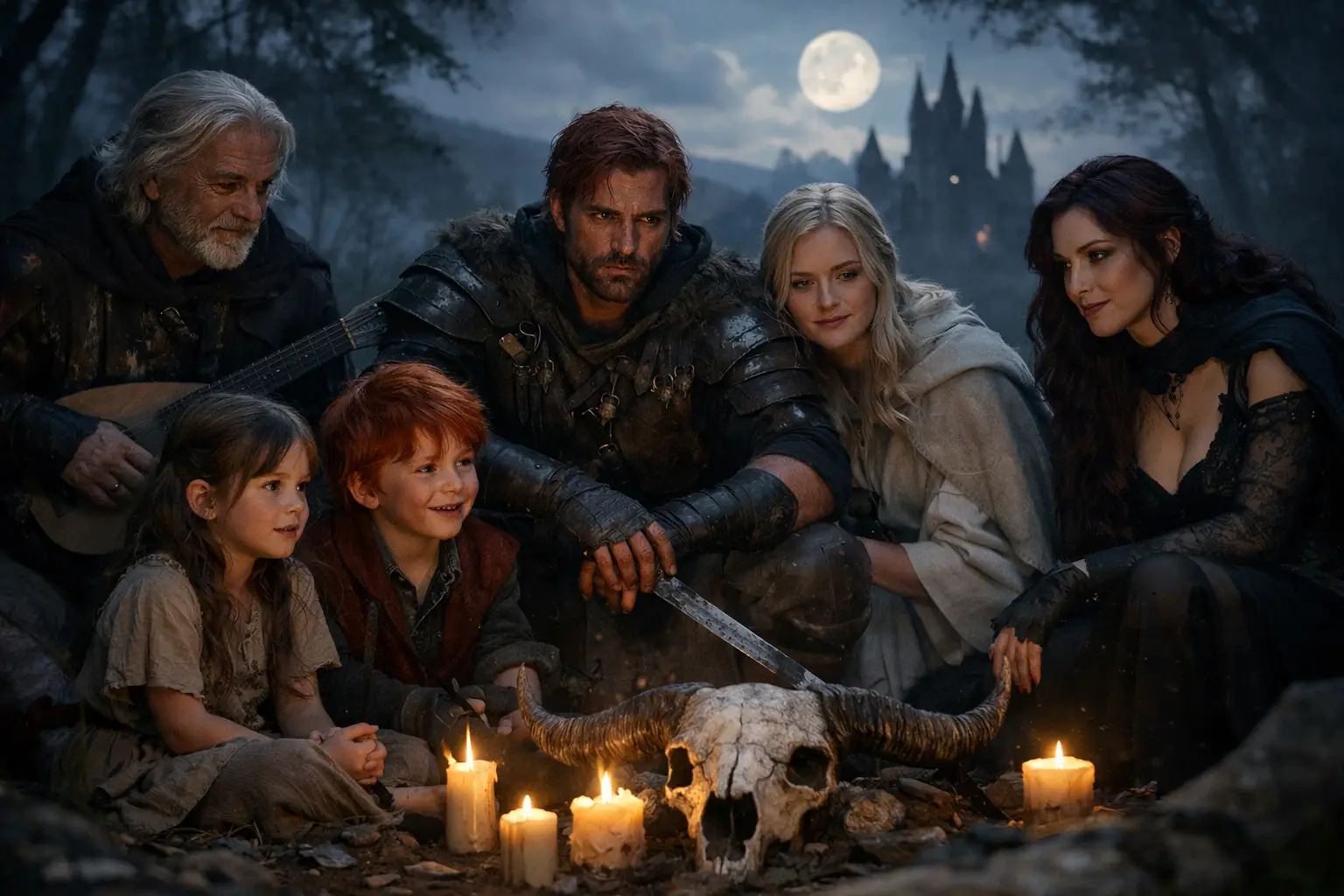
The bell beneath the village has rung for the first time in a century.
Every elder remembers the warning differently. The priest says it calls the dead home. The hunter insists it was built to wake something buried under the hill. The children have already made a rhyme of it, though no one knows who taught them the words.
By dawn, one player character has mud beneath their fingernails and no memory of leaving their bed.
A conventional campaign may treat the bell as a mystery, a monster hook, or the beginning of a quest.
Mythveil asks a different question first.
Why does this world need a bell like that?
Not who built it. Not what stat block waits beneath it. Not which encounter comes next. Those questions matter later. The deeper work begins before the adventure moves. It begins by asking what kind of story the world is already trying to tell, where that story came from, and what older forms are still speaking through it.
A game world is never only its published lore.
It carries hidden roots: genre memory, old myths, pulp structures, scientific anxieties, folklore patterns, media habits, game design instincts, urban legends, internet fears, academic assumptions, and the emotional residue of everything players have learned to expect from stories before they ever sit down at the table.
Mythveil does not treat those roots as decoration.
It listens for them.
Then it decides what must be brought back into play.
A setting is not only what it says about itself
Every game universe has a surface.
There are gods, nations, factions, monsters, timelines, maps, rules, famous names, wars, cities, and sacred objects. This is the material most people recognise first. It is useful, but it is not the whole truth.
The deeper identity of a setting lives in what it repeats.
What kind of fear returns again and again? What does power look like in this world? What does corruption do to the body, the soul, the city, the family, the machine? What kinds of people become heroes here, and what kind of heroism does the world punish? Does the setting believe history is tragic, absurd, cyclical, decaying, heroic, doomed, or waiting to be redeemed?
These questions matter because campaigns often become shallow when they only reproduce the surface. A Game Master can place the right monsters, use the right terminology, follow the map, and still miss the world’s pulse.
Mythveil begins by taking the game apart.
Not to break it.
To hear what is underneath.
A dark fantasy setting may appear to be about demons and crowns, but underneath it may be about inheritance, disease, guilt, failed institutions, and the terror that civilisation is only a thin habit. A cosmic horror setting may appear to be about cults and entities, but underneath it may be about knowledge, colonial arrogance, scientific overreach, spiritual loneliness, and the unbearable scale of reality. A gothic urban setting may appear to be about vampires, werewolves, ghosts, or secret societies, but underneath it may be about identity, hunger, social masks, shame, nightlife, surveillance, and the city as a predator that learned to wear human lights.
Once that root is visible, the campaign can stop imitating the setting and begin deepening it.
Function matters more than reference
The mistake is to ask, “What can we add?”
That question produces clutter.
A better question is, “What does this campaign need to do?”
If the campaign needs pulp grandeur, the answer is not simply to add a lost temple and a villain with a dramatic cloak. Pulp has a function. It gives danger speed, gives evil a visible architecture, and turns travel into pressure. It understands cliffhangers, impossible machines, secret bases, masked intentions, and the strange pleasure of facing something too large to be reasonable.
So Mythveil looks for the places where that function has appeared before.
Flash Gordon may teach scale and imperial spectacle. Bond may teach the social mask of the grand villain, the luxury of evil, the hidden base, the ritualised speech before catastrophe. Old adventure serials may teach momentum. Expedition fiction may teach logistics, obsession, and the moral cost of entering places that were not waiting to be discovered.
None of this means copying the source.
It means understanding what the source is doing.
If a campaign turns around portals, the question is not whether to add a glowing gate. The question is what a portal means inside this world. It may be expedition, invasion, pilgrimage, exile, border control, scientific obsession, colonial temptation, religious rupture, or a wound in geography that politics will immediately try to own.
A portal treated only as transport remains a door.
A portal understood as function becomes a campaign engine.
This is where transdisciplinary work matters. Scholarship can reveal historical pressure. Science can sharpen the impossible by forcing it to leave evidence. Folklore can show how fear survives in ordinary speech. Media history can show how the same idea changes when it moves from oral tale to novel, from film to game, from forum rumour to tabletop scene. Game history can reveal why certain structures feel playable before anyone explains them.
Used carelessly, these fields become a pile of references.
Used properly, they become instruments.
The hidden roots must be woven back into play
Analysis alone is not enough.
A campaign can be brilliantly researched and still feel dead at the table. Knowing that a setting draws on medieval crisis, pulp adventure, urban folklore, cosmic dread, political theology, or game-history loops does not automatically create play. It only gives the creator a richer map of what might matter.
The real work begins when those roots are woven back into the campaign as pressure.
A pulp villain cannot merely have style. They need reach. They need people who benefit from pretending not to see them. They need money, doctrine, access, false respectability, a public face, and a private machine. If the villain has no infrastructure, they are only a costume.
A portal cannot merely shimmer in the ruins. It needs rules, witnesses, institutions, rumours, protocols, smugglers, scholars, soldiers, pilgrims, opportunists, and frightened locals who have already learned the price of standing too close. If no one tries to control the threshold, the threshold is not important enough.
A monster cannot merely be terrifying. It needs a place in the world’s logic. What fear does it carry? Who denies it? Who feeds it? Who profits from calling it superstition? Who has built an entire office, cult, law, industry, or family custom around making sure no one asks the right question?
This is why Mythveil does not add references to a campaign world.
It uncovers what the world is trying to become, then asks which older forms can help it become that more completely.
Where Rexborn begins
Once the roots are understood and the functions are clear, Rexborn begins its work.
This is the part that cannot be reduced to a public checklist.
Rexborn is the architecture beneath Mythveil’s living worlds. It is the method by which discovered roots become influence, faction movement, cultural memory, pressure, echo, and consequence. It does not simply attach lore to a setting. It asks how that lore touches institutions, how institutions touch people, how people distort memory, and how player action changes what the world can become.
This is where a campaign stops being a designed mood and begins to behave.
The portal develops ownership. The villain gains a social body. The old legend finds new mouths. The scientific anomaly produces records, denials, funding disputes, failed expeditions, and quiet terror among those who have measured too much. The monster becomes not only a threat but a pressure on law, belief, family, trade, medicine, media, or whatever domains matter in that particular setting.
A world becomes immersive when its pieces do not float.
Everything has somewhere to go.
Power touches the street through influence. Factions grow from need, not from names. Conflicts arise because groups want incompatible futures. Rituals survive because they still do work. Rumours travel because someone benefits from their shape. Echoes remain because the past has not finished pressing on the present.
The players may only see a clerk opening the wrong door.
Rexborn asks who bribed him, what office failed to notice, which faction profits from the mistake, what story spreads by morning, and why that door was dangerous long before the players arrived.
Influence makes the invisible playable
Many campaigns understand power only when it arrives with soldiers, spells, or monsters.
But most worlds are moved by quieter hands.
A delayed permit can save a vampire. A missing medical report can protect a cult. A shipping schedule can decide whether a district eats. A newspaper phrase can turn panic into patriotism. A university department can bury a discovery so thoroughly that three generations mistake cowardice for consensus.
Influence is where power becomes playable without becoming obvious.
This is one of the places where Rexborn changes how a campaign breathes. Influence is not treated as a vague background force. It becomes a way of understanding where power can touch the world and how far that touch can travel. In one setting, influence may move through courts, temples, guilds, and bloodlines. In another, it may move through police databases, hospitals, logistics networks, nightclubs, research grants, churches, and local media.
The domains change because the world changes.
The principle remains.
A campaign becomes more alive when players learn that a monster’s body is not always its weakest point. Sometimes the better target is its reputation, its supply chain, its legal protection, its priest, its patron, or the frightened official who signs the same form every Thursday and has no idea what that form has protected for twenty years.
That is a different kind of agency.
It does not replace the sword, the spell, the chase, or the confrontation.
It gives them a world.
Factions are not teams on a board
A shallow faction has a name and a goal.
A living faction has appetite, memory, shame, habits, internal pressure, and a way of misunderstanding itself.
The church does not simply want faith. Part of it wants silence. Part of it wants reform. Part of it wants the old miracle back even if the miracle was monstrous. The guild does not simply want profit. Different families inside it may fear different kinds of loss. A revolutionary cell does not simply want freedom. Some members want justice, some want revenge, and some have already begun designing the next prison.
Rexborn turns this inner weather into movement.
That is where consequence becomes interesting. When players strike one part of a faction, they may strengthen another. When they expose the truth, they may destroy the only people who were managing the lie responsibly. When they spare an enemy, that mercy may return not as gratitude, but as political embarrassment.
This is not complexity for its own sake.
It is how a world stops behaving like a quest menu.
A living world must remember incorrectly
Memory is not a clean archive.
People change stories to survive them. Institutions edit the past to protect legitimacy. Families soften old crimes into traditions. Children preserve terror more accurately than official records because they are not trying to sound reasonable.
This is one of the places where Mythveil and Rexborn meet most deeply.
The campaign event is only the beginning. What matters is what the world does with it. A battle becomes a holiday. A betrayal becomes a proverb. A mercy becomes evidence of weakness. A failed ritual becomes heresy in one district and proof of divine absence in another. Years later, the players may hear a song about what they did and realise that the song is useful, beautiful, and wrong.
That is not a mistake.
That is history.
A world that remembers perfectly feels mechanical. A world that remembers through fear, pride, grief, propaganda, faith, and gossip feels alive.
The workshop begins where the article must stop
The public shape of the Mythveil Method is simple enough to understand.
A game world is read beneath its surface. Its roots are uncovered. Its functions are recognised. Related forms from other traditions, media, disciplines, and genres are brought into conversation with it. Then Rexborn translates that deeper reading into influence, factions, echo, and living consequence.
That is enough to see the doorway.
It is not enough to rebuild the house.
The actual work depends on the setting. A World of Darkness city does not breathe like a Warhammer border town. A pulp Cthulhu expedition does not need the same pressures as a mythic fantasy kingdom. A portal campaign, a political horror chronicle, a school for young heroes, a cursed frontier, and a modern urban legend all require different roots, different influence structures, and different kinds of memory.
This is why the full method belongs in Mythveil workshops, mentoring, and consulting.
In a workshop, the focus is learning how to see the hidden roots of a game world and understand what those roots are doing. In mentoring, that method becomes personal: a Game Master, writer, educator, or designer brings a world they care about, and the work becomes diagnostic. In consulting, the same approach can support larger projects that need coherence, depth, and living consequence without collapsing under their own lore.
The point is not to produce more material.
The point is to make the material behave.
From game roots to living worlds
A campaign world becomes immersive when it feels internally true.
Not realistic in a narrow sense. Not explainable by one discipline. Not reduced to lore logic or canon obedience.
True.
The world has reasons. Its fears have ancestry. Its factions have pressure. Its monsters have cultural weight. Its science leaves traces. Its folklore has local voices. Its pulp has momentum. Its portals have politics. Its villains have infrastructure. Its myths have debts. Its cities have habits. Its memories are contested. Its players can wound it, heal it, misread it, and change what it becomes.
That is the Mythveil Method.
We do not add references to make a campaign look deeper.
We read what the world is trying to become.
We follow the roots until the hidden structure appears.
Then Rexborn gives that structure influence, conflict, memory, and consequence.
Only then does a setting become more than a setting.
It becomes a place that can answer.
Learn the Mythveil Method
At Mythveil Chronicles, game worlds are not treated as static lore containers.
They are living structures shaped by cultural roots, genre memory, influence, faction pressure, and player consequence.
The full Mythveil Method is taught through workshops, mentoring, and consulting for Game Masters, writers, educators, studios, and worldbuilders who want campaigns with depth rather than decoration.
The public face is simple:
Players act.
The world answers.
The deeper work begins before that answer is ever heard.
Read more: https://mythveilchronicles.com
Play in a Mythveil campaign: https://startplaying.games/gm/dunchan
Support the worldbuilding: https://www.patreon.com/c/mythveilchronicles
Collaborate: [LinkedIn link]
Stories that remember. Worlds that change.