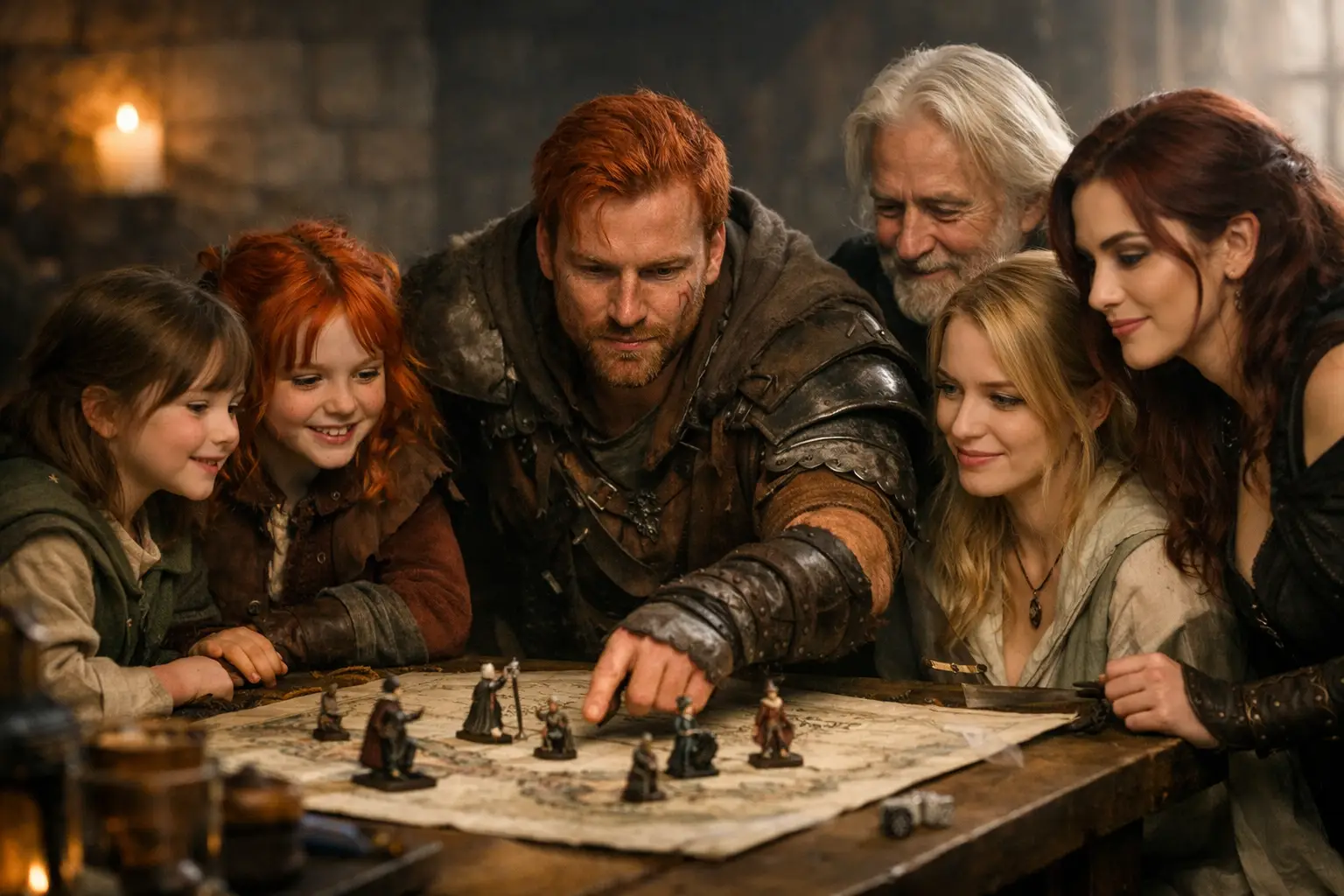
The governor is assassinated in the second session.
The players did not plan it. The Game Master did not script it. A frightened clerk, bribed three weeks earlier for an entirely different reason, opened the wrong door at the wrong hour, and a city tipped into panic.
That is a true player agency campaign example – not a story where players choose between pre-written doors, but one where their smallest actions alter the future in ways no one at the table could fully predict.
Too often, player agency is described as freedom in the shallowest sense. You can go left instead of right. You can ally with faction A instead of faction B. You can spare the villain or strike. That is choice, certainly, but not always agency.
Agency begins when the world responds with memory, resistance, and consequence. It means players do not merely move through a setting. They impress themselves upon it.
What a player agency campaign example really shows
A worthwhile player agency campaign example is not about chaos for its own sake. It is not a campaign where the referee shrugs and says yes to everything. It is a structure in which decisions matter because the world has shape.
Factions have motives. Communities have histories. Institutions protect themselves. Secrets spread unevenly. Violence solves one problem while awakening three more.
In other words, agency and structure are not enemies. They depend on each other. If the world has no weight, then choice has no gravity. If every path produces the same scene with different dressing, players sense it quickly. But if the world is alive enough to push back, remember, reward, resent, and evolve, then even an apparently minor decision can become mythic.
This is why so many campaigns feel thin despite good preparation. The setting exists only where the party looks. Once they leave a place, it freezes. Once they spare an enemy, that enemy vanishes until dramatically convenient. Once they anger a noble house, no one updates the politics.
The campaign becomes a stage set rather than a living world.
A living-world player agency campaign example
Imagine a grim river city at the edge of famine.
Three powers dominate it: the Cathedral of the Last Lantern, which controls burial rites and public mourning; the Salt Guild, which controls food imports; and a network of smugglers who move medicine, relics, and fugitives through flooded catacombs beneath the old quarter.
The players arrive with a simple goal. They need a missing scholar who was last seen investigating plague pits outside the city walls. That is the hook. The campaign does not begin by announcing a grand prophecy. It begins with a problem local enough to touch, but connected enough to widen.
During their search, the players discover that the scholar had uncovered records proving the Cathedral falsified death counts during a previous outbreak. One player wants to expose the truth. Another sees the greater danger: if the records become public during a famine, riots may begin. A third negotiates with the smugglers, hoping to trade the records for access to the catacombs.
Now the campaign branches, but not in a simplistic tree.
The players choose not to expose the Cathedral immediately. Instead, they leak fragments of the truth to a grieving mutual aid society in the dock district, believing controlled pressure will force reform without collapse.
That choice changes everything.
The Cathedral responds by denouncing the mutual aid organisers as grave-defilers. The Salt Guild quietly funds this accusation because unrest in the docks strengthens its bargaining power. Meanwhile, the smugglers gain influence because fearful citizens begin moving goods outside official channels. The missing scholar, horrified by the unintended consequences, attempts to flee with the full archive.
The players are now entangled in a city they have changed.
Nothing here requires illusionism. The players were not pushed towards a hidden correct route. They made a morally complex decision with partial information. The world answered according to its own pressures.
That is agency with consequence.
Why this example works
The strength of this player agency campaign example lies in delayed consequence.
The result of the choice is not immediate applause or punishment. It unfolds across sessions. That delay gives events the texture of reality.
It also works because every faction wants something understandable. The Cathedral is not evil for the sake of theatre. It fears collapse of public trust. The mutual aid society is compassionate, but not strategically prepared. The Salt Guild is predatory, yet rational within its interests. The smugglers are both exploiters and protectors depending on whom one asks.
When players act in such a world, they are not choosing between labels. They are intervening in systems.
Finally, the example works because information is imperfect. Agency does not require omniscience. In fact, too much certainty can flatten drama. What matters is that players can form intentions, act on them, and see the world respond honestly.
The hidden trap in weak agency design
Many Game Masters believe they are offering agency when they are really offering variation.
The players may choose which patron hires them, which district they visit first, or which clue to pursue. Yet if every route leads to the same revelation, the same villain, and the same climax, then the campaign is only wearing the mask of freedom.
There is a place for guided structure. Not every group wants an open political sandbox, and not every game benefits from endless possibility. Horror, especially, often gains strength from pressure and narrowing options.
But even in a highly atmospheric, tightly framed campaign, players need the power to change meaning, relationships, timing, and aftermath. They need to feel that what they do matters beyond the next scene.
A useful test is simple:
If the party made a surprising but plausible decision tonight, would the world still make sense next month?
If the answer is no, the campaign may be too brittle to support real agency.
Building your own player agency campaign example
If you want to design a stronger campaign, begin with pressure rather than plot.
Create a situation already in motion. A cult is losing members. A trade route is failing. A noble line has no clear heir. A military order is covering up an atrocity.
Then ask who benefits, who suffers, and what each faction will do if the players never arrive.
From there, give the players access points rather than scripted chapters. A witness, a patron, a rumour, a theft, a funeral, a contaminated well. Let them choose where to place their trust and attention.
Their decisions should change not just what they learn, but what remains possible.
Then track consequences with discipline. This is where many ambitious campaigns falter. Grand promises of living worlds collapse if no one records who was helped, who was humiliated, what resources were spent, and which rumours are now circulating.
A campaign remembers through process, not wishful thinking.
This is also where long-form world design becomes powerful. In a properly maintained campaign, a spared enemy may return changed by gratitude, shame, or ambition. A village saved from one threat may become dependent in unhealthy ways. A revolution the players encouraged may produce a harsher authority than the one it replaced.
Agency is rarely tidy.
That is precisely why it matters.
The trade-off most tables ignore
Real agency often means surrendering neat narrative arcs.
Some threads will end abruptly. A beloved non-player character may die because the players arrived one day too late. A mystery may remain partially unsolved because the party chose a war over an investigation.
This can feel uncomfortable, especially for Game Masters trained to think in terms of satisfying story beats.
But campaigns gain power when they allow for incompleteness. Memory works that way. History works that way. People carry unanswered questions for years.
If your world can bear that weight, the table begins to feel less like a sequence of encounters and more like a place.
For that reason, the finest player agency campaign example is not the most explosive one. It is the one players still speak about months later in strangely personal terms.
Not, “We completed the plot,” but, “We trusted the wrong priest and the city never recovered,” or, “We saved those children, and that mercy cost us the alliance.”
Those are not just anecdotes.
They are signs that the campaign allowed choice to become history.
If you are building for that kind of play, resist the urge to control every current. Give the world motives. Let it move when the players are absent. Record what changes. Then, when they act, let the consequences arrive with the dignity of truth.
That is when a campaign begins to breathe.
And when the people within it realise the world will remember them.
Build worlds that remember
At Mythveil Chronicles, this is the kind of play we build for: living worlds, meaningful choices, political pressure, emotional consequence, and campaigns where player actions do not vanish when the scene ends.
If you want campaigns that breathe, remember, and change, follow the work here:
Read more: https://mythveilchronicles.com
Play in a Mythveil campaign: https://startplaying.games/gm/dunchan
Support the worldbuilding: https://www.patreon.com/c/mythveilchronicles
Stories that remember. Worlds that change.