Time Without Tide

Learn more about our Time Without Tide campaign
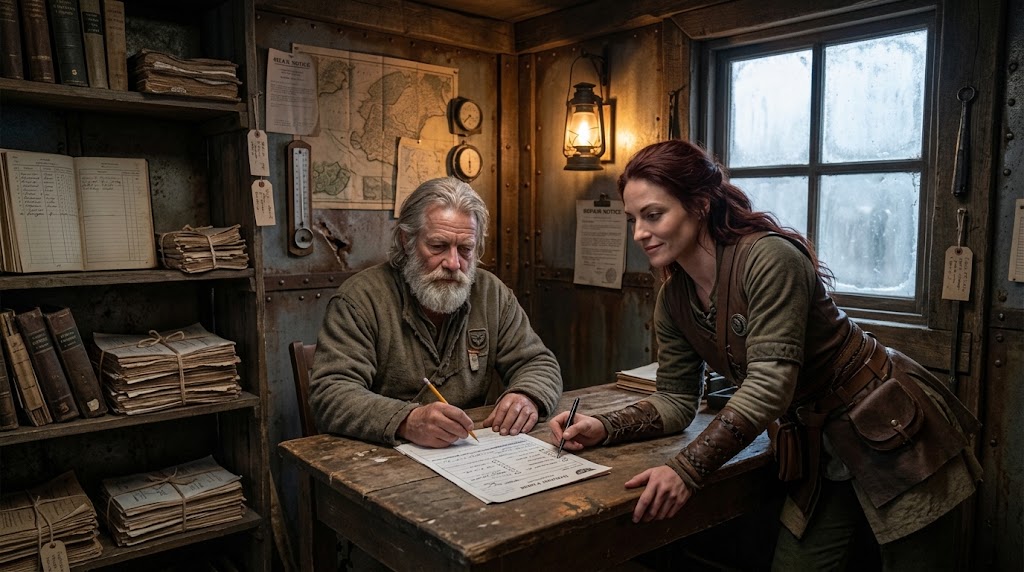
Sean had been staring at the form for long enough that Eljara had begun to enjoy it. That was usually a bad sign.
ELJARA: “You look offended.”
SEAN: “I am offended.”
ELJARA: “By bureaucracy?”
SEAN: “By this particular achievement of bureaucracy.”
He pushed the paper across the desk.
There were boxes. Many boxes.
Name. Residence. Occupation. Location of incident. Witnesses. Property lost or damaged. Visible bodily alteration. Suspected environmental exposure. Previous exposure.
And beneath that: Nature of Incident: Accident. Mechanical. Animal. Fog-related. Unknown. Other.
Eljara read the list twice.
ELJARA: “I like ‘other.’”
SEAN: “Of course you do.”
ELJARA: “It has possibilities.”
SEAN: “It has a second page.”
She turned the sheet over. It did.
Eljara smiled.
ELJARA: “Civilisation.”
We tend to imagine the supernatural at exactly the wrong moment.
The apparition. The impossible sound. The thing moving where nothing should be moving. The door opening by itself. The body changing. The dead answering.
Those are the moments stories remember. They are rarely the moments institutions care about most.
Institutions arrive afterwards.
Someone has been injured. Something has been damaged. A family wants an explanation. An employer wants to know whether the worker can return. An official wants to know whether this has happened before. A doctor wants symptoms. A priest wants circumstances. A magistrate wants witnesses. An insurer, if one is unfortunate enough to exist, wants everything in triplicate.
SEAN: “We’ve been trying to organise the inexplicable for a very long time.”
ELJARA: “No. We’ve been trying to organise people who encounter the inexplicable.”
Sean considered that.
SEAN: “That may actually be worse.”
It is also much closer to history than the comfortable modern division between rational institutions and irrational superstition suggests.
People did not simply encounter things they considered extraordinary and scream until the Enlightenment arrived. They classified. Argued. Recorded. Regulated. Investigated. Sometimes badly. Sometimes brutally. Sometimes with surprising care.
A theologian might ask what kind of being had been encountered. A physician might ask whether the experience came from illness. A court might ask whether testimony could be trusted. A community might care less about any of those questions than whether a particular healer could cure a dangerous bite.
The categories were not ours. That matters. Calling all of it superstition afterwards can hide more than it explains.
ELJARA: “So the interesting question isn’t whether they were right.”
SEAN: “Not first.”
ELJARA: “What did they do with what they thought they knew?”
Sean nodded.
That question changes everything. Because the moment a society accepts that an unusual phenomenon may affect real people, it acquires practical consequences.
Who is responsible? Who is allowed to intervene? Who is believed? Who is paid? Who is blamed? Who gets examined? Who gets protected? And who gets locked away because everyone has decided they already know the answer?
In the World of Fog, those questions become harder. Not easier.
The Ward works. That does not mean everyone understands why. People can encounter forces and environments capable of altering bodies. That does not mean every change has the same cause. People travel beyond protected places and return with experiences those who remained behind may never share. That does not make every traveller a reliable witness.
Saltport can develop procedures. A Tenderhold can develop completely different ones. A Delver can know something through experience that an administrator has only encountered in reports. And the administrator may possess twenty reports showing that what the Delver believes happened cannot be the whole story.
Both may have evidence. Neither needs to be stupid.
SEAN: “That’s what I like about it.”
ELJARA: “People being wrong?”
SEAN: “People having reasons.”
Eljara leaned back.
ELJARA: “Much more dangerous.”
SEAN: “Always.”
Because a living supernatural world should not divide neatly into believers and sceptics. That argument belongs to a world in which the first question is still: Is this real?
Once the answer is sometimes demonstrably yes, the arguments become much more interesting.
Was this particular incident supernatural? What kind? What caused it? Could it have been prevented? Will it happen again? Does the old procedure still work? Was the procedure ever designed for this? And perhaps most importantly: Who has the authority to decide?
Imagine a Delver returning to Saltport changed. Not necessarily monstrous. Changed.
Something about the body is different now. The Delver knows when it happened. Or thinks they do. The crew has another version. A physician sees symptoms. An official sees a category. A family sees the person who left home.
Those are four different truths standing in the same room.
ELJARA: “And somebody will try to make them fit into one box.”
SEAN: “Probably the wrong box.”
ELJARA: “Then they’ll invent another.”
SEAN: “Now you’re understanding bureaucracy.”
There is something deeply human about that. We create categories because categories allow us to act.
If this is an illness, call the physician. If this is a crime, call the authorities. If this is dangerous exposure, isolate it. If this is sacred, find someone who understands the sacred. If this is normal—go home.
But the supernatural is particularly good at sitting between categories.
A strange voice might be an experience of grief. A poisoned room might produce visions. A traditional warning might preserve useful environmental knowledge. An encounter understood religiously might also have legal or medical consequences. And a perfectly rational explanation for one case tells us almost nothing about the next one.
That is why good investigation does not merely replace one certainty with another. Sometimes it makes the world more complicated.
ELJARA: “You’re saying the form needs more boxes.”
SEAN: “No.”
He looked down at it again.
SEAN: “I’m saying we need to know when the boxes stop helping.”
There is another danger.
Once institutions learn that something exists, they rarely remain neutral about it. Knowledge becomes authority. Authority becomes procedure. Procedure becomes power.
Someone decides what counts as a legitimate experience. Someone decides which expert may speak. Someone decides when a person is safe. Someone decides what must be reported. And someone eventually discovers that a category created to protect people can also be used against them.
The supernatural does not remove politics from a world. It creates new things to have politics about.
ELJARA: “There you are.”
SEAN: “What?”
ELJARA: “You finally found the frightening part.”
SEAN: “I thought the thing in the fog was the frightening part.”
ELJARA: “The thing in the fog doesn’t have a stamp.”
Sean looked at the form. Then at her.
SEAN: “I hate that you’re right.”
ELJARA: “You usually do.”
But institutions are not automatically the enemy either. That would be just as easy.
Records preserve patterns. Doctors compare cases. Engineers learn from failures. Communities remember disasters. Procedures can keep the next crew alive. A report nobody wants to fill out today may contain the detail that saves somebody ten years later.
The same human impulse that produces maddening bureaucracy also produces accumulated knowledge.
That matters enormously in a world like Time Without Tide.
The World of Fog does not need people who already understand everything. It needs people capable of remembering what happened. Comparing it. Arguing about it. Passing useful knowledge on. And changing their rules when the old ones fail.
That is much harder than simply believing.
SEAN: “So we fill it in.”
ELJARA: “Oh, absolutely.”
Sean sighed and picked up the pencil.
SEAN: “Nature of incident.”
He read the options again. Accident. Mechanical. Animal. Fog-related. Unknown. Other.
Something made a faint scratching sound inside the wall behind them.
Sean stopped writing. Eljara looked at the wall. The scratching stopped. Neither moved for several seconds.
Then Eljara leaned across the desk and tapped the final box.
ELJARA: “Other.”
Sean ticked it.
From somewhere inside the wall came another scratch.
Sean turned the page over.
SEAN: “There is a section for additional information.”
ELJARA: “See?”
She smiled.
ELJARA: “Civilisation.”
And perhaps that is what happens when the supernatural truly becomes part of a world.
Eventually, somebody has to decide what to call it. Someone has to record what happened. Someone has to decide what happens next. And somewhere, inevitably, there is a form.
When the impossible becomes real enough to regulate, who gets to decide what it means?