Warhammer Fantasy Roleplay · From The Old World to 5th Edition · Mythveil Chronicles
Spooky October · Week 1 · Longform 1

Rain had followed us for most of the afternoon.
Not dramatic rain. No thunder. No lightning splitting the sky above some conveniently abandoned castle.
Just Imperial rain.
Cold, persistent, and apparently personally offended by travellers.
By the time Stacy and I reached the village, the road had become mud, my boots had become buckets, and Stacy had stopped speaking to me because I had said, for the third time, that the inn was “probably just around the next bend.”
It had not been.
The village was small enough that nobody had bothered with a wall. A dozen houses clustered around a shrine, a smithy, two barns and, blessedly, an inn.
Every door was closed.
That was not strange.
What was strange was what hung above them.
Twigs bound with red thread. Small iron nails driven into lintels. On one house, a crude twin-tailed comet had been scratched into the wood. Another had a little bunch of dried plants tied beside the frame.
Stacy stopped beneath the eaves of the inn.
“You’re staring.”
“So are you.”
“I’m investigating.”
“I’m wet.”
“That doesn’t prevent investigation.”
“It encourages beer.”
She ignored that and leaned closer to the doorframe.
There was a small mark cut into the timber. Old enough that generations of paint and weather had softened its edges.
“Sigmar?” I asked.
“Probably.”
“Comforting.”
“No.”
That got my attention.
“Why not?”
“Because that nail isn’t part of it.”
Beside the carved mark was a black iron nail. Not holding anything together. Just hammered into the wood.
Stacy pointed to the dried bundle. “And I don’t think that is either.”
“So?”
“So we have a religious symbol, an iron nail and what may be rowan.”
“Three times the protection.”
“Or three completely unrelated traditions.”
I knocked.
Nothing happened.
I knocked again.
From inside came a woman’s voice. “Who?”
“Travellers.”
Silence.
Stacy looked at me. I shrugged.
“We have coin,” I added.
Apparently theology has its limits, because the bolt moved immediately.
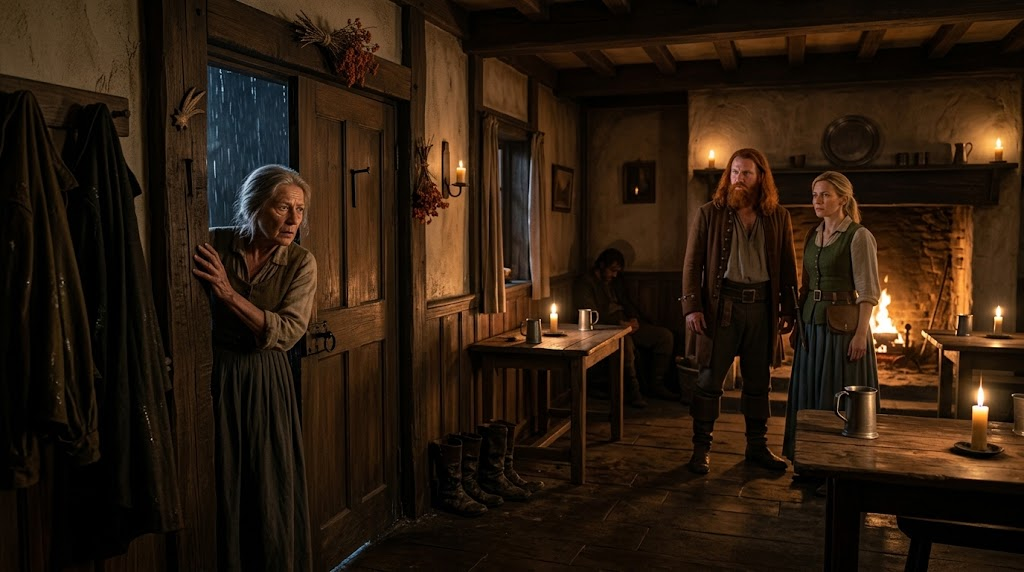
The innkeeper opened the door only a hand’s width.
She was perhaps sixty, broad-shouldered, grey-haired and entirely unimpressed by either of us.
She looked at Stacy. Then at me. Then behind us.
“Just you two?”
“Yes.”
“Say your names.”
Stacy’s eyebrow rose.
“Stacy.”
“Caelwyn.”
The woman waited.
“For what?” I asked.
“For you to say them properly.”
I gave her my full name. Stacy did the same.
Only then did the door open.
“Inside.”
We obeyed.
The door shut behind us. Bolt. Hook. A second bolt near the floor.
Then the innkeeper touched two fingers to the little symbol carved on the inside of the frame.
Stacy noticed. Of course she noticed.
“What was that?”
The woman looked at her. “What was what?”
“The door.”
“It’s a door.”
“The mark.”
“Sigmar.”
“The nail?”
“My grandmother.”
“The rowan?”
“My husband’s grandmother.”
Stacy glanced at me. I could already see the question forming.
“And which one works?”
The innkeeper stared at her for several seconds. Then she laughed. Not mockingly. Genuinely.
“Oh, sweetheart.”
We like categories.
Religion. Superstition. Magic. Tradition. Habit.
In the Empire, those categories are considerably less tidy than scholars would like them to be.
Sigmar is real to the people who worship him. His priests perform rites, bless communities and stand against things that have very good reasons to dislike holy symbols.
Morr watches over the dead, and his gardens are not merely decorative cemeteries. The proper treatment of a corpse matters in a world where occasionally the corpse objects to being dead.
Priests bless homes. Witch Hunters search for corruption. Magisters know that magic exists because they can set things on fire with it.
And ordinary people?
Ordinary people still listen to their grandmothers.
That matters.
Because most people in the Empire are not theologians, daemonologists or licensed wizards.
They are millers. Farmers. Bakers. Carters. Servants. Children.
People who cannot identify a creature from an illuminated bestiary when something scratches at the shutters after midnight.
They need simpler knowledge.
Don’t answer a voice outside if you cannot see who is speaking. Don’t bring something home from a crossroads. Don’t disturb an old grave. Keep iron near the door. Say the prayer. Close the shutters.
And if Grandmother told you never to open the door after the third knock, perhaps you do not need to understand why.
You just need to remember.
That is where superstition becomes interesting.
Because superstition is often described as a failed explanation.
But what if the explanation is wrong and the behaviour is right?
Stacy was still thinking about the door when our food arrived.
Stew. Bread. Beer.
After several hours in Imperial rain, this constituted compelling evidence for the existence of benevolent gods.
“The nail bothers me,” she said.
I looked at my bowl. “The stew doesn’t.”
“Cael.”
“Sorry.”
She pointed towards the entrance.
“If the Sigmarite blessing protects the house, why the iron?”
“Because Grandmother said so.”
“That isn’t an explanation.”
“It may be all they have.”
“And if the iron does nothing?”
“Then they own a nail.”
“And if the blessing does nothing?”
I looked at her. She smiled slightly.
There she was.
Stacy does not dislike faith. She dislikes answers pretending to be evidence.
“The interesting possibility,” I said, “is that both work.”
“For different reasons?”
“Or neither works.”
“Or one used to work.”
“Or something believes they work.”
She paused. “That is unpleasant.”
“Spooky October.”
She threw a piece of bread at me.
Later, the innkeeper joined us.
Stacy asked her about the nail.
Her grandmother had taught her to put iron beside every outside door.
Why?
She did not know.
Had her grandmother known? Probably not.
Had anything ever happened when there was no nail?
The woman thought about that.
“When I was little, old Gerlach took his down.”
“Why?”
“Said it was peasant rubbish.”
“What happened?”
“Nothing.”
Stacy gave me a look. There it was. Evidence.
The innkeeper drank from her cup.
“For eleven years.”
Stacy slowly looked back at her. “What happened in the twelfth?”
The woman shrugged. “His wife heard him knocking one night.”
“And?”
“He was asleep beside her.”
The fire cracked. Nobody spoke.
“What did she do?” I asked.
“Nothing.”
“She didn’t open the door?”
“Of course not.”
“Why?”
The innkeeper looked genuinely puzzled by the question.
“Because her grandmother wasn’t an idiot.”
There it was.
Not proof. Not even particularly good evidence.
A story about somebody who knew somebody whose wife heard something outside a door.
Every village has those. So does our world.
The details change. The door does not.
For thousands of years, humans have treated thresholds differently from the spaces on either side of them.
We mark them. Bless them. Decorate them. Guard them. Lock them. Knock before crossing them. Ask permission to enter. Welcome guests across them. Keep strangers outside them.
Sometimes we hang sacred symbols beside them. Sometimes lucky objects. Sometimes plants. Sometimes nothing more mystical than a camera and a very expensive lock.
The technology changes. The idea underneath it is remarkably stubborn.
Here is inside. There is outside. Something decides what may cross between them.
In our world, that something is usually us.
In Warhammer, that assumption is less comfortable.
Sometime after midnight, I woke to knocking.
Three quiet taps.
I lay still.
Another three.
Across the room, Stacy whispered: “Cael?”
“I heard it.”
Someone knocked again.
The inn was silent. No footsteps downstairs. No voice from the other rooms. Just rain.
Then: Knock. Knock. Knock.
Stacy sat up. “Could be a traveller.”
“Yes.”
“They could be freezing.”
“Yes.”
Another knock.
We looked at each other.
There is an easy version of this story. We open the door and discover a monster. Grandmother was right. Always obey the old ways. Very satisfying. Very simple.
But that is not the problem ordinary people in the Old World actually face.
The problem is that there might be a monster outside.
And there might be a frightened seventeen-year-old carter whose horse broke a leg two miles down the road.
If monsters were everywhere, survival would be easy. Never open the door.
But monsters are not everywhere. People are.
Stacy got dressed. “So what do we do?”
I looked towards the dark corridor. For the first time that evening, the little iron nail downstairs seemed considerably less ridiculous.
“We find out who’s knocking.”
“Without opening the door?”
“Preferably.”
She nodded.
Another three knocks came from below.
And somewhere downstairs, I heard the innkeeper getting out of bed.
She did not shout. She did not pray. She did not reach for a sword.
The first thing she did was something much older and much simpler.
She asked: “Who is there?”
And perhaps that is the real purpose of the threshold.
Not to keep the supernatural out. Not even to keep danger out. A door cannot promise that.
It gives us something smaller. A moment. A boundary. A chance to ask a question before we let the unknown come inside.
The Empire surrounds that moment with gods, iron, prayers, charms, locks and stories handed down by people who may no longer remember why the story began.
Some of those protections are probably nonsense. Some may once have meant something different. Some might work for reasons nobody in the village understands. And somewhere among them may be the rule that keeps you alive.
Which leaves Stacy’s question unanswered. Perhaps deliberately.
If a ritual has protected your family for generations, how much proof would you need before you stopped doing it?