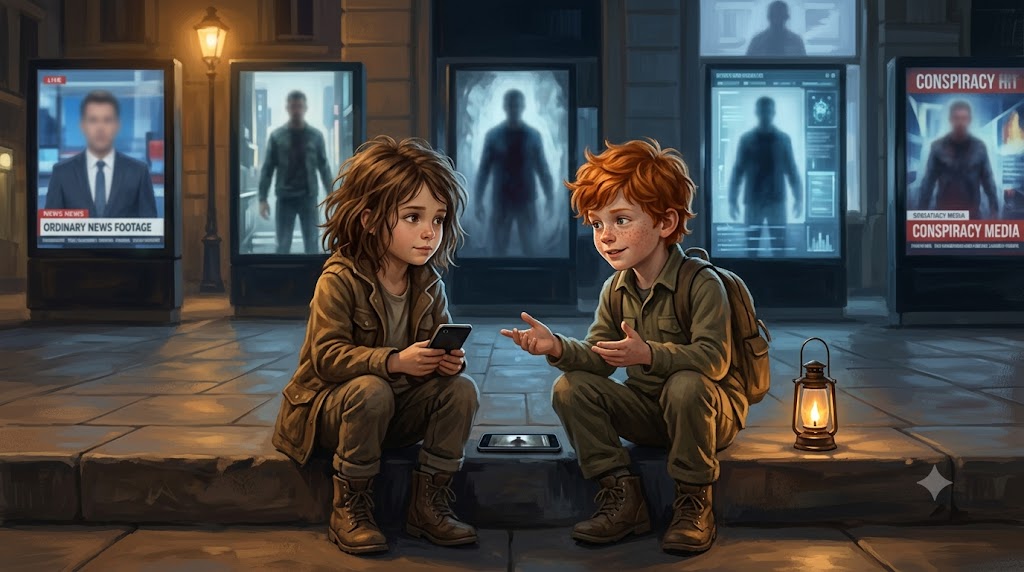

Mara:
Chibi?
Chibi:
Hmm?
Mara:
If I see something with my own eyes…
is it real?
Chibi:
Usually.
Mara:
Usually?
Chibi:
Mirrors.
Dreams.
Magic tricks.
That plastic spider Sean left on your chair.
Mara:
I was seven.
Chibi:
You screamed.
Mara:
You climbed onto the table.
Chibi:
Tactical retreat.
Mara:
That’s not what I mean.
Adults always say:
“Seeing is believing.”
But now they tell us pictures can be fake.
Videos can be fake.
Voices can be fake.
Someone can make a person say something they never said.
Someone can make a photograph of something that never existed.
Someone can even make dead people look like they’re speaking again.
Chibi:
Yeah.
Mara:
So how do we know what’s real?
Chibi:
Oh.
That question.
Mara:
You know the answer?
Chibi:
No.
But I know adults don’t either.
They just use longer words when they’re confused.
Mara:
Like epistemology.
Chibi:
Exactly.
Mara:
It means how we know what we know.
Chibi:
See?
You explained it without needing eleven syllables.
Mara:
That’s not the point either.
Chibi:
You have many points today.
Mara:
Look at this.
Chibi:
The video?
Mara:
Pretend it’s real.
A man gets hit by a car.
Hard.
He should be badly hurt.
But he gets up.
Almost immediately.
Someone says they saw fangs.
Another person caught something strange on a phone.
Chibi:
Vampire.
Mara:
How do you know?
Chibi:
Fangs.
World of Darkness.
Fairly strong evidence.
Mara:
No.
You’re doing exactly what everyone else does.
You already know what kind of story you’re in…
so you choose the explanation that fits.
Chibi:
Oh.
Mara:
Someone else sees the same thing and says:
“AI.”
Chibi:
Someone says special effects.
Mara:
Someone says government experiment.
Chibi:
Someone says demon.
Mara:
Someone says publicity stunt.
Chibi:
Aliens.
Mara:
Why do you always say aliens?
Chibi:
Because eventually somebody will.
Mara:
Fine.
Aliens.
The point is…
everybody sees the same recording.
But they don’t see the same event.
Chibi:
They see the same pixels.
Mara:
That’s worse.
Chibi:
Why?
Mara:
Because it means seeing isn’t just what reaches your eyes.
It’s what happens afterward.
Inside your head.
Chibi:
You take what you saw…
and fit it into everything you already believe.
Mara:
Exactly.
Like putting a puzzle piece into the wrong puzzle because you really want it to fit.
Chibi:
Adults do that a lot.
Mara:
Children do too.
Chibi:
Yes.
But we have better snacks.
Mara:
Chibi.
Chibi:
Sorry.
Continue destroying reality.
Mara:
Caelwyn told me another example.
Three people walk into the same forest.
A Garou.
A Changeling.
A Dreamspeaker.
The forest speaks to them.
Chibi:
That still sounds like the beginning of a joke.
Mara:
The Garou says:
“Spirit.”
The Changeling says:
“The Dreaming.”
The Dreamspeaker explains it through Magick and Spirit.
Who is right?
Chibi:
Maybe all three.
Mara:
Everybody keeps saying that.
But if I say this apple is brown…
and you say it’s purple…
we don’t both become correct just because we’re sincere.
Chibi:
True.
Mara:
So maybe they aren’t all describing the same thing.
Chibi:
Or maybe they’re describing different parts.
Mara:
Different parts of what?
Chibi:
Imagine an elephant.
Mara:
Why an elephant?
Chibi:
Because if I say squirrel, this analogy becomes very difficult.
One person touches the trunk.
They say:
“It’s like a snake.”
Another touches the leg.
“No, it’s like a tree.”
Another touches the ear.
“You’re both wrong. It’s like a huge blanket.”
Mara:
But there’s still one elephant.
Chibi:
Exactly.
Mara:
So maybe Glamour, Spirit and Magick are different parts of something bigger.
Chibi:
Maybe.
Mara:
Or maybe they’re actually different.
Chibi:
Also maybe.
Mara:
That’s incredibly unhelpful.
Chibi:
Reality isn’t required to be convenient.
Mara:
You sound like Caelwyn.
Chibi:
That was unnecessarily cruel.
Mara:
But there’s another thing.
Names change what we do.
Chibi:
Explain.
Mara:
If you call something a spirit…
you might speak to it.
Chibi:
If you call it a dream…
you might imagine with it.
Mara:
If you call it energy…
you might measure it.
Chibi:
If you call it a demon…
Mara:
Do not summon it.
Chibi:
I was going to say run away.
Mara:
Good.
Chibi:
Mostly.
Mara:
So maybe the thing doesn’t change.
Maybe the name changes us.
Chibi:
And then we behave differently.
Mara:
And what we do next changes what happens.
Chibi:
So belief can change reality even without magic.
Mara:
Not truth.
Chibi:
Right.
Mara:
That’s important.
If everyone believes the sun is made of cheese…
the sun doesn’t become cheese.
Chibi:
Unfortunately.
Mara:
But if everyone agrees a piece of paper is worth money…
suddenly that piece of paper buys food.
Chibi:
So agreement can make something socially real.
Mara:
Even if it doesn’t change physics.
Chibi:
And then World of Darkness cheats.
Mara:
What?
Chibi:
It takes that ordinary idea…
and makes it scarier.
Mara:
Mage.
Chibi:
Exactly.
Belief isn’t just an opinion there.
Reality and accepted possibility aren’t completely separate.
Mara:
Changeling does something similar with imagination.
Chibi:
Werewolf gives actions and emotions consequences in a spirit world.
Mara:
Wraith makes memory and Passion strong enough to bind the dead.
Chibi:
Hunter gives Conviction enormous weight.
Mara:
And vampires have Blood Sorcery.
Different supernatural beings.
Different explanations.
Different ways of touching things humans normally can’t.
Chibi:
So maybe the deepest question isn’t:
“Which one has the correct magic system?”
Mara:
Maybe it’s:
“What lets each of them reach whatever is underneath?”
Chibi:
Nature.
Mara:
Culture.
Chibi:
Belief.
Mara:
Practice.
Chibi:
The grown-up version.
Mara:
Nature determines access.
Culture gives it language.
Belief gives it meaning.
Practice gives it form.
Chibi:
That sounded suspiciously prepared.
Mara:
I took notes.
Chibi:
Nerd.
Mara:
Redhead.
Chibi:
Fair.
Mara:
But now put the vampire video back.
Because that’s where V6 makes everything strange.
Chibi:
The new Masquerade.
Mara:
Yes.
Once, if someone caught a vampire on camera, that was dangerous.
You had to destroy the recording.
Hide the body.
Silence witnesses.
Make everyone believe nothing happened.
Chibi:
And now?
Mara:
Maybe you don’t have to.
Because people already know images can be fake.
Voices can be fake.
Video can be generated.
So the vampire gets filmed…
and everyone begins fighting about what they’re seeing.
Chibi:
The monster doesn’t disappear.
Mara:
Certainty does.
Chibi:
That’s actually worse.
Mara:
Much worse.
Because nobody even needs to organize the lie.
The public does it themselves.
Chibi:
One person says AI.
Mara:
Another says stunt.
Chibi:
Another says aliens.
Mara:
You really wanted that one.
Chibi:
Very much.
Mara:
And the Masquerade survives because nobody needs to agree.
They only need to stop agreeing about the truth.
Chibi:
But then Mage has a problem.
Mara:
Maybe.
And this is where we must be careful.
V6 does not say Consensus has shattered.
It does not say Paradox is gone.
That’s our question.
Chibi:
So imagine a Mage flies over the street.
Mara:
Everybody films it.
Chibi:
And everybody says AI.
Mara:
Then maybe Consensus is actually stronger.
Chibi:
Because everyone still believes:
“Humans cannot fly.”
Mara:
Exactly.
The impossible event gets absorbed by a mundane explanation.
Chibi:
So AI might not kill Paradox.
It might help it.
Mara:
That’s one possibility.
Chibi:
And the other?
Mara:
People don’t only disagree about what happened.
They start disagreeing about how anyone can know what happened.
One group trusts scientists.
Another doesn’t.
One trusts government.
Another thinks government lies.
One trusts photographs.
Another thinks photographs are useless.
One trusts witnesses.
Another thinks witnesses were manipulated.
Chibi:
Then they don’t share the same way of finding truth.
Mara:
Right.
And maybe that’s when society starts breaking into bubbles.
Not just groups with different opinions.
Groups with different rules for reality.
Chibi:
Different authorities.
Mara:
Different evidence.
Chibi:
Different stories.
Mara:
Different truths?
Chibi:
Claims to truth.
Mara:
Good correction.
Chibi:
I’ve been listening.
Mara:
And then I started wondering…
maybe adults never really lived in the same world.
Chibi:
What do you mean?
Mara:
Think about it.
One person believes the forest is alive.
Another sees timber.
One believes ancestors remain near us.
Another thinks death is the end.
One believes dreams contain messages.
Another thinks they’re random noise.
They stand in the same place…
but they don’t experience the same world.
Chibi:
So maybe grown-ups never lived in the same world.
Mara:
Maybe they just used to agree that they did.
Chibi:
That’s a very unpleasant thought.
Mara:
Because maybe what we’re losing isn’t reality itself.
Chibi:
It’s agreement.
Mara:
And trust.
Chibi:
Trust?
Mara:
You can’t check everything yourself.
You’ve never personally measured the distance to the moon.
Chibi:
I could.
Mara:
No.
Chibi:
Fine.
Mara:
You haven’t personally tested every medicine.
Visited every country.
Checked every historical document.
Measured every star.
Chibi:
So most of reality comes from trusting other people.
Mara:
Teachers.
Scientists.
Books.
Friends.
Families.
Communities.
Institutions.
Chibi:
Then maybe shared reality depends on shared trust.
Mara:
And if trust collapses…
reality doesn’t vanish.
Chibi:
But our ability to agree about it does.
Mara:
Now think about Changeling.
Chibi:
Lots of imagination online.
Good for Glamour.
Mara:
Maybe.
People build entire fictional worlds together.
Draw characters.
Write stories.
Play games.
Make costumes.
Create things with people they’ve never met.
That’s beautiful.
Chibi:
Definitely Glamour.
Mara:
But then there’s endless generated content.
Ten thousand impossible pictures before lunch.
Dragons.
Fairies.
Castles.
Ghosts.
Perfect landscapes.
Anything you can imagine.
Immediately.
Chibi:
Still sounds magical.
Mara:
Until nothing surprises you anymore.
Chibi:
Oh.
Mara:
If I show you one impossible dragon…
you stare.
If I show you ten thousand every morning…
when does wonder become wallpaper?
Chibi:
Banality.
Mara:
Maybe.
The strangest age in human history could have more fantasy than ever…
and less wonder.
Chibi:
Werewolf gets weird too.
Mara:
Very.
Millions of people angry together.
Afraid together.
Obsessed together.
Lonely together.
Chibi:
What does the spirit world do with that?
Mara:
Maybe something feeds.
Maybe something grows.
Maybe something is born from emotions that never existed at this scale before.
Chibi:
Spirit of doomscrolling.
Mara:
Do not summon that either.
Chibi:
Agreed.
Mara:
And Wraith…
I think Wraith frightens me most.
Chibi:
Because ghosts?
Mara:
Because memory.
A person dies.
But their photos stay.
Their voice stays.
Their messages stay.
Then someone makes new recordings of them.
New images.
New words.
Things they never said.
Chibi:
So a dead person can have a fake life after death.
Mara:
Exactly.
And what if the real Wraith is still there?
They remember who they were.
But millions of living people remember something else.
Chibi:
Which memory wins?
Mara:
What happens to Passions?
To Fetters?
What if the person you loved remembers a version of you that wasn’t true?
What if strangers preserve a version of you that never existed?
Chibi:
What if the fake version becomes more famous than you ever were?
Mara:
Then which one becomes your ghost?
Silence.
Chibi:
Hunter is simpler.
Mara:
Is it?
Chibi:
The Hunter saw the vampire.
Everyone says fake.
The Hunter says:
“No. I know what I saw.”
Mara:
Conviction.
Chibi:
Exactly.
Mara:
But somebody who’s completely wrong can say the same thing.
Chibi:
…
Mara:
That’s why belief can’t equal truth.
Certainty can’t equal truth either.
Sometimes refusing everyone else is courage.
Sometimes it’s madness.
Chibi:
So how do you know which?
Mara:
That’s where we started.
Chibi:
How do we know anything?
Mara:
Maybe we don’t get certainty.
Maybe we get evidence.
Trust.
Questions.
Other perspectives.
And the willingness to admit:
“I might be wrong.”
Chibi:
That sounds difficult.
Mara:
Probably why adults don’t do it often.
Chibi:
Mara.
Mara:
What?
Chibi:
You’re becoming dangerous.
Mara:
Good.
Chibi:
So what’s the answer to The Shattered Reality?
Mara:
I don’t think we should give one.
Chibi:
Stories need endings.
Mara:
Stories need questions that follow you home.
Chibi:
Sean definitely taught you that.
Mara:
Maybe.
Chibi:
Then who decides?
The Mage?
The vampire?
The Garou?
The Changeling?
The Wraith?
The Hunter?
Mara:
None of them.
Not completely.
Each carries a piece.
Each has a language.
Each sees something.
Maybe none sees everything.
Chibi:
Then we’re missing someone.
Mara:
Who?
Chibi stopped.
His grin vanished.
For the first time, he looked away from Mara.
Not toward the phone.
Not toward the room.
Beyond it.
Toward you.
Chibi:
Them.
Mara followed his gaze.
Mara:
Oh.
Right.
Chibi:
You’ve heard Caelwyn and Stacy argue about what reality means.
Mara:
You’ve heard Sean and Eljara describe what happens when thousands witness the same impossible event.
Chibi:
And now you’ve heard us trying to understand why adults trust anything at all.
Mara:
But if belief is part of the question…
then you’re part of it too.
Chibi:
Maybe you think Consensus would fracture.
Mara:
Maybe you think AI would make ordinary reality stronger.
Chibi:
Maybe Spirit, Glamour, Blood and Magick are completely different things.
Mara:
Maybe you think they’re different ways of touching something larger.
Chibi:
Maybe you think none of that matters because truth exists whether anyone believes it or not.
Mara:
Maybe.
But even if truth exists…
we still have to find it.
Together.
Chibi:
And that’s harder when everyone lives in a different bubble.
Mara:
So there’s one question left.
Both children look directly toward you.
Mara:
If pictures can lie…
Chibi:
…voices can lie…
Mara:
…memories can change…
Chibi:
…and people can watch the same thing and return home with completely different realities…
Mara:
How do you decide what is real?
Chibi:
And if belief really does matter in the World of Darkness…
Mara:
…then choose carefully.
MARA & CHIBI:
What do you believe?
🎲 PLAY EPIC. FEEL THE STORY.
Game: World of Darkness
Campaign: Mythveil Chronicles
Theme: Month 8 · The Fire Within · Week 2 · The Shattered Reality
Children are taught that seeing is believing.
We built a world where seeing may no longer be enough.
And in the World of Darkness — where belief, dreams, spirit, memory and conviction can carry consequences far beyond opinion — that leaves one uncomfortable question:
What happens when we stop agreeing on how reality can be known?
👉 https://startplaying.games/gm/dunchan
Want to explore the stories behind the philosophy?
Discover the complete Mythveil Chronicles, exclusive essays, research dossiers, and living worlds where belief, memory and consequence matter.
👉 https://www.patreon.com/c/mythveilchronicles_bydunchanhuntergames
OUR TAKE ON VAMPIRE: THE MASQUERADE V6
When Seeing Stops Being Believing
The Vampire: The Masquerade V6 Public Alpha gives this week’s entire thought experiment its starting point.
For years, increasing surveillance appeared to create an obvious problem for the Masquerade.
Everyone carries a camera.
Cities are recorded.
Videos spread globally within minutes.
An impossible event can be captured from multiple angles before anyone has time to suppress it.
By older assumptions, this should make supernatural secrecy harder and harder to maintain.
The V6 Alpha introduces a striking reversal.
In a culture shaped by synthetic media, post-truth and AI slop, the existence of footage does not guarantee belief in what that footage appears to show.
A recording can be dismissed as generated.
A voice can be synthetic.
A photograph can be manipulated.
Witnesses can be accused of seeking attention.
The supernatural may therefore no longer need every piece of evidence to disappear.
Sometimes uncertainty itself can protect the Masquerade.
That is the published idea we start from.
The Shattered Reality is what happens when Mythveil deliberately takes that premise and places it beside themes from the wider World of Darkness.
For Vampire, the implications are immediate. A Masquerade breach might no longer require one convincing cover story. A dozen mutually incompatible explanations can serve the same purpose if they prevent society from establishing one trusted account of what happened.
For Mage: The Ascension, the implications become more speculative.
Consensus has always made shared assumptions about reality important to the practice and consequences of Magick.
But post-truth does not automatically mean Consensus disappears.
Indeed, there is a strong counterargument: if every apparently supernatural event is immediately dismissed as AI, CGI, technology or fraud, mundane Consensus may become more resilient, because society possesses increasingly powerful conventional explanations for the impossible.
The alternative possibility is more radical.
What happens if fragmentation goes beyond individual explanations and communities begin rejecting one another’s standards for determining truth itself?
If different groups trust different institutions, different evidence, different authorities and different accounts of reality, does that eventually matter metaphysically?
Could Consensus become increasingly contextual?
Could reality resemble overlapping bubbles?
Could something analogous to local paradigmatic spaces emerge socially rather than merely geographically?
The V6 Alpha does not say so.
These are Mythveil questions.
For Changeling: The Dreaming, the same technological world creates an extraordinary contradiction.
Digital communities allow people across the planet to imagine together on a scale that would have been impossible in previous generations.
Shared fictional universes.
Collaborative storytelling.
Games.
Costumes.
Characters.
Art.
Entire communities constructed around wonder.
Yet the same technologies can produce unlimited quantities of disposable fantasy imagery.
When the impossible becomes endlessly reproducible, does it become more magical…
or merely ordinary?
A culture could simultaneously produce unprecedented sources of Glamour and unprecedented oceans of Banality.
For Werewolf: The Apocalypse, we deliberately avoid turning the Umbra into another form of Mage Consensus.
Werewolf possesses its own spiritual cosmology.
But human behaviour, emotion, technology and social structures already have consequences within that cosmology.
Millions of people experiencing fear, rage, isolation, obsession, identity or hope through the same digital structures raise fascinating questions about what those concentrations mean spiritually.
If a factory can have a spirit…
if a city can generate spiritual ecosystems…
what might a culture organized through algorithms and global networks create?
For Wraith: The Oblivion, the issue becomes especially disturbing.
Passions, Fetters and memory give meaning enormous metaphysical weight.
But contemporary technology changes the relationship between death and memory.
A person’s photographs may survive indefinitely.
Their voice can be reconstructed.
New images of them can be generated.
Entire communities may develop emotional relationships with someone they never met.
The living can continuously rewrite a dead person’s public identity.
What does that mean for a Wraith who remembers the actual life behind those representations?
What happens when the dead person and the living world no longer agree about who that person was?
For Hunter: The Reckoning, the crisis becomes one of Conviction.
The Hunter who sees a monster may find themselves surrounded by people insisting the event was fabricated.
Their ability to say:
“No. I know what I saw.”
may preserve an uncomfortable truth.
But certainty alone is not a guarantee of truth.
Fanaticism is certain too.
That tension becomes sharper in a world where the traditional mechanisms for verifying extraordinary claims become increasingly contested.
And then there is the wider metaphysical question running underneath all of these game lines.
Blood Sorcery.
Magick.
Spirit.
Glamour.
Passion.
Faith.
Conviction.
Are these completely separate supernatural realities?
Or might some be different relationships with deeper structures that no single supernatural community fully understands?
We do not claim one answer.
Our working model is deliberately provisional:
Nature determines access.
Culture provides language.
Belief gives meaning.
Practice gives form.
And beneath all of them may lie either many fundamentally different fires…
or one reality far larger than any single observer is able to perceive.
A NOTE ON CANON
The Shattered Reality is a Mythveil interpretation and thought experiment. It is not established Vampire: The Masquerade V6 or wider World of Darkness canon.
Our starting point is the Vampire: The Masquerade V6 Public Alpha, particularly its treatment of the modern Masquerade in an environment shaped by post-truth culture and AI-generated media.
From there, we intentionally place that premise beside metaphysical themes developed across earlier and wider World of Darkness game lines.
The V6 Alpha does not establish that Mage’s Consensus has shattered.
It does not establish that Paradox has disappeared.
It does not establish that social-media communities function as metaphysical Sancti or reality zones.
It does not establish that Glamour, Spirit, Blood Sorcery, Magick, Passions, Faith or Conviction all originate from one universal metaphysical source.
Those conclusions and questions belong to our interpretation.
We deliberately keep alternative possibilities open.
AI-era skepticism might fragment shared expectations.
It could equally reinforce mundane Consensus by providing immediate conventional explanations for supernatural events.
Digital communities may develop extraordinary cultural and psychological cohesion without acquiring any direct metaphysical influence.
The different supernatural systems may overlap in some places while remaining fundamentally distinct in others.
Our purpose is not to flatten decades of World of Darkness metaphysics into one easy answer.
It is the opposite.
We want to place those contradictions beside one another and ask what they reveal.
Because the World of Darkness has always been more interesting when its supernatural systems create philosophical problems rather than merely solving mechanical ones.
This is not an attempt to declare:
“This is how World of Darkness works.”
It is an invitation to ask:
“What if it worked this way?”
And ultimately:
What do you believe?
A NOTE OF APPRECIATION
The World of Darkness exists because generations of writers, designers, developers, artists and storytellers were willing to create worlds where the supernatural was never merely spectacle.
Vampires became questions about humanity, power and hunger.
Werewolves became questions about rage, responsibility and a wounded world.
Mages became questions about reality, belief and who has the right to define what is possible.
Changelings became questions about imagination and what humanity loses when wonder dies.
Wraiths became questions about memory, grief, identity and everything we refuse to leave behind.
Hunters became questions about certainty, fear and what happens when ordinary people finally see the darkness looking back.
The ideas explored in The Shattered Reality stand on that enormous creative foundation.
From the people who first created and shaped the World of Darkness to those revisiting, challenging and reinventing it for another generation, their work gave us a setting rich enough to still inspire arguments about reality itself decades later.
We will not always agree with every interpretation.
Neither should anyone else.
These worlds were never interesting because they provided only one answer.
They became enduring because they gave us questions worth carrying back to our own tables.
Without those creators, there would be no Masquerade to reinterpret.
No Consensus to challenge.
No Dreaming threatened by Banality.
No Umbra waiting beyond the material world.
No Shadowlands where memory refuses to die.
No Conviction powerful enough to make an ordinary person stand against the impossible.
And no Mythveil conversation in which two fictional children can look beyond the edge of their own story…
and ask us what reality means.
With gratitude to the creators, past and present, who gave us a World of Darkness worth arguing about.