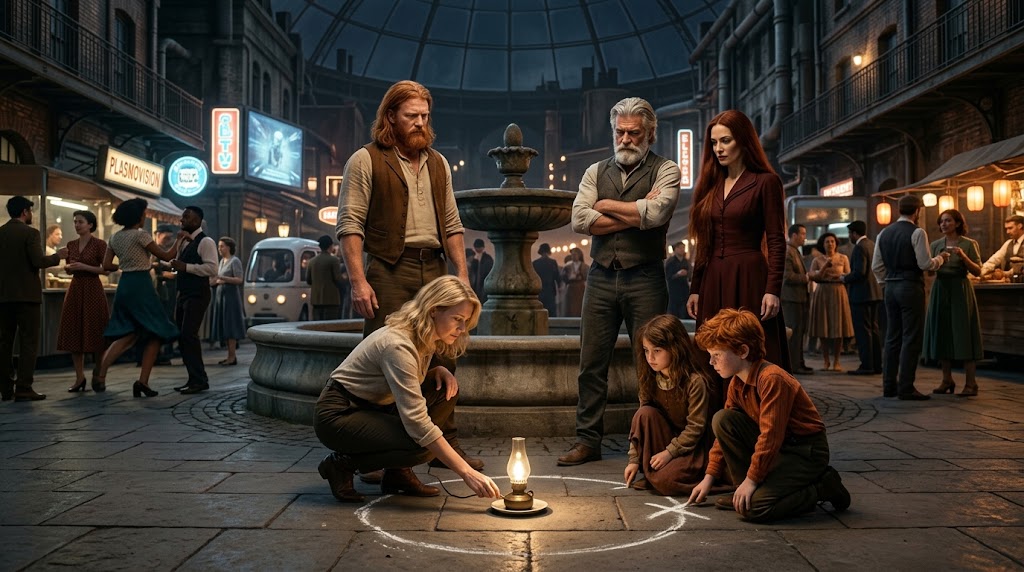
The harbour master is dead.
For twenty years, his people controlled the docks. They knew which customs officer could be persuaded, which warehouse could lose a crate without anyone asking questions, which captain owed money and which policeman preferred not to know.
Then the players removed him.
It was a good plan. It worked.
The harbour master is dead.
So what happens on Monday?
Mara looked up from the table.
“Who tells everyone at the harbour what to do now?”
That is a much more dangerous question than it sounds.
Because in a living world, removing power does not remove the space that power occupied.
Someone will notice the empty chair.
Probably several someones.
Chibi frowned.
“Why are we assuming only one person wants the chair?”
Sean sighed.
“I hate it when the wee bastard has a point.”
And suddenly we are no longer designing the aftermath of an adventure.
We are watching a faction system begin to evolve.
Factions are not quest dispensers
Many campaigns have factions.
They have names, symbols, leaders, territories, allies, enemies and beautifully written histories. Some have pages of internal politics.
Then play begins, and they wait.
The thieves’ guild waits until the characters visit it. The church waits until somebody investigates the bishop. The rebels remain conveniently rebellious. The evil cult continues performing precisely the ritual the Game Master prepared three weeks ago.
They exist.
But they do not live.
A living faction needs something more fundamental than detail. It needs the ability to act without waiting for the players.
It wants things.
It fears things.
It remembers things.
It has resources, relationships and limits.
And when the world changes, it must decide what that change means.
That decision may be intelligent.
It may also be catastrophically wrong.
Both are evolution.
The world acts first
This is one of the important differences in Rexborn.
Player agency does not mean that the world waits for player action.
A faction may start a war.
A bishop may die.
A merchant house may collapse.
A new technology may make an old source of influence almost worthless.
Two enemies may discover that they suddenly need each other.
None of this requires the players to press a button first.
The world acts.
Then the players decide whether they care.
If they intervene, their actions enter an already moving system. If they do nothing, the system continues moving without them.
That distinction matters because it changes the Game Master’s question.
Instead of asking:
“What happens when the players visit this faction?”
we can ask:
“What is this faction doing right now?”
And then:
“What happens because it did that?”
Now the faction has begun producing story rather than merely receiving it.
Success must remain success
Return to our harbour.
The players killed the harbour master.
If the Game Master simply introduces his identical twin on Monday morning, gives him the same resources and continues the same plot, nothing evolved.
Worse, the players’ success has effectively been erased.
Rexborn does not need to do that.
The harbour master really is dead.
His organisation really has lost its leader.
Contacts may panic. Smugglers may stop paying. A frightened lieutenant may disappear with the accounts. Police officers who were being bribed may suddenly wonder whether the arrangement still protects them.
The players changed the world.
Their success remains success.
But success has consequences too.
Eljara leaned back.
“So who profits?”
Stacy shook her head.
“Too early. First ask who can.”
That distinction is where influence becomes interesting.
Wanting the harbour is not enough.
Who has people there?
Who has money?
Who has information?
Who has relationships with customs, shipping, crime, unions or local government?
Who can move quickly?
Influence is reach.
It is not automatic control.
And when one network weakens, all the networks touching it have a reason to reconsider their position.
Guardian asks about balance
This is where Guardian enters the picture.
Guardian is not there to punish the players for changing things.
Nor is it there to restore the old status quo because the Game Master liked it.
Guardian watches balance.
The harbour master may have been corrupt, violent and thoroughly unpleasant. He may also have been the person preventing three rival organisations from fighting openly on the docks.
His removal therefore changes more than one faction.
Perhaps smuggling becomes easier.
Perhaps it becomes harder.
Perhaps the police suddenly become stronger because their compromised officers are no longer being managed.
Perhaps a small union that had survived by playing two criminal groups against each other is suddenly exposed.
Caelwyn had been quiet for some time.
“What if the man they killed was the reason the other three had never gone to war?”
Nobody answered immediately.
Good.
That silence is where the world begins to move.
Guardian asks us to look beyond the immediate victory and see what has shifted around it.
Not to undo the change.
To understand it.
Nemesis sees the empty chair
Nemesis asks a different question.
There is now a power vacuum.
Who fills it?
Not who would make the most dramatic villain.
Not who the Game Master wants to use next.
Who, in this world, would actually recognise the opportunity and possess enough reach to act on it?
Perhaps the dead man’s deputy takes half the organisation.
Perhaps a rival faction buys the warehouses.
Perhaps customs officials use the confusion to reclaim authority.
Perhaps an apparently insignificant group of dockworkers has spent ten years building relationships nobody noticed.
Or perhaps Chibi was right.
Three groups move at once.
Now none of them gets exactly what it wanted.
That is not a scripted plot twist.
It is the world responding to changed conditions.
And once those groups act, they create new conditions.
Actions create counteractions
Suppose the deputy claims the eastern docks.
A rival faction immediately approaches the western warehouses.
The police increase patrols.
Smugglers move upriver.
The union demands protection.
A merchant house hires private security.
Each action creates something for somebody else to respond to.
And the players are part of that ecology, not outside it.
They may support the deputy.
Expose him.
Ignore him.
Make a deal with the union.
Help the police.
Rob everybody while they are distracted.
Or leave town.
None of those choices stops the world.
They simply change what the world has to respond to next.
This is why a living campaign is not a chain of scenes.
It is closer to a conversation.
The world speaks.
The players answer.
The world answers back.
Sometimes somebody misunderstands horribly.
Those tend to be particularly good sessions.
Factions remember
Evolution is not only about territory and resources.
It is also about memory.
Imagine that the union survives because the players protect it.
Ten sessions later, those workers may still remember them.
Twenty sessions later, the original workers may be gone, but the story remains.
Perhaps it has changed.
Perhaps the players are remembered as heroes.
Perhaps as dangerous outsiders.
Perhaps somebody has conveniently forgotten that half the warehouse burned down during the rescue.
“They’ll get that bit wrong,” Mara said.
“They always do,” Sean replied.
That matters.
Factions do not inherit events perfectly.
They inherit stories about events.
Victories become traditions.
Defeats become grievances.
Temporary alliances become precedents.
Betrayals become warnings told to new members.
A leader who died foolishly may become a martyr once enough people need him to have died nobly.
This is where faction evolution becomes cultural rather than merely strategic.
The faction is no longer reacting only to what happened.
It is reacting to what it believes happened.
Bardic News lets the players hear the world moving
The Game Master does not need to show the machinery behind all of this.
The players do not need a report saying:
“Harbour faction influence decreased by two. Rival faction influence increased by one.”
They need the world.
Two nights after the harbour master’s death, three warehouses change ownership.
A familiar customs officer stops answering calls.
Someone has painted a new symbol on a loading crane.
The newspaper reports an unexpected police operation.
A dockworker tells the characters that strangers have been asking about them.
A song in a waterfront pub has acquired a new verse.
These are Bardic News.
They are how the world tells the players that things happened while they were looking elsewhere.
Some reports will be accurate.
Some will be incomplete.
Some may be nonsense.
And some may be nonsense that becomes important because enough people believe it.
The players hear these fragments, interpret them and choose what to do.
Their choice becomes another action.
And the world moves again.
Evolution does not mean improvement
A faction that evolves does not necessarily become wiser, stronger or more sophisticated.
It may fracture.
It may become paranoid.
It may lose influence while becoming more ideologically extreme.
A temporary alliance may slowly become friendship.
A friendship may become dependence.
A defeat may teach caution.
Or it may teach entirely the wrong lesson.
A new leader may reject everything their predecessor believed.
Another may turn the predecessor into a saint and become more rigid than the original ever was.
That is important because living worlds should not optimise themselves.
People do not.
Institutions certainly do not.
Why should fictional ones?
How much can a faction change?
Eventually we reach the uncomfortable question.
If leadership changes, alliances change, territory changes, methods change and even the story a faction tells about itself changes, is it still the same faction?
There is no universal answer.
Sometimes continuity lives in a name.
Sometimes in a purpose.
Sometimes in a ritual, a place, an enemy, a bloodline, an oath or a story everyone refuses to stop telling.
And sometimes the honest answer is no.
The old faction is gone.
Something descended from it now wears its name.
That too is evolution.
The campaign never returns to zero
This is the part that matters most.
After the harbour master dies, the campaign does not eventually settle back into the world that existed before his death.
Guardian has recognised the changed balance.
Nemesis has found the empty spaces.
Factions have acted.
Other factions have countered them.
People have gained and lost influence.
Stories have spread.
Bardic News has carried fragments of those changes back to the players.
And the players have acted upon what they heard.
The next cycle therefore begins from a different world.
World action creates player action.
Player action creates world reaction.
World reaction creates counteraction.
Changed power creates new opportunities and new vulnerabilities.
The world communicates those changes.
The players interpret them.
Then everyone acts again.
There is no reset button.
There should not be one.
Because the answer to “Can factions evolve?” is not simply yes.
In a world that genuinely moves, they have no choice.
The moment everyone around them begins to change, standing still becomes a decision too.
And decisions have consequences.
That is Rexborn.
A world that does not wait to be played.
A world that remembers what happened when you did.
Can Factions Evolve? Why Living Worlds Need More Than Static Enemies