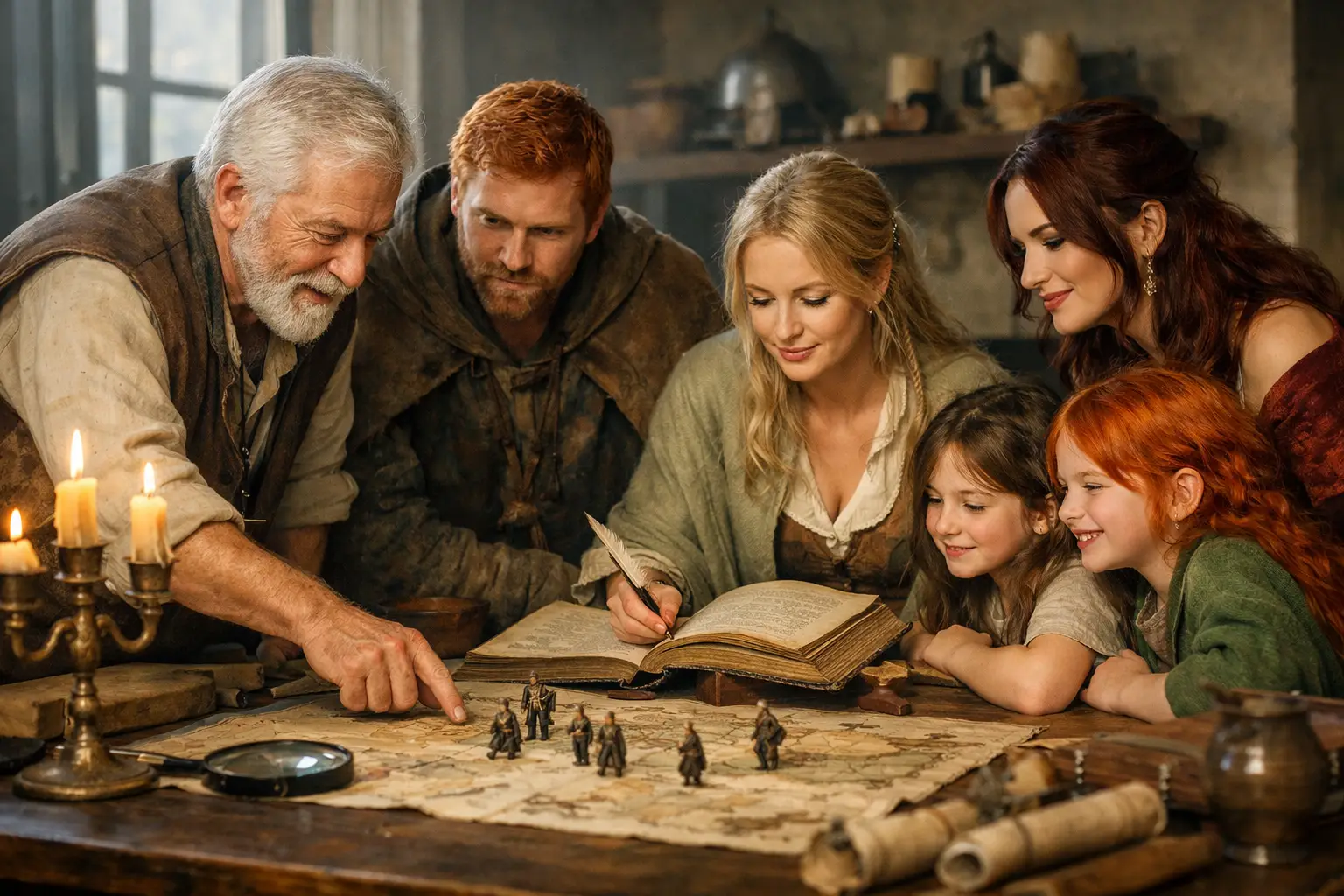
A Historically Researched RPG Campaigns: Building Living Worlds Instead of Period Pieces
A plague cart rattles through a narrow street before dawn. A church bell sounds somewhere beyond the fog. Your players do not need a lecture on seventeenth-century Europe to understand where they are. They understand because the world behaves consistently. Fear travels through the streets faster than disease. Neighbours avoid eye contact. Markets close early. Priests gain influence while physicians lose certainty.
That is the real power of historical research in tabletop roleplaying.
But history alone is only the first layer.
A living campaign is built from many ways of understanding the same world. Academic history, scientific research, folklore, urban legends, archaeology, game design, mythology, conspiracy culture, pulp adventure, horror fiction, internet folklore, and local memory all describe different aspects of reality. None of them should automatically dominate the others. Each answers a different question, and together they create a setting that feels larger than any single source ever could.
Historical research is the foundation, not the ceiling
Many Game Masters approach research as a search for accuracy. They collect dates, rulers, wars, and architecture until they feel confident enough to run a campaign.
That is valuable—but it is only one discipline.
A believable city is never built from history alone.
History explains how a city developed.
Geography explains why it exists.
Economics explains who profits.
Religion explains what people fear.
Science explains what is physically possible.
Urban legends explain what people whisper after dark.
Mythology explains what they believe.
Modern internet folklore reveals how contemporary myths are born.
Game design teaches what creates meaningful choices.
Pulp fiction teaches escalation.
Horror teaches uncertainty.
Together these disciplines transform research from information into worldbuilding.
A transdisciplinary approach to living worlds
Traditional research often ranks sources according to academic authority. Primary sources stand above secondary sources, which stand above fiction or popular culture.
A living-world approach asks a different question.
Instead of asking whether a source is prestigious, it asks:
What does this source contribute?
Academic history reveals institutions.
Science reveals mechanisms.
Folklore reveals cultural memory.
Urban myths reveal collective anxiety.
Creepy pastas reveal digital folklore.
Roleplaying games reveal decades of tested adventure structures.
Spy fiction reveals organisation and conspiracy.
Archaeology reveals forgotten landscapes.
Architecture reveals how people move through space.
Economic history explains why conflicts continue long after battles end.
None of these disciplines replaces another.
Each becomes another lens through which the same city can be understood.
A medieval monastery, for example, is simultaneously:
- a historical institution,
- an architectural landmark,
- a political actor,
- an economic landowner,
- a religious symbol,
- a source of local legends,
- a possible archaeological mystery,
- and an excellent adventure location.
Reality is layered.
Great campaigns should be too.
What makes a historically researched RPG campaign work
The strongest campaigns are not museums.
They are systems.
A historically researched RPG campaign succeeds because historical forces continue to shape the present.
Authority.
Trade.
Inheritance.
Disease.
Religion.
Law.
Weather.
Infrastructure.
Memory.
None of these are simply background information.
They create pressure.
When pressure interacts with player decisions, stories emerge naturally.
Research therefore becomes less about collecting facts and more about understanding relationships.
Who controls food?
Who owns the roads?
Who records births?
Who writes history?
Who benefits when rumours spread?
Those questions generate far richer adventures than simply remembering which king ruled in 1645.
History is only one system among many
History tells us what happened.
Science explains how it happened.
Folklore explains how people remember it.
Urban legends explain how later generations reinterpret it.
Modern conspiracy theories explain how today’s society transforms uncertainty into narrative.
A ruined bunker may be explained by military archives.
It may also become the centre of UFO stories.
Internet communities may turn it into a haunted location.
Children invent games around it.
Paranormal investigators visit it.
All of those layers become real social forces inside a campaign, regardless of whether the supernatural exists.
Players rarely investigate objective truth.
They investigate competing interpretations.
That tension creates mystery.
Research vertically, then connect horizontally
One common mistake is researching an entire century.
A better approach is researching one location deeply.
Choose a district.
Study its economy.
Its architecture.
Its folklore.
Its transport.
Its industries.
Its local myths.
Its political influence.
Its criminal history.
Its scientific importance.
Its popular culture.
Then connect these elements.
A harbour is never just a harbour.
It is trade.
Smuggling.
Immigration.
Disease.
Naval power.
Labour disputes.
Ghost stories.
Corporate interests.
Environmental change.
Adventure hooks emerge naturally because every institution interacts with every other institution.
Living worlds emerge from interacting systems
Many campaigns treat locations as static descriptions.
Living worlds treat them as active systems.
A plague is not simply an event.
It changes medicine.
Religion.
Crime.
Trade.
Government.
Migration.
Rumours.
Black markets.
Family structures.
Every major historical event leaves behind institutions, habits, myths, and unresolved consequences.
Those consequences become tomorrow’s adventures.
History never ends.
It accumulates.
Accuracy serves experience
Absolute historical accuracy is not always the highest goal.
The purpose of research is to preserve believable pressure, not to trap players inside a textbook.
Sometimes emotional truth matters more than literal reconstruction.
Players rarely remember whether every historical detail was perfect.
They remember whether the world reacted consistently.
Consistency builds trust.
Trust builds immersion.
Immersion creates investment.
Consequences create history
Players do not remember dates.
They remember consequences.
If a guild controls river trade, destroying the guild changes prices across the city.
If a church dominates education, exposing corruption reshapes generations.
If a bank collapses, political power shifts.
If an archaeological discovery attracts global attention, academics, governments, corporations, cults, treasure hunters, conspiracy theorists, journalists, and opportunists all arrive for different reasons.
History continues to write itself through systems.
That is where campaigns stop feeling scripted.
The world begins responding.
Why players respond so strongly
Players instinctively recognise worlds that possess internal logic.
Not because every historical detail is correct.
Because everything appears connected.
One decision ripples outward.
One rumour changes politics.
One scientific discovery fuels conspiracy theories.
One local legend inspires cult activity.
One economic collapse creates organised crime.
One forgotten myth becomes tomorrow’s apocalypse.
The world feels alive because every discipline reinforces the others.
Start with one true thing
Begin with one genuine historical fact.
Then ask what science says about it.
What archaeology uncovered.
What local folklore remembers.
What conspiracy theorists invented.
What horror writers imagined.
What adventure fiction exaggerated.
What internet folklore transformed.
Do not ask which version is correct.
Ask why each version exists.
Because people do not live inside objective history.
They live inside stories about history.
Those stories shape behaviour.
Behaviour shapes institutions.
Institutions shape cities.
Cities shape adventures.
The past is not valuable because it is old.
It is valuable because every generation rewrites it from a different perspective.
A truly living RPG world embraces every one of those perspectives, allowing history, science, myth, folklore, popular culture, and imagination to stand side by side—not as competitors, but as complementary ways of understanding the same world.