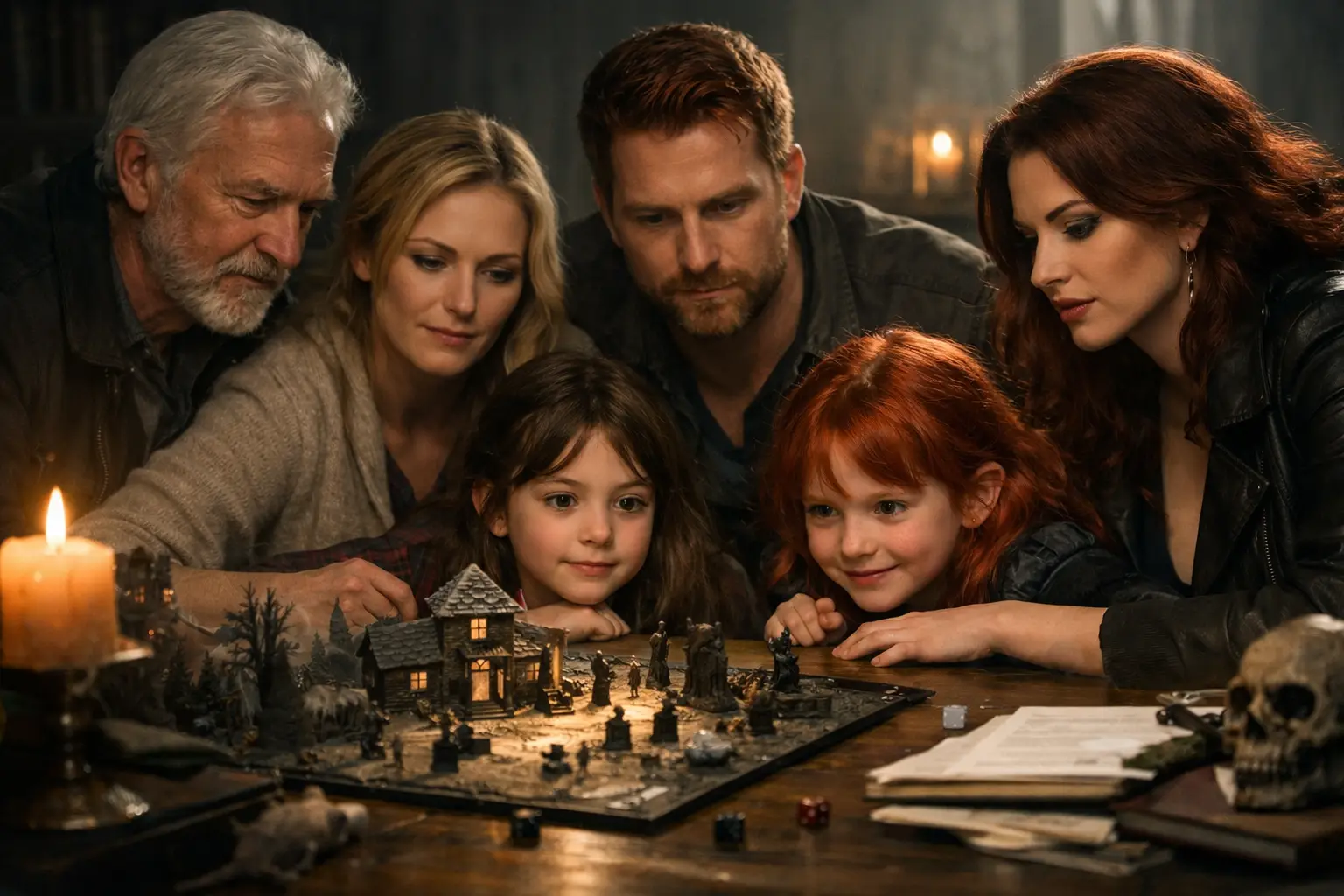
Building a Cinematic Horror Roleplaying Campaign
The torch goes out first.
Not because anyone failed a roll, but because the scene needed darkness more than light.
A good cinematic horror roleplaying campaign begins there—in the moment the table understands that safety was always temporary, and that every choice from this point onward will carry a price.
That is the difference between horror that merely startles and horror that stays with people. In tabletop play, cinematic horror is not just a question of mood music, grim descriptions, or monsters revealed at the right moment. It is the art of building pressure through structure, consequence, memory, and timing. When it works, players do not simply witness terror. They participate in it, shape it, and suffer its aftermath.
The monster is rarely the first thing that matters.
The first thing that matters is the silence before anyone knows what the monster is.
What makes a cinematic horror roleplaying campaign feel cinematic
The word cinematic is often misused to mean visual, dramatic, or stylish. In roleplaying, it means something more precise. A cinematic campaign understands framing. It knows when to linger and when to cut away. It allows silence to do work. It gives each revelation weight by controlling what is shown, what is withheld, and what the players are allowed to fear before they fully understand it.
That last point matters more than any monster stat block. The unknown is almost always stronger than the explained. A bloodstain in a church crypt, a missing week in a journal, a familiar voice heard through a dead radio—these are cinematic because they create an image in the mind, and the mind is crueler than most rulebooks.
A cinematic horror roleplaying campaign does not rush to answer the question. It lets the table sit with it.
Imagine the year is 1938.
For weeks, the players have crossed North Africa following the final expedition of Professor William Ashcroft, one of Europe’s most respected archaeologists. Officially, the expedition vanished during a sandstorm somewhere beyond the Atlas Mountains. The newspapers accepted that explanation. French colonial authorities filed their reports. The world moved on.
The journals did not.
Every diary tells a slightly different story. A military dispatch mentions lights over the dunes. A Berber elder refuses to name the valley and quietly leaves the room. An old Roman travel account describes the same region nearly two thousand years earlier, warning that those who entered did not always return with the same memories.
History points one way.
Folklore points another.
The players follow both.
Late on the third evening, they finally reach the abandoned excavation.
Nobody speaks.
The desert should feel empty.
Instead, it feels as though something is listening.
Canvas tents sway gently in the wind. A kettle still hangs above a cold fire. Maps lie scattered across a folding table, pinned beneath smooth desert stones. An excavation brush rests beside an open trench exactly where someone dropped it. A notebook remains open beneath a thin layer of drifting sand, its final sentence unfinished.
No bodies.
No blood.
No signs of struggle.
Only absence.
One player quietly says,
“Something is wrong.”
Nobody asks for an Investigation roll.
Nobody wants to interrupt the silence.
The expedition photographer notices the camera first. Not because he is searching for evidence, but because photographers notice other people’s cameras. Half buried beneath the sand lies a battered Leica, its leather strap cracked by weeks beneath the desert sun. He brushes it clean almost absent-mindedly.
“If we’re lucky…” he mutters.
Nobody answers.
Hours later, in Cairo, the darkroom fills with the smell of developer. The first image slowly appears in the tray. Professor Ashcroft stands proudly before the entrance of the newly uncovered temple. His deputy smiles beside him. Surveyors wave toward the lens. Everyone looks exhausted. Everyone looks alive.
The player holding Ashcroft’s journal begins counting.
One.
Two.
Three.
Eleven.
He frowns.
Then he counts again.
The journal contains twelve names. Twelve signatures. Twelve sleeping assignments. Twelve payroll entries. Six months of notes written by twelve different hands.
The photograph shows eleven people.
No face has been scratched away.
Nobody stands outside the frame.
Nothing looks altered.
Nothing looks wrong.
And somehow that is exactly what makes it terrifying.
Silence settles across the table.
Finally someone looks up.
“Then who took the photograph?”
No monster appears.
No initiative is rolled.
Nothing attacks.
Yet every player leans forward.
The expedition no longer feels lost.
It feels erased.
That is what makes a cinematic horror roleplaying campaign feel cinematic. Not spectacle. Not constant threat. Not a creature waiting behind every door. Cinematic horror is the careful arrangement of image, silence, implication, and timing until the players begin to fear the shape of the story itself.
Atmosphere alone is not enough. A horror campaign becomes cinematic when its scenes feel purposeful rather than random. Characters should move from ordinary unease to escalating threat, from fragmentary clues to dreadful recognition. Each session should feel like part of a larger grammar of fear. The players begin by asking what is happening. Later they ask what it wants. Eventually they ask what it has already done to them.
That final question is where horror stops being decoration.
It becomes the campaign.
Dread is built through consequence, not constant violence
Many campaigns mistake horror for frequency. More bodies, more gore, more attacks, more noise. The result is often numbness. If everything is terrible all the time, very little feels terrible in a meaningful way.
A better cinematic horror roleplaying campaign uses restraint. Violence lands hardest when it interrupts fragile normality. The first unnatural death matters. The second one changes behaviour. By the third, the group should already understand that the world they move through is becoming hostile in ways that cannot be repaired by a short rest and a clever plan.
Consequence is what lets dread accumulate.
If a witness vanishes after speaking to the investigators, that should alter the shape of the story. It should change who dares talk to them next. It should make every future interview feel heavier. If a character lies to protect someone, that lie should not disappear when the scene ends. It should wait. It should gather weight. It should return later with sharper teeth.
If players burn down the manor to stop what is inside, the town should remember the fire even after the smoke clears. Children should dare each other to approach the blackened gates. Insurance men should ask questions. Local families should argue over whether the heroes saved them or doomed them. Perhaps the creature died. Perhaps it did not. Either way, the ruin remains.
Horror gains force when the world keeps score.
That is where long-form design matters. In a disposable campaign, fear can become theatrical. In a living campaign, fear becomes historical. What happened three months ago still stains the present. What was buried does not stay buried just because the session ended.
In a Mythveil-style campaign, the aftermath is not an epilogue. It is another layer of the horror.
The abandoned excavation in the desert does not end with the photograph. Over the following sessions, the players find traces of its consequences everywhere. A French officer who once investigated the valley drinks himself into silence. A museum curator in Alexandria locks one archive room and pretends the key is lost. A Berber family refuses hospitality after recognising Ashcroft’s name. A colonial official insists the expedition never existed, although his signature appears on the supply papers.
The horror does not come from one attack.
It comes from the sense that every institution touched the truth, recoiled from it, and then continued living around the wound.
That is consequence.
Not punishment.
Memory.
Character vulnerability is more powerful than character weakness
There is a subtle but important distinction here. Weak characters are easy to pity and easy to replace. Vulnerable characters are dangerous to lose.
Cinematic horror thrives when players care deeply about who their characters are before terror begins to strip those identities apart. A war-scarred detective who keeps every promise. A village doctor who still believes suffering can be mended. A scholar who has built a life around the idea that all mysteries can be solved if one reads carefully enough.
Horror enters not by making them incompetent, but by forcing them into truths their strengths cannot easily answer.
The detective can follow every clue and still discover that justice has no jurisdiction over what happened.
The doctor can save the body and still lose the soul.
The scholar can read every inscription correctly and realise too late that understanding was the first stage of contamination.
That is why emotional architecture matters as much as encounter design. Ask what your characters love, what they regret, what they refuse to become. Then let the campaign place pressure exactly there. Fear is not only the possibility of death. Fear is the possibility of moral compromise, memory loss, betrayal, contamination, obsession, and becoming unrecognisable to oneself.
In the Ashcroft expedition, one investigator may be a rational archaeologist who believes every myth is a misremembered event. Another may be a former soldier who trusts maps, discipline, and chain of command. Another may be a photographer who believes images preserve truth better than memory ever could.
Then the campaign attacks those certainties.
The myth becomes evidence.
The map lies.
The photograph remembers one person too few.
A table that understands this will play differently. They stop asking only whether they can survive. They begin asking what survival will cost. They stop treating fear as damage and start treating it as transformation.
That is where cinematic horror becomes personal.
Not because the characters are weak.
Because the campaign finds the strongest thing in them and asks whether it can break.
Pace horror like a film, but respect the freedom of play
This is the central challenge. Cinema controls the lens. Roleplaying does not. Players can leave the room, pursue the wrong lead, trust the wrong person, or decide that the side character you expected to disappear in act one deserves rescuing at any cost.
That freedom is not a problem to solve.
It is the source of the medium’s power.
The task is to create structures that preserve momentum without strangling agency. Think in sequences rather than scripts. A village arrival, a first unsettling sign, a social fracture, an impossible discovery, a failed attempt at containment, a revelation that recontextualises everything—these are strong dramatic movements because they invite many choices while still carrying emotional direction. The players may decide how they move through them, but the campaign understands where pressure is likely to rise.
A cinematic horror roleplaying campaign should not feel like a railroad.
It should feel like weather.
The players can walk where they choose, but the storm is still coming.
In Shadows of Atlantis, the players may interview the French officer first, or ignore him entirely. They may trust the Berber elder, dismiss him as superstition, break into the archive, follow the supply manifests, develop the film, or return to the dig site before they understand what the photograph means. The order can change. The dread should not vanish.
Good pacing also requires variation. Not every session should crescendo into screaming catastrophe. Some should end quietly, with a letter opened too late or a reflection seen in black glass. Horror breathes through contrast. Panic exhausts. Unease endures.
Sometimes the strongest ending is not a chase, a battle, or a scream.
Sometimes it is a player staring at a handout and counting the names again.
One.
Two.
Three.
Eleven.
Then checking the journal.
Twelve.
And saying nothing for a very long time.
Setting is not backdrop – it is an active participant
The most memorable horror campaigns are rooted in places with memory. A fen village where names vanish from parish records. A polar station where radio transcripts contradict eyewitness accounts. A decaying district where every family can tell you which house is cursed, but none agree on why.
In a cinematic frame, setting carries mood, history, and resistance. It should not feel like a stage dressed for a single evening. It should feel older than the characters and capable of outlasting them.
This is also where worldbuilding earns its keep. Factions, local beliefs, inherited feuds, ruined institutions, half-remembered rituals—all of these deepen horror because they suggest that the present crisis has roots. The thing in the cellar is frightening. The fact that three generations chose not to speak of it is more frightening.
For Mythveil Chronicles, this is where research becomes more than preparation.
When we build a campaign like Shadows of Atlantis, we do not begin with the monster. We begin with the place. The Atlas Mountains. The colonial routes. The French reports. Berber oral memory. Roman fragments. Greek myth. Archaeological ambition. Pulp adventure. Cosmic dread. Each layer asks a different question, and each answer changes the way the table experiences the location.
The desert is not empty.
It is archived.
In reports, in rumours, in maps, in warnings, in lies, in stories people tell their children so they will not walk too far after sunset.
A world that evolves between sessions strengthens this effect further. If the cult gains influence while the players investigate elsewhere, if the press misreports a massacre, if a grieving parent becomes politically powerful because the town needs someone to blame, then horror ceases to be episodic. It becomes societal. It enters the bloodstream of the setting.
In Rexborn terms, the setting is never passive. A place remembers pressure. Institutions react. Factions shift. Local stories mutate. What the players do does not simply change the next scene. It changes the conditions under which every later scene will occur.
The excavation is not a location.
It is a wound in the map.
And wounds attract attention.
Journalists arrive. Scholars argue. Governments deny involvement. Occultists whisper. Treasure hunters misread the evidence. Local families keep their doors closed. The horror spreads not because the monster moves, but because meaning moves.
That is when setting stops being backdrop.
It becomes an active participant in the campaign.
The monster matters less than the pattern around it
Players often remember the pattern long after they forget the mechanics. They remember that all the victims had dirt beneath their fingernails. They remember children humming the same melody in different towns. They remember the photographs where one face never appeared clearly.
A monster is strongest when it generates behaviour, signs, and consequences before it is fully seen. This does not mean every threat must remain hidden forever. Revelation can be glorious. But revelation should feel earned, and it should change the emotional temperature of the campaign.
Sometimes the best choice is to reveal the creature and let the true horror become human response. Panic, denial, exploitation, devotion, opportunism—these are often more durable than shock. The creature opens the wound. Society decides whether to cauterise it, worship it, or widen it.
That is one reason cosmic and psychological horror work so well in campaign play. They do not depend on a single jump scare. They alter interpretation. Once the players understand what kind of world they are standing in, every ordinary scene becomes newly unstable.
In the Atlantis campaign, the missing twelfth archaeologist is not the monster.
It is the pattern.
The players begin noticing it elsewhere. A guest register with one torn line. A payroll column that no longer balances. A campfire circle with twelve bedroll marks but eleven surviving inventory tags. A photograph in which everyone looks slightly to the left of the camera, as though listening to someone who is no longer visible.
No claw marks.
No roar.
No chase through the ruins.
Just evidence that reality has edited itself and left the seams behind.
That is why the pattern matters. It teaches the players how to fear. It gives them a language for dread before the creature ever appears. By the time they finally descend beneath Atlantis, they are not simply afraid of being attacked. They are afraid of being removed from the story and leaving only a mathematical error behind.
This is where the monster becomes secondary.
The true horror is interpretive.
What if the journals are right?
What if the photograph is right?
What if both are right?
What if the human mind can only remember eleven because twelve would reveal something it was never meant to perceive?
Those questions are more frightening than teeth.
They linger because they infect every later scene. A dinner table becomes suspicious because someone set one extra plate. A railway compartment feels wrong because the ticket count does not match the passengers. A friendly NPC becomes terrifying because nobody can remember when he joined the group.
That is cinematic horror at its strongest.
Not the moment the monster appears.
The moment the players realise it may already have changed the rules by which appearances are understood.
Why some horror campaigns fade and others linger
Most fading horror campaigns make one of two mistakes. They either explain too much, or they fail to let events matter. Once the mystery becomes tidy, fear often evaporates. Once consequences vanish between sessions, tension becomes decorative.
The campaigns that linger do something harder. They preserve mystery while still delivering meaning. They allow victories, but not clean ones. They let players change the world, but never pretend the world is untouched by what was required.
This is where authored craft and responsive design meet. A campaign should feel shaped, not improvised into formlessness. Yet it should also feel alive enough to answer the players honestly. When those two principles hold together, horror gains a rare quality. It feels inevitable in retrospect, but uncertain in the moment.
For studios such as Mythveil Chronicles, that long echo matters. A frightening evening is easy enough to produce. A world that remembers the wound, and changes because of it, is rarer.
Years later, another expedition may enter the same valley.
They carry better maps.
Better cameras.
Better weapons.
Better science.
Perhaps they even know what happened to Ashcroft.
But the first thing they find is not a monster.
It is an old photograph.
Eleven smiling archaeologists in front of a temple door.
Twelve names in the journal.
No explanation.
Only the question waiting patiently beneath the dust.
Who took the photograph?
That is why cinematic horror lingers.
The monster can die.
The cult can burn.
The ruin can collapse.
But the question survives.
If you are building your own cinematic horror roleplaying campaign, begin with the scar rather than the scream. Ask what your world refuses to forget, and what your players will have to become in order to face it. Let history leave evidence. Let folklore distort it. Let institutions deny it. Let the players uncover enough truth to wish they had not.
The rest is not decoration.
It is the slow, careful art of letting dread earn its place.