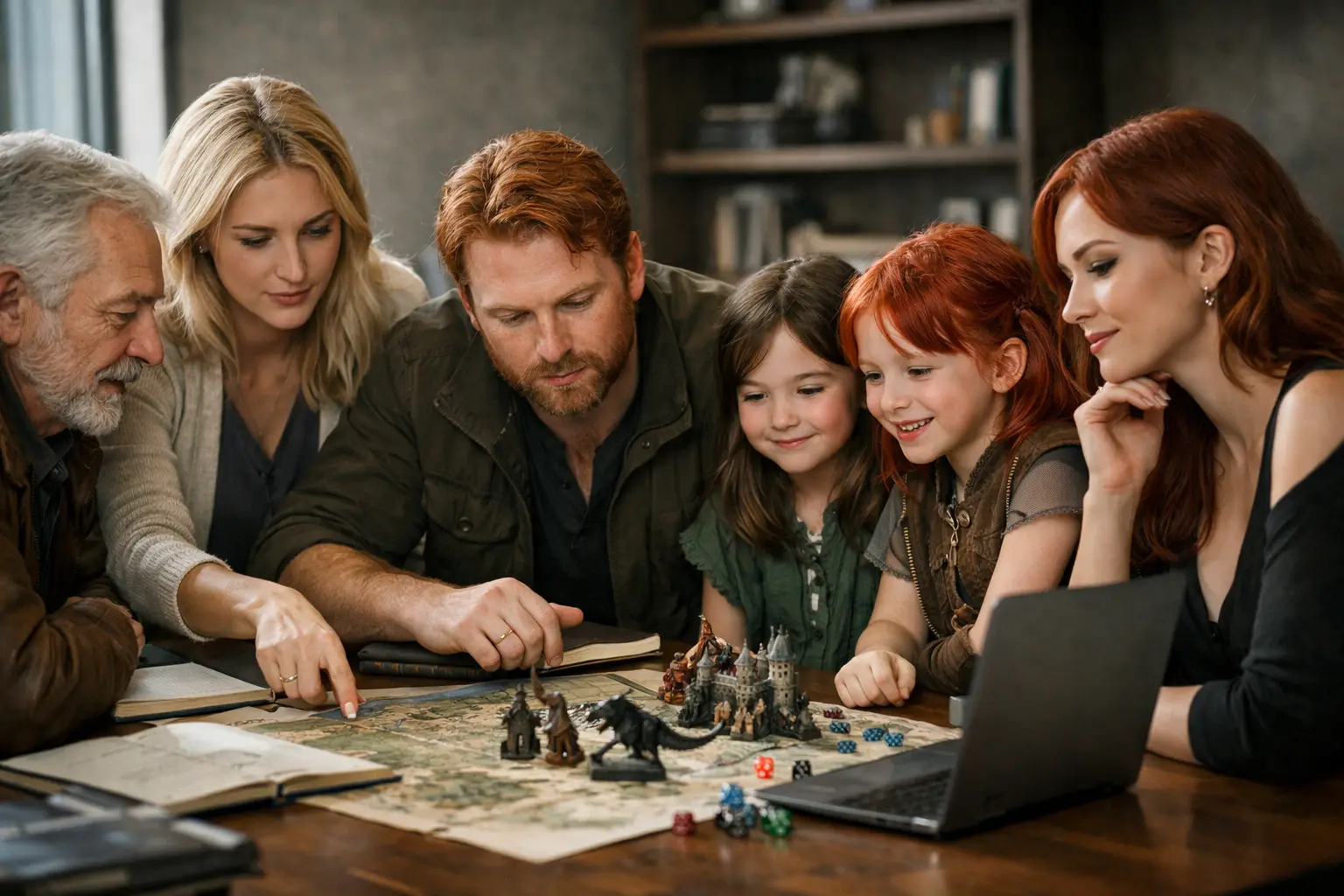
What Narrative Design Consulting Really Does
A city remembers who burned its archives.
A cult remembers who spared its prophet.
A player remembers the moment they realised their choice had changed more than a single scene.
It had changed the world around them.
That is where narrative design consulting becomes valuable.
Not when a campaign needs more lore.
Not when a setting needs another sourcebook.
Not when someone wants a prettier world map.
But when a world must begin behaving like a living system.
The difference matters.
Most projects have content.
Far fewer have consequence.
Far fewer have memory.
And fewer still have the structure needed to turn a good idea into a world people still talk about years later.
What Narrative Design Consulting Actually Solves
The phrase can sound abstract until you look at the problems it addresses.
A campaign may have a brilliant premise but nowhere to grow.
A setting may be imaginative but static, with factions that only exist when the players are looking at them.
A mystery may be compelling until somebody asks the wrong question.
A long-running world may begin with energy and slowly lose momentum because nobody designed how consequences accumulate over time.
The problem is rarely a lack of ideas.
The problem is that the world never learns how to remember.
Narrative design works on those deeper layers.
It asks how stories emerge.
How pressure builds.
How information moves.
How decisions leave marks behind.
Most importantly, it asks what happens after the scene ends.
Because that is where living worlds begin.
The Difference Between Content and Narrative Architecture
Many campaigns struggle for a surprisingly simple reason.
Things happen.
Then more things happen.
Then something else happens.
The timeline grows.
The world does not.
By the eighth session, everyone is reacting to events without feeling a larger pattern emerging.
The story moves.
But it never deepens.
Narrative architecture asks different questions.
Who remembers what happened?
Who benefits?
Who loses?
What changes after the event is over?
If the players ignore the obvious path, what still advances?
If they save the village, what happens next?
If they fail, who takes advantage?
Good design begins there.
Not with more content.
With consequence.
A Living World Needs Pressure, Not Just Description
Worldbuilding can become an elegant trap.
Histories are fun.
Maps are fun.
Pantheons are fun.
Lore is fun.
But none of them automatically create drama.
A city with a thousand years of history can still feel dead.
A world starts to breathe when people want things badly enough to act.
When factions pursue goals.
When institutions protect themselves.
When rivals compete.
When secrets matter.
In a living world, things continue moving even when nobody is watching.
That movement creates pressure.
And pressure creates story.
When Narrative Design Consulting Is Worth It
Not every project needs outside guidance.
Sometimes enthusiasm is enough.
Sometimes improvisation is enough.
But eventually complexity catches up.
You start building a long-term campaign.
A fictional universe.
A community.
A setting that needs to survive more than a handful of sessions.
And suddenly the challenge is no longer creation.
It is continuity.
The question changes.
Not:
“Can we build this?”
But:
“Can this continue growing without falling apart?”
It Depends on Your Goals
If your goal is a short adventure or a light episodic experience, extensive narrative design may be unnecessary.
But if you want players to remember a decision six months later, everything changes.
Because memory requires structure.
Agency requires consequences.
Freedom requires a world capable of responding.
Otherwise every choice feels the same.
And if every choice feels the same, nothing truly matters.
What a Consultant Should Be Looking At
A good narrative consultant is not there to replace your ideas.
They are there to identify the engines beneath them.
How does this world create conflict?
How does information travel?
How do institutions react?
How do consequences spread?
Where does pressure come from?
And perhaps most importantly:
Does this world actually need more content?
Or does it need stronger connections between what already exists?
One forgotten promise can generate more story than an entire sourcebook.
One unresolved rivalry can fuel years of play.
The strongest worlds often grow through connection rather than expansion.
The Best Consulting Protects Player Agency
There is a common misconception that stronger narrative design means tighter control.
In reality, the opposite is often true.
Weak worlds break when players do something unexpected.
Strong worlds adapt.
A mystery survives the wrong suspect.
A political crisis survives a failed alliance.
A horror story survives the destruction of one monster.
The details change.
The world continues.
That resilience is one of the clearest signs of good narrative design.
The setting answers back.
Why Consequence Needs Tracking
Most players do not remember every battle.
They do not remember every dice roll.
They rarely remember the exact statistics.
They remember the inn that became home.
The ally they failed.
The city that stopped welcoming them.
The promise they should never have made.
The moment they realised the world had not forgotten.
That is consequence.
Not punishment.
Not reward.
Memory.
Without some way of tracking change, consequence becomes theatre rather than structure.
The real question is never:
“What happened?”
The real question is:
“What changed?”
Choosing the Right Kind of Consultant
Not all narrative consultants solve the same problems.
Some focus on storytelling.
Some focus on education.
Some focus on worldbuilding.
Some focus on community design.
The important thing is finding someone who understands the experience you want to create.
Someone who thinks beyond scenes and events.
Someone who understands continuity.
Someone who understands memory.
Someone who asks better questions than you expected.
Not just:
“What happens next?”
But:
“What will people still be talking about a year from now?”
Why This Matters More Than Ever
People can tell the difference between something that is merely presented and something that feels alive.
They can feel the difference between a plot that waits for them and a world that continues without them.
The strongest worlds grow differently.
They do not rely on constant expansion.
They rely on consequence.
A forgotten character returns.
An old rumour becomes important.
A minor event changes the future.
New stories emerge from old foundations.
And when something genuinely new arrives, it feels inevitable.
Players have already heard the name.
Already seen the signs.
Already felt the consequences.
The world prepared them for it.
That is why the best expansions rarely feel like additions.
They feel like promises finally being fulfilled.
Narrative design is not about making stories more complicated.
It is about making them matter.
Because years later, people rarely remember the sourcebook they bought.
They remember the world that felt alive enough to remember them.